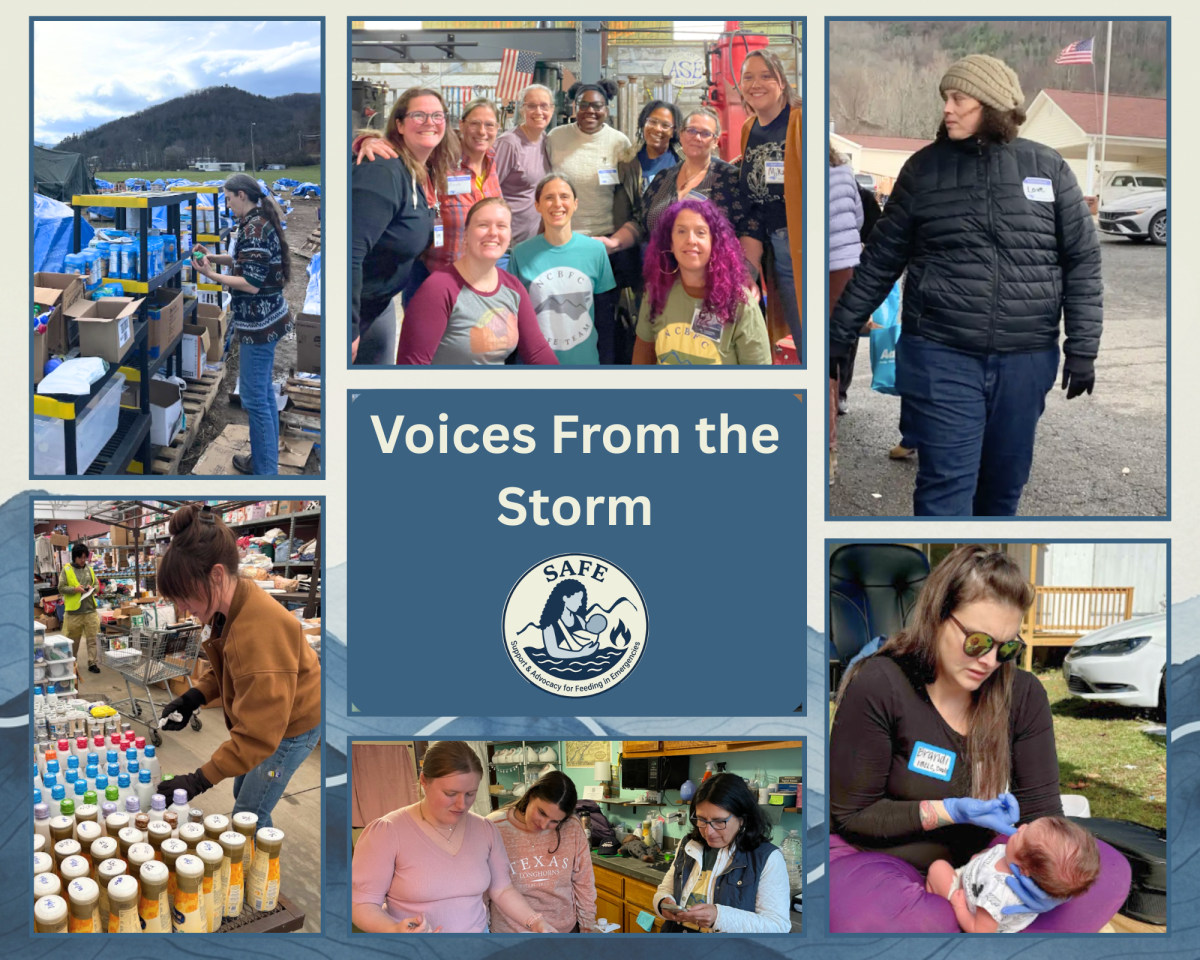
Collage of SAFE Team volunteers and families from the Voices from the Storm series

Nourishing Resilience is over I am sad, still wounded, still not done, and also prouder than I know how to say: we thought we might reach fifty or a hundred people, more than seven hundred of you registered and came and stayed, and what we built together is far too big to fit in a video series, so here are our Voice from the Storm.

The Calm Before the Storm
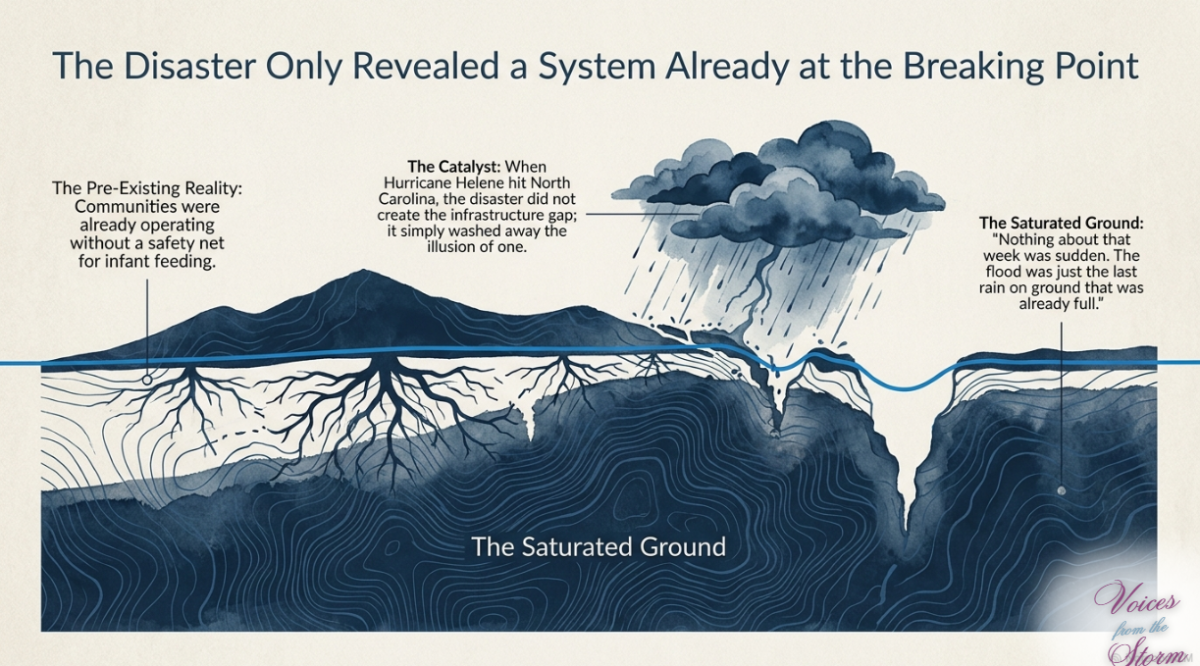
The Flood Image

It had been raining for days before Hurricane Helene ever had a name in our mouths.

I homeschool my kids, and a few mornings a week they climb onto a video call with their Nana, my mom, who lives up in Black Mountain. That week, every single call kept dropping. Her internet would come up, then fall away, then come back. The ground out there was so saturated from days of rain that even the signal could not hold steady. We laughed about it at the time. Nana's freezing again. We had no idea what that saturated ground was about to mean.

On Thursday, September 26, around four in the afternoon, I was driving the kids home from camp out in Chatham County through the worst rain I can remember driving in. It was not a hard, violent rain. It was a soaking rain, the kind that just keeps coming, hour after hour, until the whole world feels waterlogged.

Then Friday morning I got on a call.

It was a maternal and child health group, people who work, professionally, on keeping mothers and babies well in North Carolina. And while we talked, my phone was lighting up with messages from the mountains. First my friend Jennifer, telling me the road up to Beech Mountain had washed out, a gully twenty feet deep, she said, and by the end it was closer to forty. Then a photo from someone I had gone to Appalachian State with, floodwater had risen up over the top of a Wendy's drive-through sign.

That is when I came off mute.

I said, out loud, to a room full of people whose whole job is the health of mothers and babies, that this was a catastrophe. And someone on the call said, not unkindly, just matter of factly, "We don't have anyone from Buncombe County on the call. I think we're okay to continue."

I have thought about that sentence a hundred times since. These were good people. They simply could not see what I was seeing, because I could not share the photo, because the connection was too weak, because the disaster was still just pixels and rumors leaking out of a region that was losing power and cell service by the minute. But in that moment I understood something that has shaped everything I have done since. Our state, our country, does not yet understand how tightly the health of mothers and babies is tied to a weather event. We treat a hurricane as a problem for emergency managers and linemen and the Red Cross. We do not think of it as an infant feeding problem. And because families - especially mothers - are often used to managing on their own, no one in authority thinks a problems exists unless they ask. That gap is exactly where babies fall through.

I knew, sitting there, what was coming, because I had seen a smaller version of it before.

Years ago, in the fall of 2018, around my sister-in-law Cailin's wedding, there was flooding down near the coast. It was severe on the coast and barely a footnote in Durham. But water runs downhill, and people do not. Families from the coast had driven inland, up to us, to get away from it. I went to a Walmart near I-40 to buy my boys two cheap matching polo shirts for the wedding and a box of Cheerios, because what does a little kid eat? Cheerios. And I could not find either one. The polos were gone from half of Durham. The entire cereal aisle was empty. The store had been stripped bare by exhausted, weathered families who had evacuated a week earlier and were still trying to put clothes on their kids and food in their bellies.  I can still see their faces.

Standing in that emptied-out store, years before Helene, I filed something away without knowing it. This is what a disaster looks like a hundred miles from where it happens. It looks like tired parents buying out the Cheerios.

So here is the part I most need you to understand about the calm before the storm. We were not starting from nothing.

By the fall of 2024, the organization I chair had spent years quietly building the exact machinery a disaster would demand. We just thought we were building it for ordinary life. More than twenty communities across North Carolina were working with us to become Breastfeeding Family Friendly Communities, putting in place a set of steps to make everyday feeding easier for everyday families.  Three weeks before Helene, I sat in a room at the White House. The Office of Public Engagement and the Gender Policy Council had invited a small group of us to talk about the PUMP Act and the Pregnant Workers Fairness Act, about what life was like for nursing mothers before those protections existed and what still needed to change. Days before that, I had sent a letter to the U.S. Breastfeeding Committee proposing that we organize nationally around breast pump access and Medicaid, because families in one state could get support that families one state over could not, and there was no federal floor under any of it. We had sent questionnaires to candidates up and down the ballot asking where they stood on keeping mothers and babies healthy. We sat on our state's perinatal health committees.

I tell you all of this not to list accomplishments, but because it is the heart of the calm before the storm. The response that the world would later call heroic and improvised was standing on years of unglamorous, blue-sky policy work. The plane we would build in the air already had an engine. We just did not know we were about to fly it into a hurricane.

Let me tell you the thing I am least proud of…

I knew these stories. I knew what happened to babies after Hurricane Maria in Puerto Rico. I knew the failures after Katrina. I came up through the advocacy world that formed in Katrina's wake. I had heard, more than once, how badly infant feeding can go when the water and the power and the roads are gone. And still, somewhere underneath, I believed it could not really happen here. Puerto Rico is an island the country chronically underfunds and under-supports. New Orleans sits below sea level. Those places had infrastructure problems we did not have. We were North Carolina. We were fine.

We were not fine. Not in the mountains.

That belief, it cannot happen here, is not just a personal failing of mine. It is the national policy gap, wearing a comforting disguise. It is the reason no one's job description says make sure the babies are safely fed when the water goes out. It is the reason a room full of maternal and child health experts could agree, in good faith, that we were okay to continue without addressing the disaster unfolding around some of our members that were not present.

The rain kept falling. By that weekend the water was coming down the mountains, and everything I thought I knew about who is responsible for feeding a baby in a disaster was about to be tested, and found missing.


The Flood
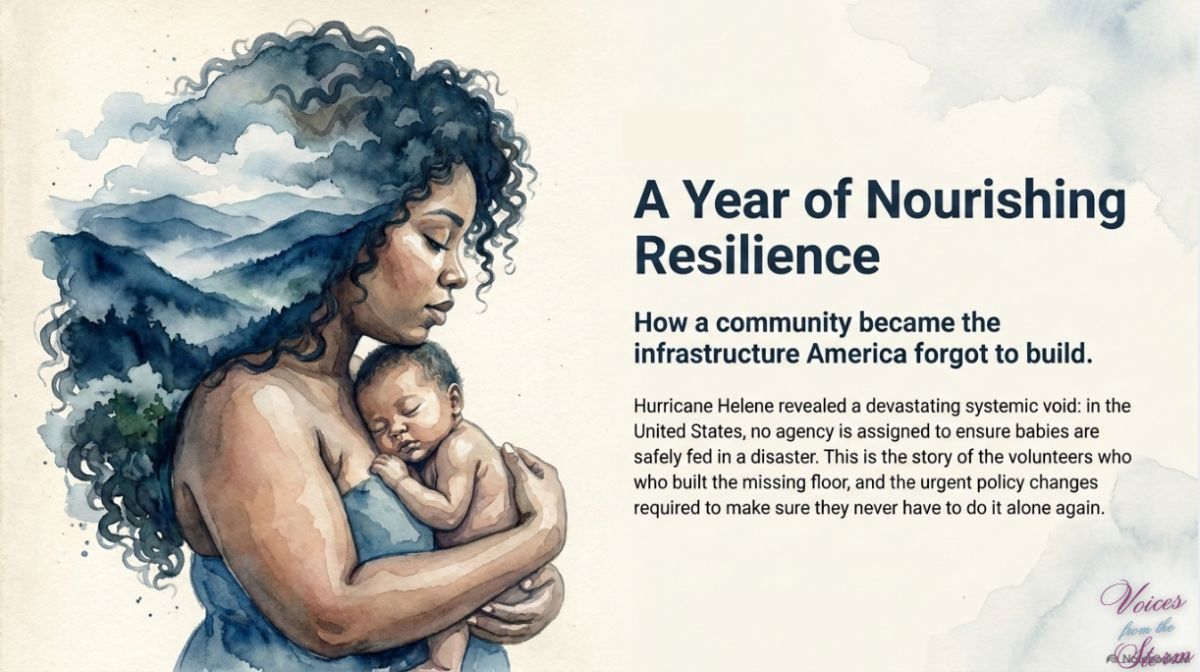
Mother cradling baby in storm

Two years ago this week, when the rain finally slowed and the size of what had happened started to come clear, I want to tell you what I was actually thinking about. It was not kits, or formula, or policy. It was my mama.

My mother lives in Black Mountain. My sister lives in Asheville. In the first hours after the storm, my sister drove over to my mom's house and got word out to me that she was safe, and I let myself breathe. And then, for three days, my mother went silent. Her texts stopped coming. My sister had to evacuate to Atlanta. And in that silence, I will be honest with you, it was very hard to think about anyone else's mother.

Because here is what almost no one tells you about a disaster. You are asked to help other people while you are terrified about your own.

We had The Call with the North Carolina Breastfeeding Coalition. We started organizing, dropping supplies where families in Western North Carolina were begging for help, and the entire time, underneath every sentence I said about other people's babies, I was thinking about your babies. One day someone called to ask if I needed anything. It had been so long since I had heard from my mom that I had just texted her to say that if I did not hear back within twenty-four hours, I was sending someone to go check on her. So when that person asked me what I needed, I did not need supplies, or a spreadsheet, or a plan. I needed someone to go check on my mother.

She is fine. I want to say that plainly, because she is a strong woman, the same as me, and she would want me to say it. It turned out she could see every one of my messages. She simply could not get one back out. She grew up in a house with a cistern and an outhouse. She had ninety days of her medication on hand. Logistically, my mother was never in danger.

But emotionally, she has never been quite the same, and I do not think she will be for a while. Black Mountain is where she retired. It is where the love of her life is buried, on land she loves. That land is scarred now, and her town is not the town it was. There was a brightness in my mother that the flood dulled. The land, the community, the people out there may take five years to come back, and maybe another five after that. When I picture the storm, I do not only picture washed-out roads. I picture the light gone dim in my mother.

And here is the thing I need you to carry into the rest of this story. My mother was safe, prepared, and three hours away from me. If the not-knowing did that to me, imagine the mother still up in the mountains with a five-day-old baby, no clean water, and no way to reach a single soul.

For those first hours, I made the mistake I now know none of us must ever make again. I assumed someone else had the babies handled. I thought WIC had a plan. I thought the North Carolina Department of Health and Human Services had a plan. I thought Save the Children, or the American Red Cross, or FEMA had long ago worked out how you feed an infant when a whole region loses clean water. As I would put it later, I honestly believed that somebody had already figured out how to deal with infant feeding in an emergency.

They had not. What existed was a guideline. The CDC has real, sound guidance on infant feeding in emergencies. What did not exist was a single person, or agency, or office whose job it was to carry that guidance into a shelter and put it into a mother's hands. The instructions were sitting on a shelf, and no one had been assigned to open the book.

I found that out the way you find out a floor is missing. I stepped onto it. Around noon in those first days, one of our board members, an IBCLC named Brandi who was already inside the disaster zone, called me. She did not ask whether we could help. She said, "Love, I need you to send me twenty IBCLCs or infant feeding specialists tomorrow." And I stood in my kitchen, three hours away, my own kids fighting a stomach virus, my mother still not answering, and I understood that the somebody I had been waiting for was going to have to be us.

The stories that came down out of the mountains are the reason I will never make that assumption again. Reporters who made it into the impact area described families choosing, in their words, whether to feed their babies or flush their toilets. Lactation consultants got on hiked up washed-out roads to reach a single home with a single baby inside. The pediatric practices that still had their doors open began seeing exactly what you would predict when clean water disappears: a rise in infants with diarrheal illness, the very thing that kills babies in emergencies the world over. Formula-fed babies were the most at risk of all, because formula is only ever as safe as the water you mix it with, and there was no safe water for weeks.

There is one story from those first days that I have never been able to set down, and I want to tell it to you carefully, because I do not know how it ends. A father got out of his flooding house carrying his baby and his toddler. His wife was right behind him. She did not make it out of the house. I never reached that family, and I cannot tell you for certain what became of her. What I can tell you is that in a matter of seconds a family was broken in two, and that somewhere in the middle of that unimaginable morning there was still a baby who needed to be fed.

The formula itself became one of the hardest lessons. Kind people all over the country did the thing that feels obviously good. They bought up formula and shipped it toward the disaster. So much of it that we actually ran out of formula for the families I serve back home in Durham. And a heartbreaking amount of what arrived out west ended up in a landfill, because it had been donated close to its expiration date, or left in a hot car, or frozen and thawed until it was no longer safe to give a baby. One of the least intuitive truths of this whole field is that a mountain of donated formula is not the same thing as a fed baby, and can sometimes make things worse.

I would love to tell you that we knew what we were doing in those first days. We did not. We were, as we said to each other a hundred times that fall, building the airplane while we were flying it. The communication lines were so broken that information reached us garbled and frightening, and in the fog you came to believe things that later turned out not to be true, and you acted anyway, because a baby cannot wait for you to be certain.

What I want to leave you with, on this anniversary, is not the water. It is the silence underneath it. In one of the worst natural disasters in our state's history, with the entire machinery of emergency response spinning up, the National Guard and FEMA and the Red Cross and mutual aid pouring in from all over the country, there was no one whose job it was to make sure the babies were safely fed. Not because anyone was cruel. Because in the whole architecture of how this country answers a disaster, that job had simply never been given to anyone.


So we started doing it ourselves. That is the next part of the story, and it is the part where I learned how unprepared every one of us was, and how much we could do anyway.

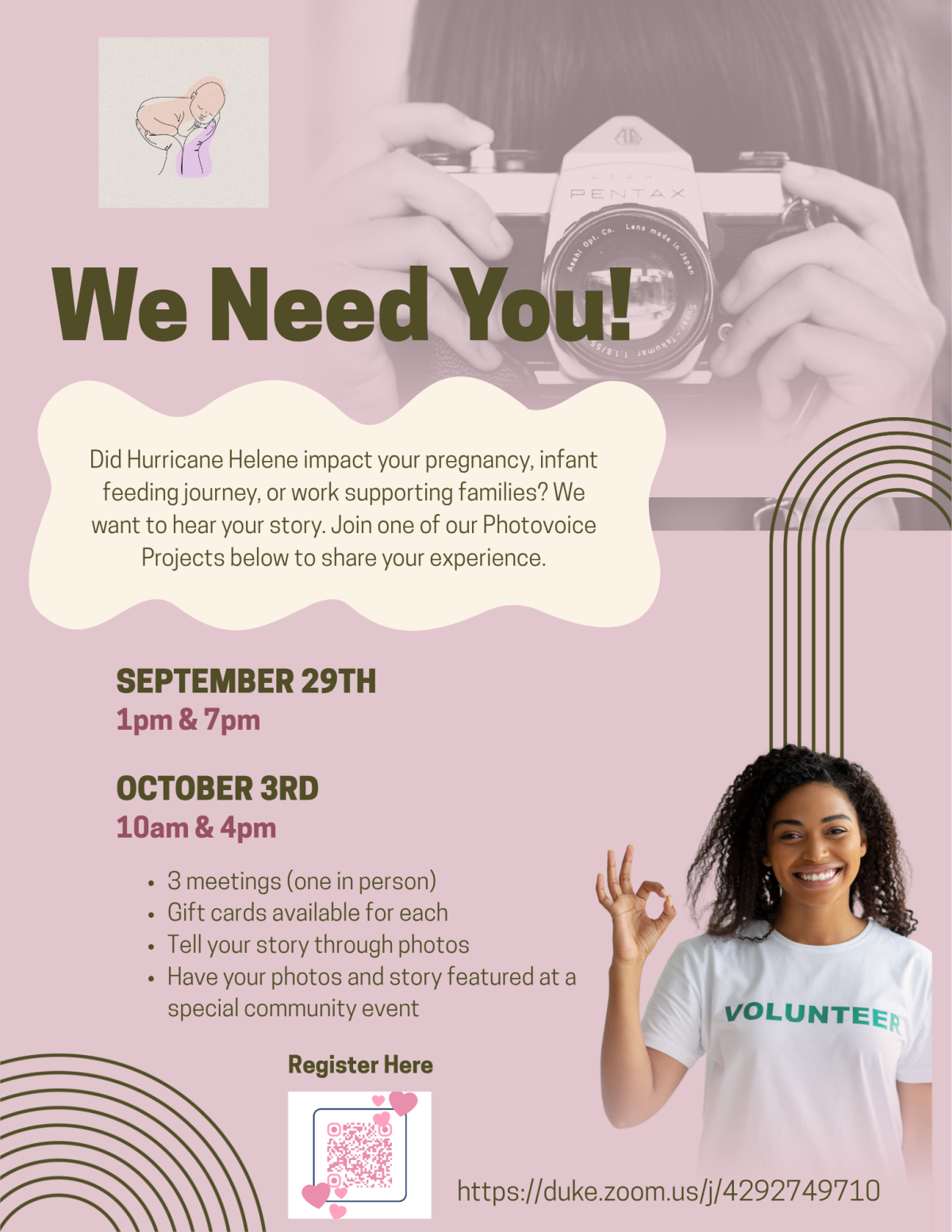
Photovoice

Will You Support Our Work?

We greatly appreciate all support for our work. Please consider donating or sponsoring to help us ensure that all families can safely feed their babies in emergencies of all kinds.

Learn about Sponsorship Opportunities

Questions about anything? Need support? Reach out to us at info@SafeInfantFeeding.org

Donate
SAFE Infant Feeding in Emergencies
Unsubscribe   |    Manage your subscription   |    View online
SAFE Team
info@safeinfantfeeding.org
Copyright 2026, All rights reserved. Most content can be used unedited in the case of an emergency. Contact us for other rights of use.