|
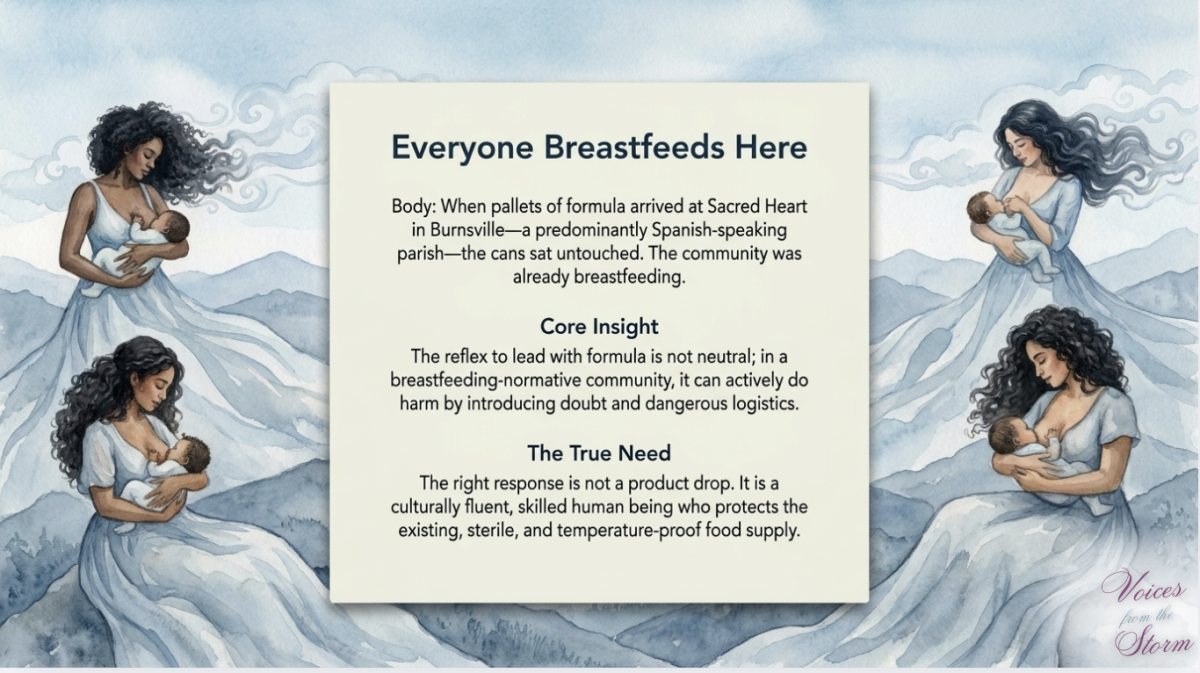
We answered a question nobody had assigned to us, with a team we did not have, using a plan that did not exist.
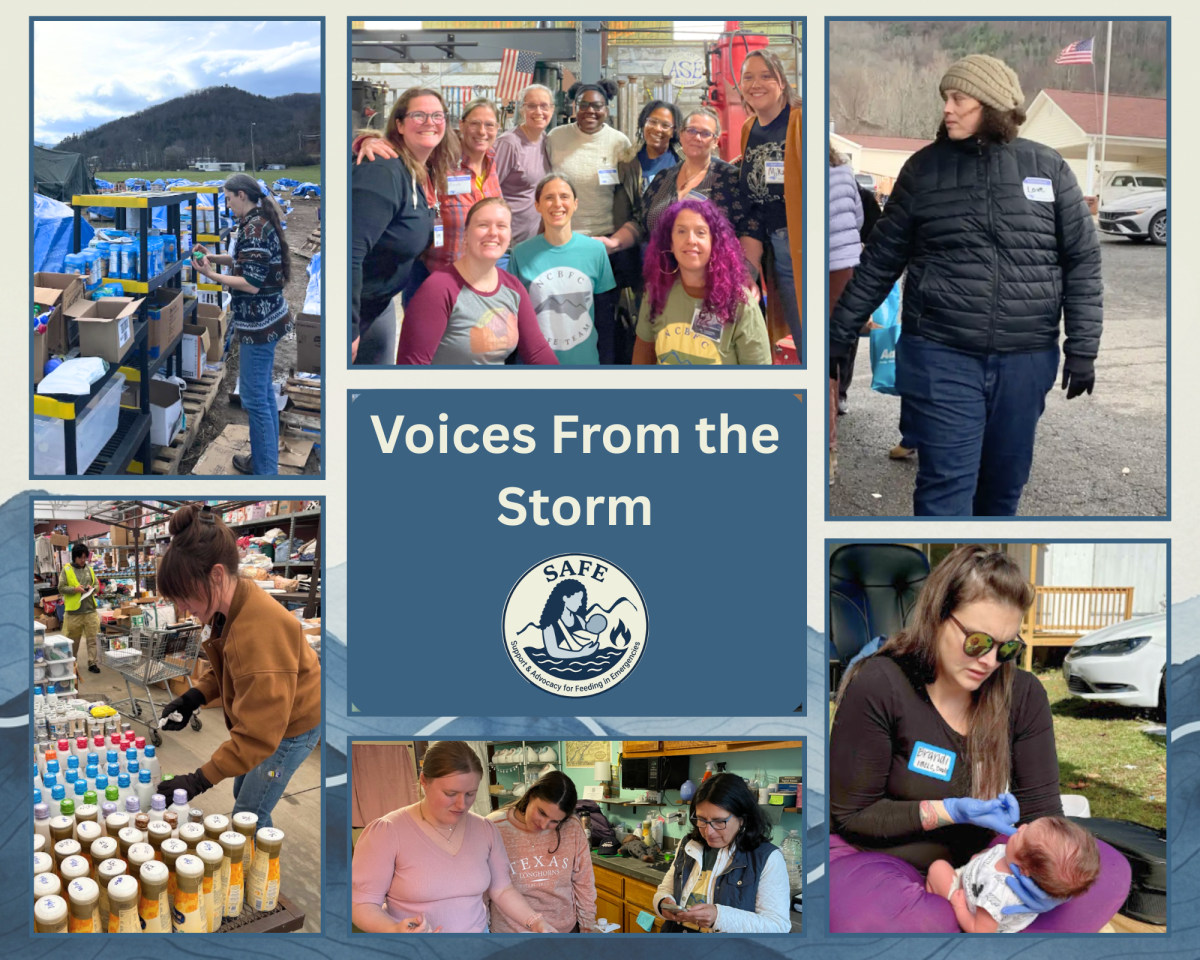
When Brandi called and said she needed twenty infant feeding specialists in Asheville by the next morning, I want to be honest about what I actually had to work with. I did not have a team. The North Carolina Breastfeeding Coalition is a volunteer coalition, and two of the four members of our board lived in the mountains, which is to say half of our leadership was itself underwater. I did not have a phone number for this. I did not have an email address for it. I did not have a website, a protocol, a supply chain, or a single kit. What I had was a stomach virus, three hours of highway between me and the disaster, my mother still not answering her phone, and a slowly arriving understanding that the somebody who was supposed to handle this was going to have to be us.
So we built it. In public, in real time, while it was already happening. We used to joke, a hundred times that fall, that we were building the airplane while we were flying it.
The first things we built were almost embarrassingly basic, and that is the point. We needed a phone number, because you cannot run a disaster response off one person's cell phone. We needed an email address, and I remember insisting it be one that did not have the word breastfeeding in it, because this was about feeding babies safely, and we could not afford to lose a frightened formula-dependent family who saw that word and assumed we had come to judge them. We set up a group text for the crew going in the next day, because the old threads had already collapsed under their own weight. And we started recording our meetings, every morning and every night, because someone in the middle of it looked at me and said, Love, you are drowning, at least start recording these so you do not lose them. That is the only reason any of this is written down. We were far too busy surviving to keep records on purpose.
We gave the thing a name around day ten, out loud, in a meeting, almost by accident. Support and Advocacy for Feeding in Emergencies. SAFE. We figured it out that day, the way you name a baby who has already been born.
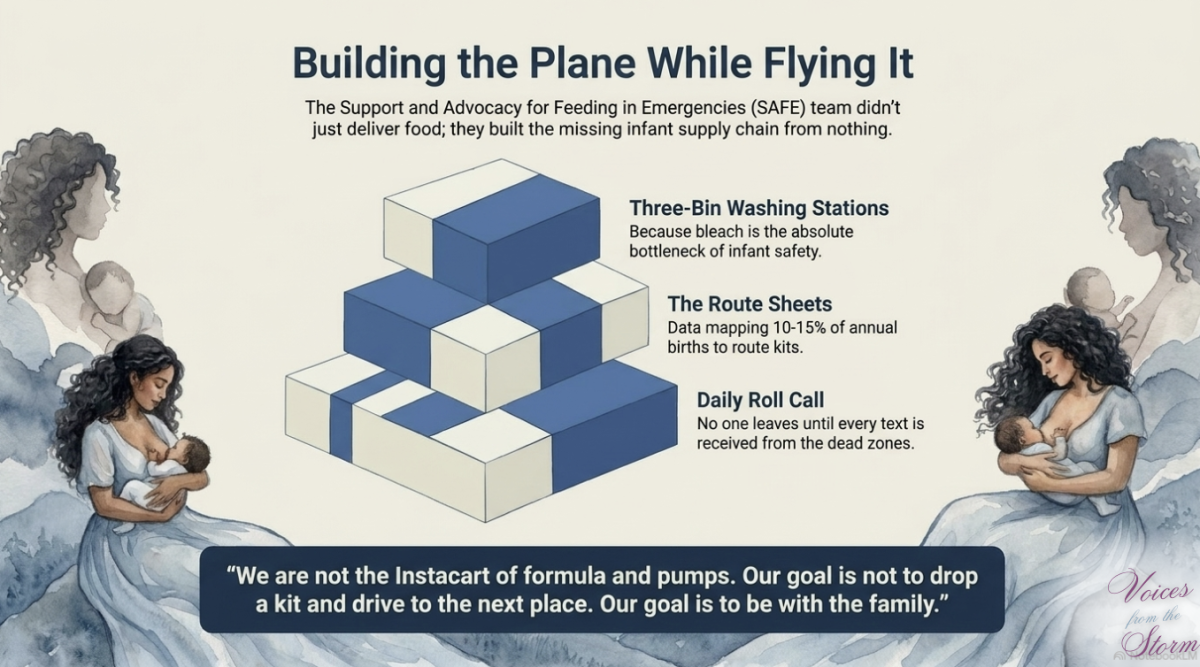
Then we built a rhythm, because chaos will kill you and a rhythm will save you. Every morning there was a virtual huddle at nine, and an in-person meeting in Asheville at nine thirty. Every evening there was a leadership call. We took roll at the end of every single day, out loud, by name, and we did not close the meeting until every volunteer had sent the text that said they were safely out of the zone, because some of them were in places with no cell service and no power, running on borrowed Starlink, and a person can disappear in country like that.
We built discipline into the work, fast, because the instinct in a disaster is to become a delivery service, and that instinct is wrong. One of our coordinators said it better than I ever have, and I have never forgotten it. We are not the Instacart of formula and pumps. Our goal is not to drop a kit and drive to the next place. Our goal is to be with the family. All you need, she said, is your heart and your hands and your sweet voice and your willingness to help.
We built the kits, and we got almost fanatical about the parts that matter, because the parts that matter are the ones that keep a baby from getting sick. Check the bleach, double and triple check it, because someone always arrives with the scented kind, or the splash-free kind, or the kind with fabric softener in it, and none of those will safely sanitize a bottle. Vinegar does not disinfect the way bleach does, not even close, no matter how many times the internet insists otherwise. We built three-bin washing stations, the same setup the Scouts use, one of them built by a volunteer's roommate out of a dish tub, and we handed kits out in five-gallon buckets so that a family would at least have a clean vessel to carry water in.
And almost immediately, long before we had any right to be thinking about it, we started building the thing that would let us hand all of this to someone else. Our volunteers only got really good after a few days, and then their few days or week was up and they drove home and we started over with new faces. So we began sketching a seven day training, an institute, a way to make more people who could do this work without us. I kept saying it out loud even when it sounded ridiculous. Maybe by next year we will be the infant feeding in emergencies institute. And one of our IBCLCs said, of which this country needs at least one.
I need you to understand what this actually cost the people doing it, because the numbers never will. I had not slept in about five days. I told my team, out loud, that if I let myself stop and think about it I would go into a closet and start crying and I was not sure I could come back, so I was going to go forward or be crushed. About a month in, still doing all of it for free, I looked around at everyone's faces and got genuinely afraid that one of our exhausted volunteers was going to get hurt. There was a morning I admitted to everyone that I did not know how to ask for help, that I was so deep in it that even opening my email gave me an anxiety attack. And then I said the truest thing I said that entire fall. This, right here, what I am feeling, is exactly what a new mother in a disaster feels. Overwhelmed, under-resourced, and unable to ask for what she needs. I understood the mothers better because I had briefly become a version of one.
We hated it. I want to say that plainly, because this story often gets told as though it were beautiful, and parts of it truly were, but most of it was brutal and improvised and lonely. We did it anyway. And we do not want anyone, ever, to have to do it this way again.
Which is the whole reason I am telling you any of this. We did not build a phone number and a training institute and a bleach standard and a washing station and a set of daily rituals because we are especially gifted at building things. We built them because there was nothing there. No agency owned this work. No plan was waiting. No plane was sitting on the runway. In one of the wealthiest countries on earth, a group of exhausted volunteers with a group text and a borrowed dish tub were the infant feeding emergency response, because we were the only ones who showed up to fill the void.
You should not have to build the plane while you are flying it. That a baby's safety in a disaster comes down to whether a coalition of lactation volunteers happens to exist in your state, and happens to have each other's cell phone numbers, is not a system. It is luck. And luck is not a policy.
That is what we would eventually set out to change. But not yet. In those first weeks I still believed this was a sprint. I told everyone we would be home in about two weeks. I was as wrong about that as I had been about everything else. |