
Session 2 – Homework Summary
<< Back to main Session 2 page
Here is the whole assignment, step by step. Jump straight to any step below, or download the identical material as a printable handout.
- Assemble your own cold sanitation kit
- Review E-Learning Module on Feeding Basics
- Practice cleaning & sanitizing feeding items when only unsafe water is available.
- Complete the Evaluation
Additional handouts and resources are at the bottom of this page.
1. Assemble your own cold sanitation kit
We all feel more comfortable teaching what we have done. To help with the next 2 tasks, create your own sanitation kit. While using real items is helpful, it is ok to use what you have on hand.
- Use the DIY Sanitation Kit handout to help you assemble your kit.
- If creating a mock kit, gather items you can pretend to use while practicing.
- If you prefer, it is ok to omit bleach and use an empty bottle of some other kind to simulate the bleach step.
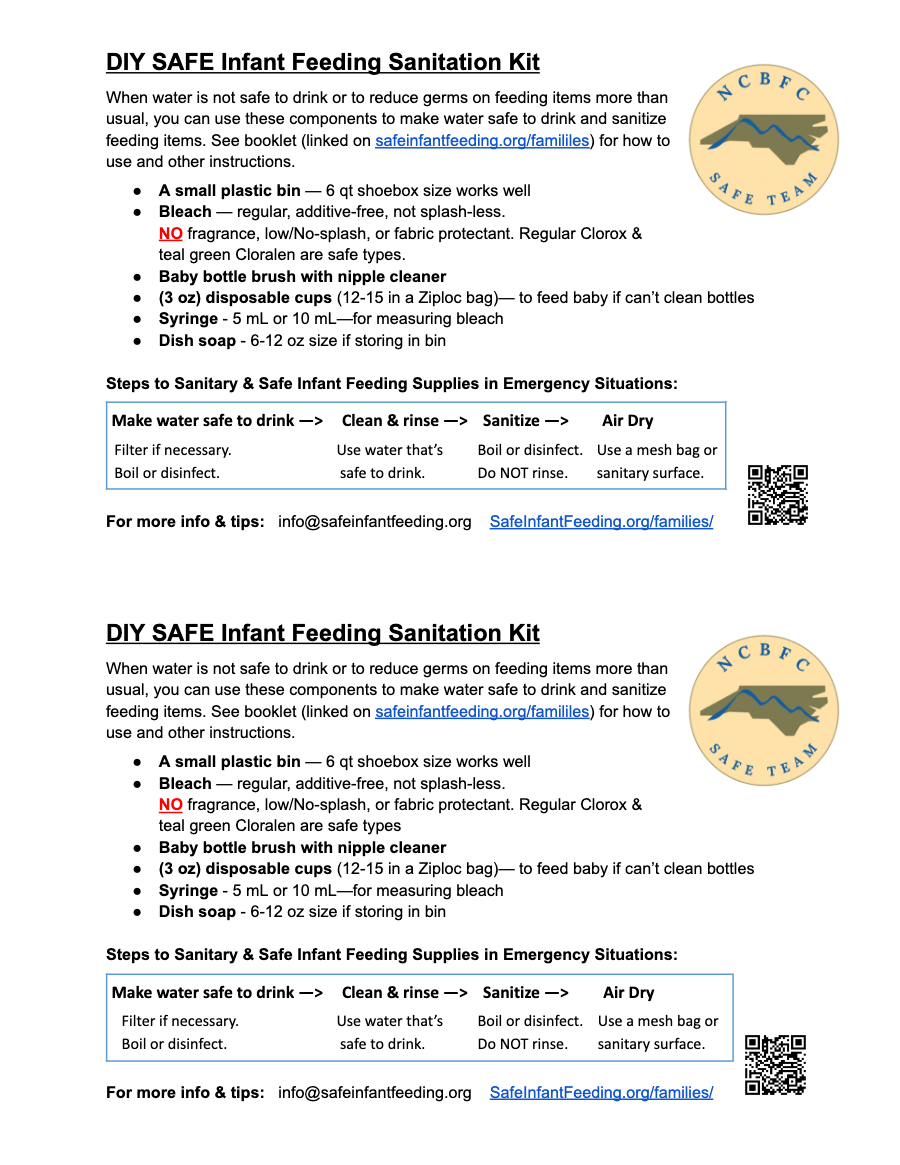
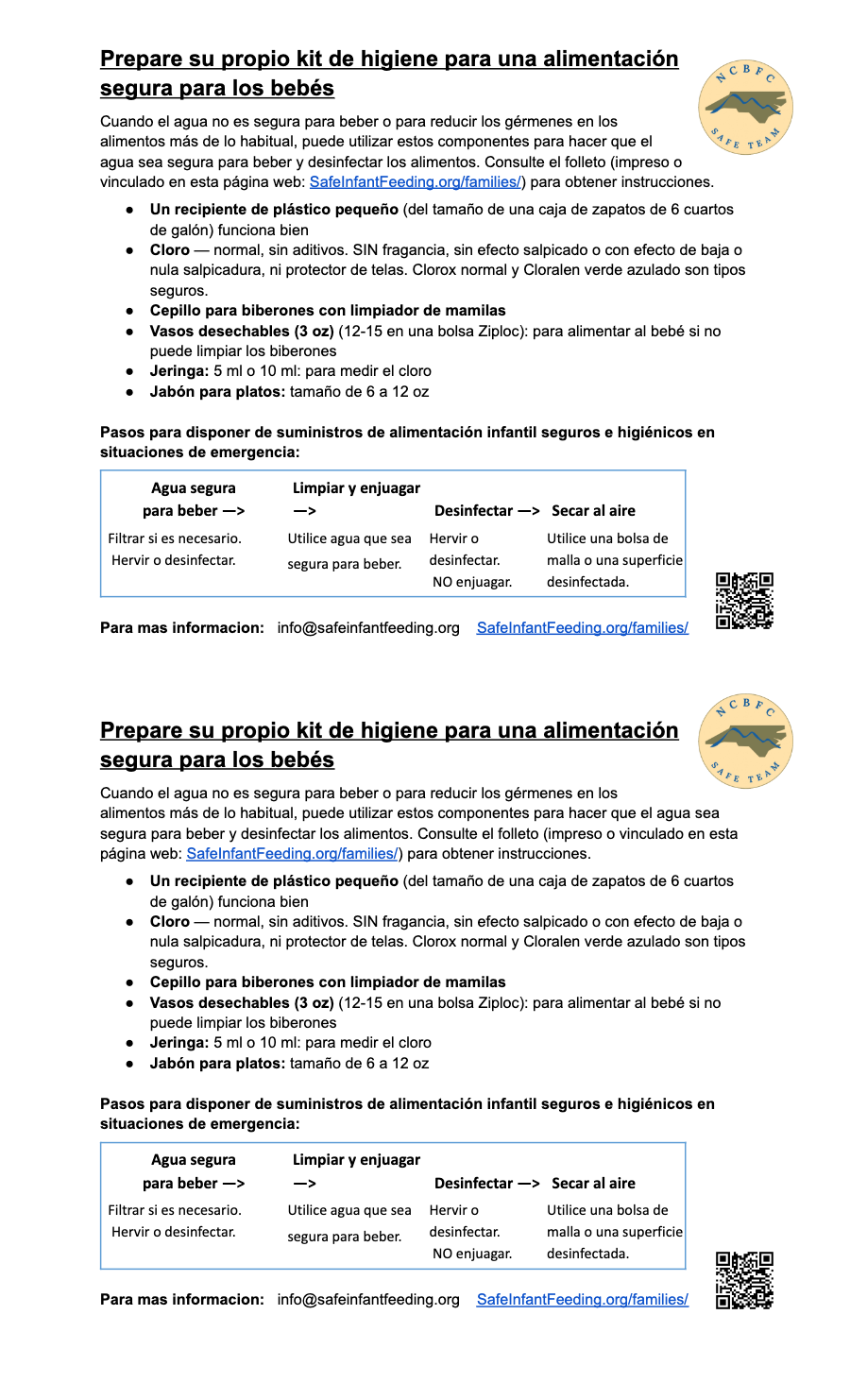
English:
DIY Sanitation Kit Components (PDF)
2. Review E-Learning Module on Feeding Basics
E-Learning Module on Feeding Basics (Optional, Recommended)
This will review much of what we have discussed, and provide additional information and a scenario to practice what you have learned. Video module © 2025 The University of North Carolina at Chapel Hill and North Carolina.
Interested in licensing these materials for reuse or co-branding? Contact the University of North Carolina at Chapel Hill Office of Technology Commercialization at 919-966-3932, or email Harmen Steele at harmen.steele@unc.edu
3. Practice cleaning & sanitizing feeding items when only unsafe water is available.
We recommend practicing both the boiling and bleach methods, but practice at least one of them. Simulating the process while describing it aloud is fine, though do try to wait the recommended amount of time where indicated.
SAFE Handout Booklet
Contains more details on all the steps. Use page 9 for reference on making water potable. Pages 2-3 discuss cleaning & sanitizing.
| Steps Using Boiling Method | Steps Using Bleach Method |
| If water is not clear, filter. Make water potable (safe to drink). Boil for 1 minute. Clean feeding items using safe water and dish soap. Rinse with safe water. Sanitize feeding items. Submerge in water, boil for 5 minutes. Remove items carefully. Air dry and store in a clean container used only for sanitized feeding items. | If water is not clear, filter. Make water potable (safe to drink). Use 8 drops bleach to 1 gallon (3.75 L) water. Wait at least 30 minutes. Clean feeding items using safe water and dish soap. Rinse with safe water. Sanitize feeding items. Soak at least 2 minutes in a solution of 1 tsp (5 mL) bleach in 8 cups or ½ gallon (2 L) of water. Air dry and store in a clean container used only for sanitized feeding items. |
Complete the Evaluation
To track your attendance and help us improve, please complete the short evaluation as soon as you can. It is how we verify your attendance for the certificate of completion at the end of the series.
Please Support Our Efforts
If you find this training helpful, please support our efforts with a financial donation. Click below and select “SAFE Team” to earmark for IYCF-E education and disaster response support.
Handouts, Links & Resources
New marks a handout you have not seen before; Shared earlier means it appeared in an earlier session.
Handout list
New this session
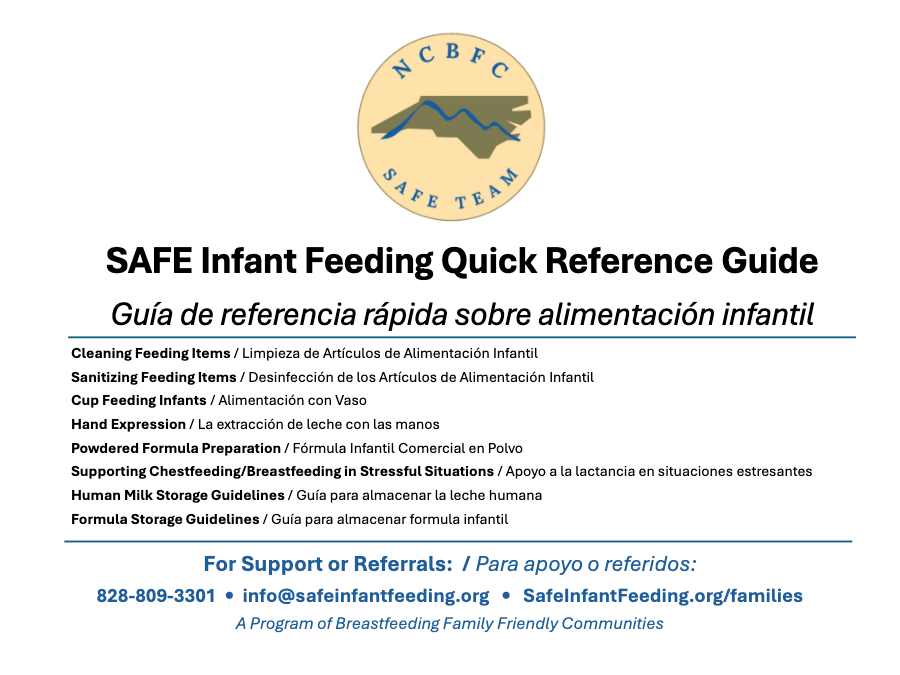
SAFE Infant Feeding Quick Reference Guide
The final version of the handout booklet we distributed in western North Carolina after Helene. Every page is bilingual, English and Spanish. It covers:
- Cleaning feeding items — Limpieza de artículos de alimentación infantil
- Sanitising feeding items — Desinfección de los artículos de alimentación infantil
- Cup feeding infants — Alimentación con vaso
- Hand expression — La extracción de leche con las manos
- Powdered formula preparation — Fórmula infantil comercial en polvo
- Supporting chest/breastfeeding under stress — Apoyo a la lactancia en situaciones estresantes
- Human milk storage — Guía para almacenar la leche humana
- Formula storage — Guía para almacenar fórmula infantil
Use this booklet in an emergency response as‑is, or co‑brand it with your own organisation’s contact information.
New this session
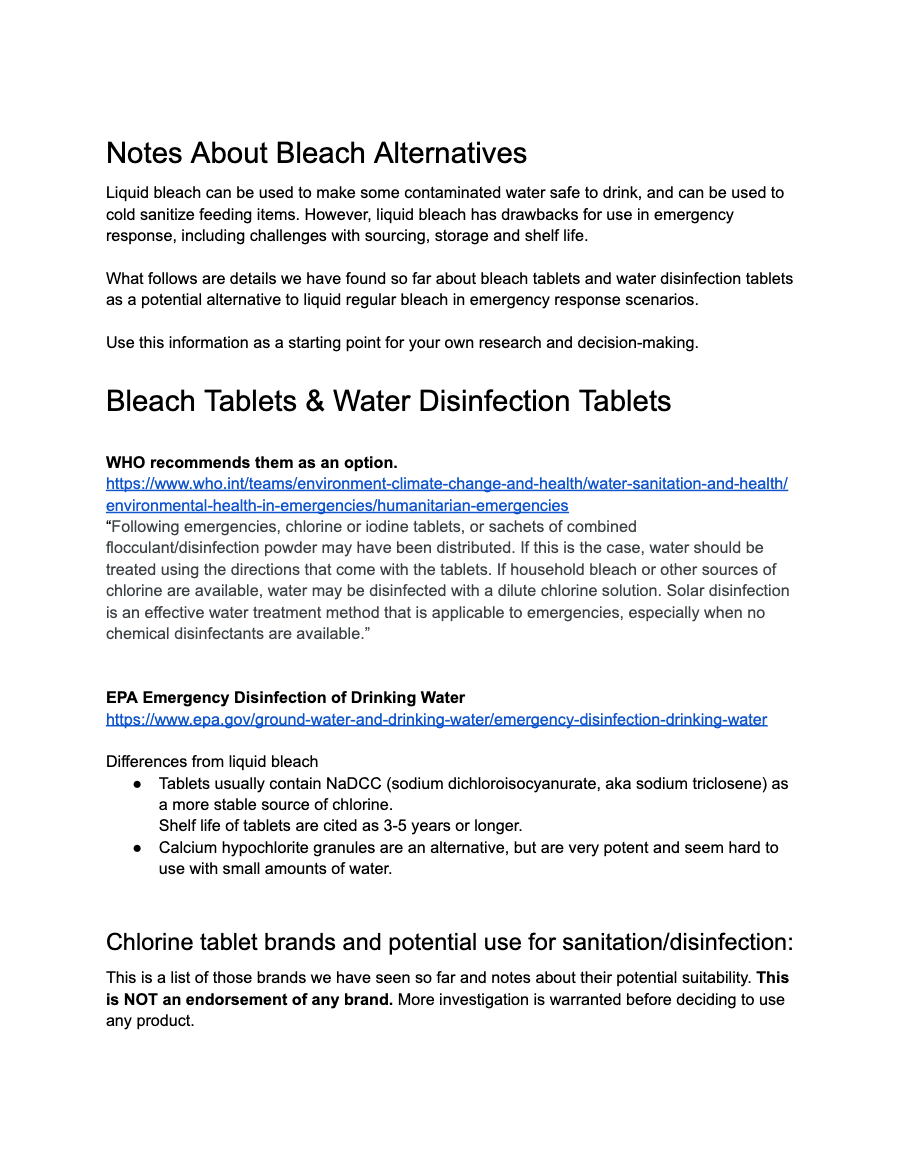
Bleach Alternative Notes
What to use for cold‑water purification when liquid bleach is not available, and what the evidence says about each option.
New this session
Water Filters Meeting WHO Standards
Household water treatment products evaluated under the WHO international scheme. A three‑star rating is the best performance tier — look for it when sourcing filters.
You can also read the WHO’s list of evaluated products.
Thanks to our sponsors
This work is free because these people and organizations paid for it.

Marcia Brady Tucker Foundation
A private family foundation dedicated to supporting charitable organizations that align with its mission of giving back. Grants are made only as a result of the Foundation’s own initiative.
Breastfeeding Family Friendly Communities
Provides technical assistance to breastfeeding coalitions and health departments across the US, using the Ten Steps to a Breastfeeding Family Friendly Community. The SAFE Team is a project of BFFC.

In memory of Elsie Perry
Elsie Perry was a founding mother of La Leche League Boston in the 1960s. A gift made in her memory by her daughters funded an eleventh month of this training series.
BabyBjörn
Founded in 1961 and still family-owned, with a mission to make everyday life easier for parents with babies. If your community needs emergency baby gear, reach them at care@babybjorn.com.

Confident Pregnancy
Helps people be healthier, feel more confident, and find their inner strength. Tips for staying calmer and more resilient under stress at MelindaDelisle.substack.com. DBA Melinda Delisle Innovations.

Birthstone Center for Appalachian Perinatal Resilience
Strengthens perinatal health in Western North Carolina by centering families, uplifting birthworkers, and advancing equitable access to lactation, doula and maternal mental health support.
Sponsor this IYCF-E training
Interested in sponsoring or partnering with us? Get in touch.
Scan to open this page on your phone
These materials are shared under the SAFE Team Open Source Use Agreement — please reuse and adapt them, with attribution.