
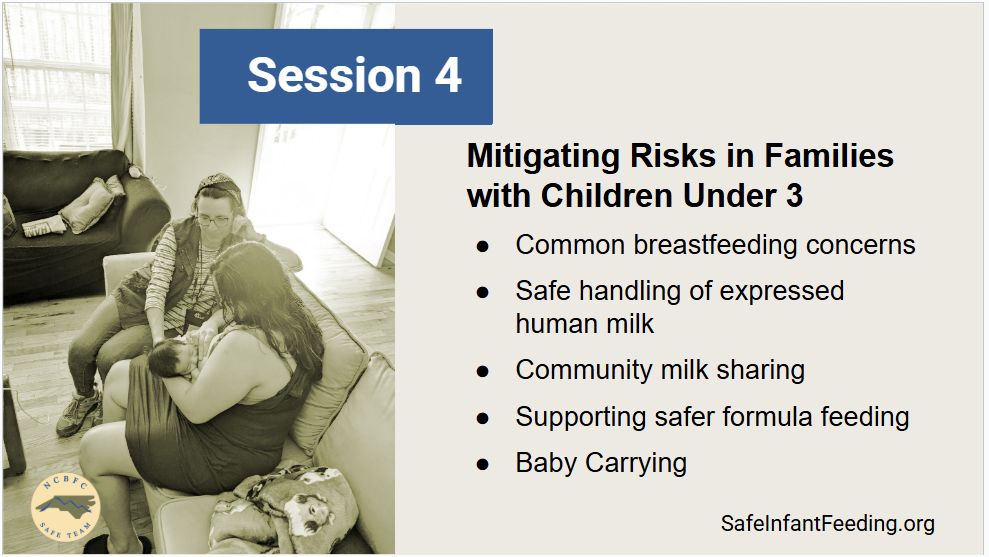
Session 4 – Homework Summary
<< Back to main Session 4 page

- Review Handouts
- Start or continue a Resource List.
- Research Donor Human Milk options in your community.
- Field / Community Experience – volunteer on-site for 1-2 hours if possible.
If you have already done this, we encourage you to go out for another session. - Complete the evaluation for this session.
- Suggested donation of $5 per session (optional, recommended)
Additional handouts and resources at the bottom
1. Review Handouts
The handouts listed below are new this session unless noted.
- Human Milk Storage Guidelines
(Page 10 of Quick Reference Guide* & CDC link) - Preparation of Powdered Infant Formula
(Page 8 of Quick Reference Guide* + CDC & WHO links) - Storing Formula Safely*
(Page 11 of Quick Reference Guide and full-page handouts) - Milk Sharing Safety Guidelines from Eats on Feets
- Informal (Peer-to-Peer) Human Milk Sharing Information from Perinatal Services BC (Canada)
- Crisis Feeding Support – Infant Regulation & Baby Carrying from Feeding in Motion
- Baby Carrying Resources
- Infant Feeding Safety Scale (aka Hierarchy of Feeding)*
*Indicates previously distributed handouts.)
2.Start a Resource List
Most organizations serving low-resource people will still operate after an emergency. Start compiling a list of these organizations that would be great referral partners during an emergency. While you are searching, look for the emergency services and disaster planning organizations and contacts that serve your area.
See more details here:

- Most organizations serving low-resource people will still operate after an emergency. Start compiling a list of these organizations that would be great referral partners during an emergency. While you are searching, look for the emergency services and disaster planning organizations and contacts that serve your area.
- See more details here: https://safeinfantfeeding.org/app/uploads/2025/12/Resource-List-Guide-for-IYCF-E-Connections.pdf
3. Research in Your Community – Donated Human Milk
Find out what options exist in your area for human milk. It’s likely there are more options than you realize.
Start with these questions:
- What are the available options for obtaining or donating human milk? Look for community or peer-to-peer options as well as official milk banks.
- For each option:
- Who does the organization serve?
- What are the screening or other protective processes in place?
- What is required to donate human milk?
- What is required to obtain human milk?
4. Field / Community Experience
If you have already done this, great! We encourage you to go out and support more families or help with (more) organizing.
The best way to get comfortable working with families and sites is to do it. You don’t need to wait for an emergency situation to occur – there are families everywhere who do not have reliable access to safe water and other resources needed to safely feed children under 3 years old, and organizations that try to meet their needs.
Try to attend an event or volunteer with an organization for 1-2 hours in the next month. If possible, try to both help with organizing feeding items and talk with families using the RNA.
Suggested steps to follow:
- Identify an organization that serves low resource people with young children. You may need to reach out to multiple organizations to find a suitable one. Examples include food banks, diaper banks, or possibly WIC, if you have access.
- Prepare – Write out what you want to say/ask. Use the Contacting Sites Template. Be sure to include:
- Who you are, and your organization, if you want to claim one.
We encourage you to call yourself something like an infant feeding specialist, and avoid titles referring to lactation. - Why you are calling. For this experience, you may want to state that you want to help the site organize their baby feeding items and help low-resource families be certain they are feeding their babies and young children as safely as they can with the resources they have access to.
- Find out when it is convenient for them for you to help.
- Who you are, and your organization, if you want to claim one.
- Call or email the organization – If possible, volunteer to help at an event or during their open to the public hours. If not, you can help sort infant feeding items during volunteer hours. This may help build rapport for later public events.
- Ask to talk to families about their feeding practices with their young children.
- Decide what you will bring. See the lists below, and consider if you also want to bring kits, the Quick Reference Guide, or the DIY handout to give families.
| Consider Bringing If Organizing Items | Consider Bringing If Talking With Families |
| Permanent marker, preferably black Safe Storage Guidelines Steps for Safe Distribution of Infant Feeding Supplies Safe Infant Feeding Tips for Families sheet, to hang up. QR code/link to resource page: https://safeinfantfeeding.org/sites/ | Safe Infant Feeding Tips for Families, for reference & to hang up. Quick Reference Guide, or QR code families can scan to access it. Short referral list for other needs (opt) DIY Sanitation Kit handout Sanitation kits, if desired. QR code/link to resource page: https://safeinfantfeeding.org/families/ |
5. Complete the Evaluation

To track your attendance and help us improve, please complete the short evaluation as soon as possible. This will allow us to verify your attendance for the certificate of completion at the end of the series. https://forms.gle/VeeMBUYYdXYzVJsXA
Please Support Our Efforts
If you find this training helpful, please support our efforts with a financial donation. Click below and select “SAFE Team” to earmark for IYCF-E education and disaster response support.
Handouts, Links & Resources
  | SAFE Infant Feeding Quick Reference Guide This is the final version of the handout booklet we distributed in western NC after Helene. Includes instructions for: Cleaning Feeding Items / Limpieza de Artículos de Alimentación Infantil. Pg 2 Sanitizing Feeding Items / Desinfección de los Artículos de Alimentación Infantil. Pg 3 Cup Feeding Infants / Alimentación con Vaso. Pgs 4-5 Hand Expression / La extracción de leche con las manos. Pgs 6-7 Powdered Formula Preparation / Fórmula Infantil Comercial en Polvo. Pg 8 Supporting Chestfeeding/Breastfeeding in Stressful Situations / Apoyo a la lactancia en situaciones estresantes. Pg 12 Human Milk Storage Guidelines / Guía para almacenar la leche humana. Pg 10 Formula Storage Guidelines / Guía para almacenar formula infantil. Pg. 11 This booklet may be used in emergency response situations as-is, or co-branded with your organization contact information. https://safeinfantfeeding.org/app/uploads/2025/11/SAFE_Feeding_Visual_Handouts_Booklet_SIF.pdf |
 | Human Milk Storage Guidelines – CDC/ABM “Breast Milk Storage and Preparation” CDC guidelines (from the Academy of Breastfeeding Medicine’s protocol) for storage and preparation of expressed milk. Page links to a 2-page PDF as well as printable quick reference images. https://www.cdc.gov/breastfeeding/breast-milk-preparation-and-storage/handling-breastmilk.html |
 | Safe preparation, storage and handling of powdered infant formula: guidelines – WHO Booklet discussing both bulk preparation in healthcare settings and individual preparation in homes. Instructions cover how to reduce risk of infection by heating water used to mix formula. https://www.who.int/publications/i/item/9789241595414 |
  | Safe Formula Storage Guidelines Guidelines for storing formula so it keeps its nutritional value and remains safe to feed a baby. Storing Factory Sealed (Unopened) Infant Formula https://safeinfantfeeding.org/app/uploads/2025/12/Storing-Formula-Unopened.png.pdf  Storing Opened Infant Formula Helpful for families and shelters. https://safeinfantfeeding.org/app/uploads/2025/12/Storing-Formula-Opened.png.pdf  |
 | Milk Sharing Safety Guidelines – Eats on Feets 4 Pillars On this page, the Eats on Feets group explains what they consider the 4 pillars of safe informed sharing of human milk. https://www.eatsonfeetsresources.org/the-four-pillars-of-safe-milk-sharing/ |
 | Informal (Peer-to-Peer) Human Milk Sharing Information from Perinatal Services BC (Canada) A handout discussing risks of milk sharing and some ways to mitigate those risks. https://sph.unc.edu/wp-content/uploads/sites/112/2022/05/InformalMilkSharing_FamilyInfo.pdf |
  | Crisis Feeding Support – Infant Regulation & Baby Carrying This short guide explains why emergencies can disrupt infant feeding beyond milk supply, the benefits of baby carrying, and ways for caregivers to help settle babies before they eat. https://safeinfantfeeding.org/app/uploads/2025/12/Regulation_for_Infant_Feeding_in_Crisis-Feeding_in_Motion.pdf |
 | SAFE Infant Feeding Quick Reference Guide This is the final version of the handout booklet we distributed in western NC after Helene. Includes instructions for: Cleaning Feeding Items / Limpieza de Artículos de Alimentación Infantil Sanitizing Feeding Items / Desinfección de los Artículos de Alimentación Infantil Cup Feeding Infants / Alimentación con Vaso Hand Expression / La extracción de leche con las manos Powdered Formula Preparation / Fórmula Infantil Comercial en Polvo Supporting Chestfeeding/Breastfeeding in Stressful Situations / Apoyo a la lactancia en situaciones estresantes Human Milk Storage Guidelines / Guía para almacenar la leche humana Formula Storage Guidelines / Guía para almacenar formula infantil This booklet may be used in emergency response situations as-is, or co-branded with your organization contact information. SAFE Infant Feeding Quick Reference Guide |
 | Baby Carrying Resources A summary of essential tips for baby carrying, and resources to help you learn more. https://safeinfantfeeding.org/app/uploads/2025/12/Baby-Carrying-Resources.pdf |
 | Infant Feeding Safety Scale (aka Hierarchy of Feeding) The relative safety of different ways to feed a baby. Use to help educate caregivers. (Spanish and English in same pdf) https://safeinfantfeeding.org/app/uploads/2025/11/Infant-feeding-Safety-Scale.pdf  |
 | VOAD Directory Use this directory to find your state or territory VOAD (Volunteer Organizations Active in Disasters), then search their list for groups active in your area: https://www.nvoad.org/state-territory-voad/ |


Thanks to our Sponsors
We express our gratitude to our sponsors that made this training possible:
Marcia Brady Tucker Foundation
The Marcia Brady Tucker Foundation is a private family foundation dedicated to supporting charitable organizations that align with its mission of giving back.
Grants are made only as a result of the Foundation’s own initiative.
Breastfeeding Family Friendly Communities
Breastfeeding Family Friendly Communities provides technical assistance to breastfeeding coalitions and health departments across the US, including Breastfeed Durham, Breastfeeding Family Friendly Communities of Asheville, and the North Carolina Breastfeeding Coalition. Our newest project, the SAFE Team, revealed national gaps in infant and young child feeding during emergencies. Our core mission of systems change uses the Ten Steps to a Breastfeeding Family Friendly Community to train and educate non-lactating community members to better welcome families, normalize breastfeeding, and prepare for safe infant feeding in emergencies. Together, we build environments where every family can thrive.

Confident Pregnancy (DBA Melinda Delisle Innovations)
We help people be healthier, feel more confident, and find their inner strength so we can show up as our best selves. Learn foundations for staying calmer and more resilient under stress in our upcoming program, Surfing Emotional Currents. Register free on our website.

Birthstone Center for Appalachian Perinatal Resilience
The Birthstone Center for Appalachian Perinatal Resilience strengthens perinatal health in Western North Carolina by centering families, uplifting birthworkers, and advancing equitable access to lactation, doula, and maternal mental health support—building resilience in mountain communities before, during, and after birth. Starting as a small private practice, Birthstone has grown into a regional nonprofit that creates innovative solutions to providing a village for Mountain Families.
Sponsor This IYCF-E Training
Creating a detailed and thorough training to the high standards we know you all expect takes funding. If you would like to learn more about sponsoring or other partnership opportunities, please contact us.