
For emergency managers and planners
The three areas map onto the structure you already run. Governance and partnership is a command and liaison question: who is named, and who reports in. Congregate care and shelter operations sits under Operations, in the Human Services Branch, where mass care sits. Public information and education belongs to your public information officer, including pre scripted messaging in every language your county speaks.
The four fixes named above each have an address. Designation of authority goes in the plan and on the call down roster. The paragraph in an annex is a mass care annex. The relationship with a lactation consultant is a roster you build in blue sky, not a phone call you make at two in the morning. And the line in your shelter protocol is one question at registration: is there a child under two in this household, and how is that child being fed.
Worth knowing before you budget. Congregate shelter supplies for infant feeding are reimbursable under Public Assistance Category B when a declaration specifies it, and the personal assistance services definition now covers feeding as well as eating. Detail is on Emergency Management and Preparedness Coordinators.
The best time to run this is before your plan reaches its revision cycle, not after.
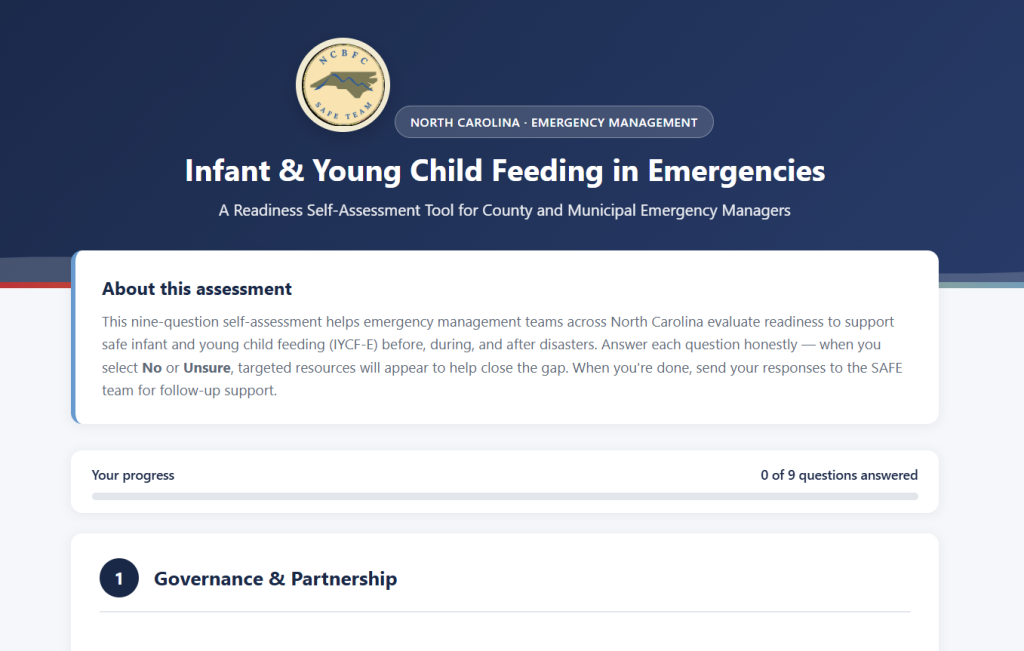
IYCF-E Self-Assessment Tool for North Carolina Emergency Management
When disaster strikes, emergency managers face an avalanche of decisions. In the chaos of those first hours and days, relying on existing protocols is essential to ensuring that nothing – and no one – is overlooked, especially not a vulnerable population like babies.
Infants need to eat every two to three hours. They cannot eat adult food, drink unfiltered water, or understand why their next meal hasn’t arrived. They are also among the most likely to get sick as a result of contamination or disrupted feeding schedules. Yet, across North Carolina and the rest of the country, the vast majority of emergency operations plans contain no specific provisions for safely feeding infants and young children when the systems families depend on, such as clean water, reliable power, and intact supply chains, have collapsed.
The SAFE Infant Feeding Team knows this firsthand. It was why we formed during the Hurricane Helene response in western North Carolina in 2024. It is also what we hear, again and again, from emergency managers, public health professionals, and shelter operators: this gap exists, and we don’t know where to start.
Today, we’re making it easier to start.
Introducing the IYCF-E Readiness Self-Assessment
The IYCF-E Readiness Self-Assessment is a free, nine-question tool designed specifically for county and municipal emergency managers in North Carolina. It takes only a few minutes to complete and gives you an honest picture of where your jurisdiction stands on infant and young child feeding preparedness.
The assessment covers three critical areas:
- Governance & Partnership
- Congregate Care & Shelter Operations
- Public Information & Education
For each question answered No or Unsure, the tool reveals targeted resources to help you close that specific gap.
Why This Matters
Safe infant feeding in an emergency is not a niche concern. It is a life-safety issue.
When water is contaminated or unavailable, improper formula preparation becomes a direct health risk to infants. When power is out, electric breast pumps can’t be charged. Storage of both formula and pumped milk becomes difficult without reliable refrigeration. When donated formula floods a shelter with no inventory management plan, expired or inappropriate products end up in the hands of families who trust that what they’re being given is safe.
These are not hypothetical scenarios. They are documented realities from Helene and from nearly every major disaster before it.
The good news is that most of these gaps are easily addressable. Designation of authority. A paragraph in an annex. A relationship with a local lactation consultant. A line in your shelter protocol. These are achievable steps, and the SAFE Team is here to help you take them.
Take the Assessment, Then Let Us Help
The self-assessment closes with an option to send your results directly to the SAFE Infant Feeding Team. When you do, we’ll follow up to discuss your next steps, such as sending you tailored resources, sample policy language, or connections to local champions in your area.
You don’t need to have all the answers to reach out. That’s exactly what we’re here for.