
Families with young children at shelters and congregate areas have special needs for feeding, depending on their feeding preferences, such as:
- Access to infant feeding support
- Safe, clean water
- A sanitary place to feed their baby and/or clean and sanitize feeding supplies (other than a bathroom)
- Any other resources to support their feeding needs (breastfeeding, pumping, bottle feeding, formula feeding)
The resources below will help you serve families with young children better.
For emergency managers and planners
Most of what makes a shelter work for a baby is decided before anyone opens a door, by someone who is not in the room.
Plan for both kinds of sheltering. In a real event families end up in official, organization run shelters and in grassroots or faith based refuge points, churches and community centers that opened because people arrived. The official networks bring structured logistics. The community sites bring immediate, local care. Families with babies use both. Federal Temporary Shelter Assistance may also place families in hotels, which recreates the same problems inside a room with no kitchen.
Four things to settle in advance. Who is named as the lead for infant feeding. Where a family feeds behind a door that closes. How a per infant feeding question gets onto the registration form. And where hot water comes from.
Hot water is two problems, not one. Formula has to be prepared with clean water heated to at least 158°F (70°C), and the feeding items have to be washed afterward. The steps for preparing powdered formula safely set out what that actually takes. Kitchens are usually closed to residents and the liability reason is real: slips, falls, equipment and food safety. Look for a staff break room with hot water and a sink. Where there is no plumbing to borrow, a mobile sink of the kind sold for camping, with hot water from a propane source, is inexpensive and can be staged in advance.
A parent who is pumping also needs somewhere cold and clean to store milk, and a plan for what happens when the power goes.
The same considerations apply at reception centers, mass feeding locations, disaster recovery centers and multi agency recovery centers. Congregate shelter supplies for infant feeding are reimbursable under Public Assistance Category B when a declaration specifies it. See Emergency Management and Preparedness Coordinators.
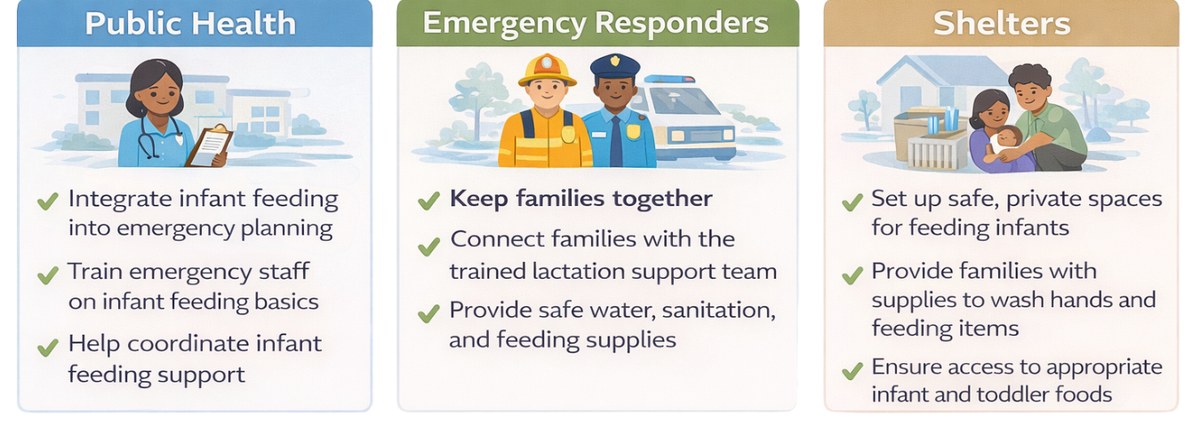
Handouts and resources
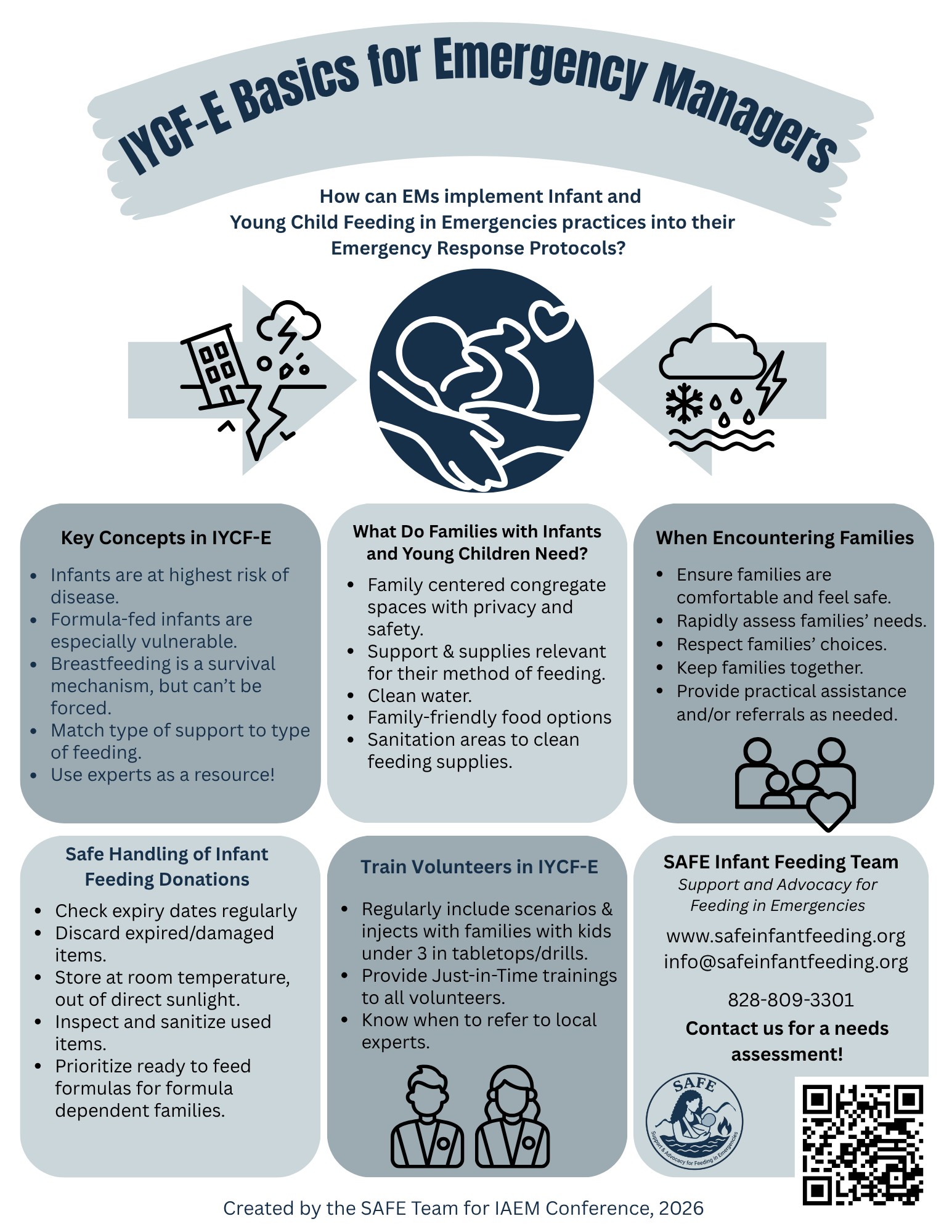
IYCF-E Basics for Emergency Managers
IAEM Conference Handout
One page, built for a briefing, a tabletop, or a shelter binder. Key concepts, what families with infants need, what to do when you meet them, how to handle donated feeding supplies, and how to train volunteers. Free to print and adapt.
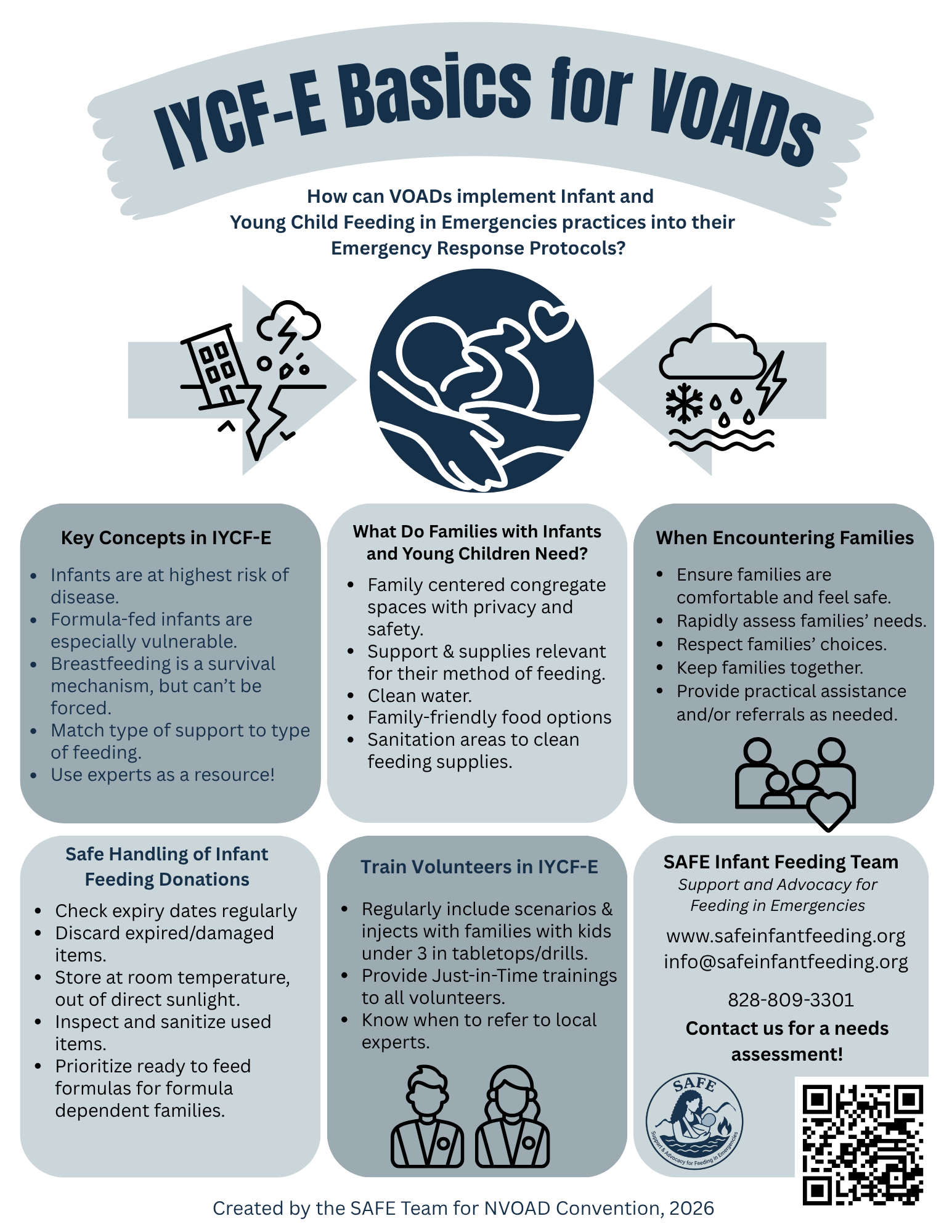
IYCF-E Basics for VOADs
NVOAD Conference Handout
Essential information to help all kinds of VOADs implement Infant and
Young Child Feeding in Emergencies practices into their Emergency Response Protocols.
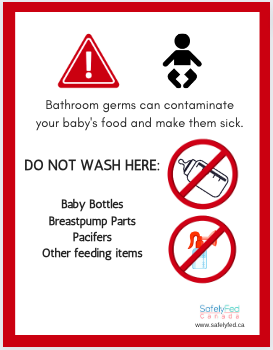
Shelter Signs
Ready-to-print or sample posters to be used in shelters and other congregate areas to support families with infants and young children in safe feeding and other needs.
Signs from multiple resources including CDC, SafelyFed Canada, USDA, TN, and others.
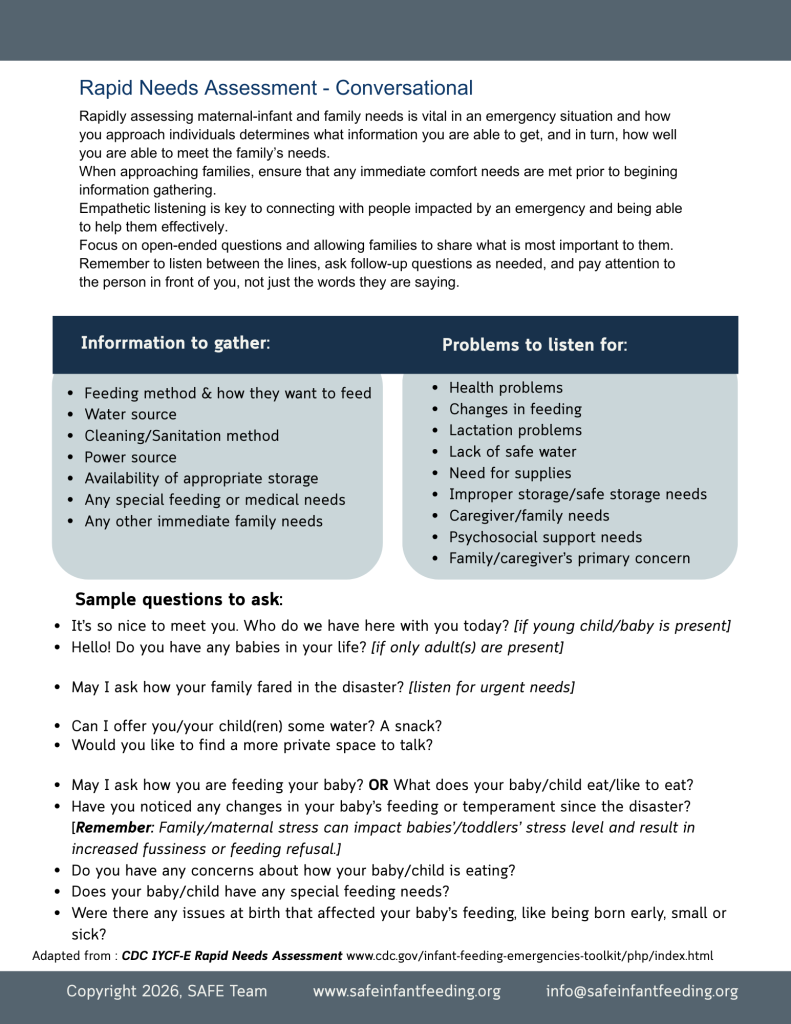
Rapid Needs Assessment, Conversational version
Learn about each family’s feeding needs before offering solutions. This document is a conversational way to learn about the feeding needs of families with young children.
Rapid Needs Assessment, Options
Learn about each family’s feeding needs before offering solutions. This page displays rapid needs assessments from multiple organizations for learning about the feeding needs of families with young children. Select the one best for your organization.
Safely Distributing Infant Feeding Supplies
Reference poster for organizations & volunteers about how to mitigate risk of donations and supplies for infant feeding.
Printable on 1 side of legal paper.
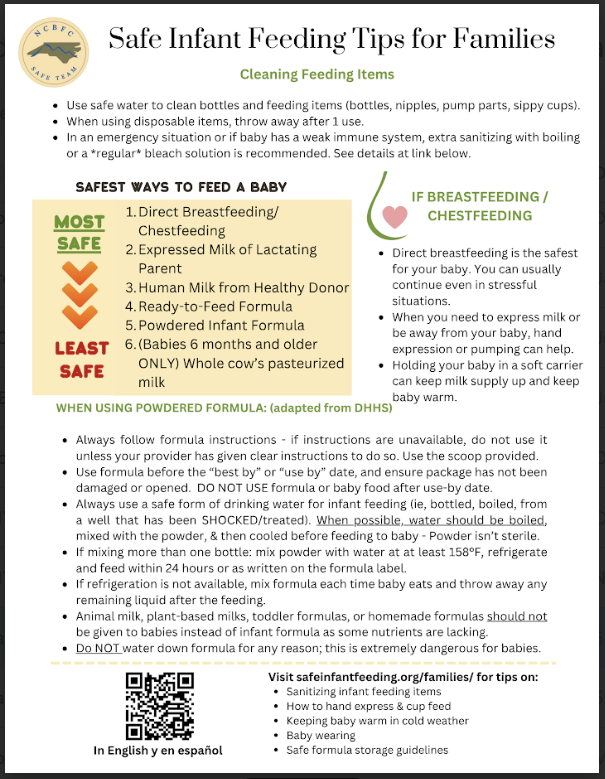
Infant Feeding Educational Poster for Families (English) – (Spanish)
Reference poster to educate families about safe infant feeding in emergencies. Can be posted in shelters.
Printable on 1-side of regular 8.5×11 paper.
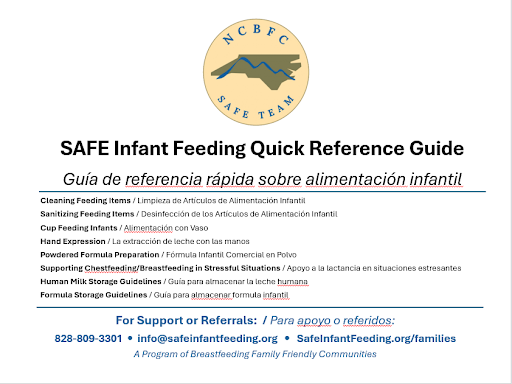
SAFE Infant Feeding Quick Reference Guide
Quick reference booklet to educate families about safe infant feeding in emergencies. Designed to be distributed to families during active response.
Text in English and Spanish.
Printable on 3 sheets (2 sided) of regular 8.5×11 paper or may be distributed electronically.
Please contact us to discuss co-branding or translation into other languages.
Looking for Other Resources?
Resources for VOADs
Resources for organizations that serve families with children under 3 years old.
Points of Distribution
Resources for groups that distribute supplies.
DCM & Direct Survivor Support
Resources for disaster case managers and other groups
Want Guidance? We Can Help.
Chat with Us About Your Org’s Needs
Talk with us about what your organization needs to ensure babies are fed safely in emergencies. Available services include:
- Technical support
- Training programs
- Tabletop exercises
- Policy guidance
- Other types of support

Scan to open this page on your phone