
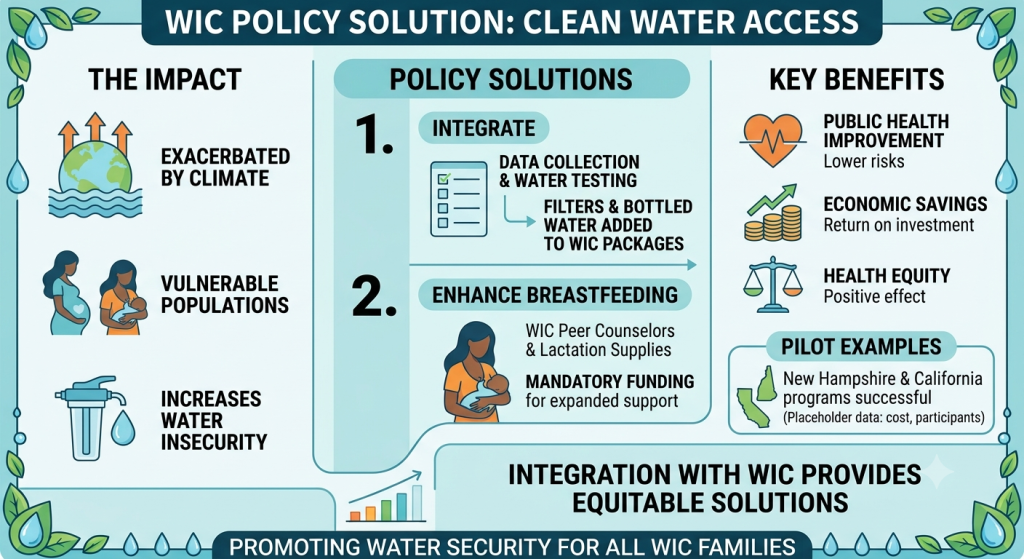
Dr. Cecília Tomori, one of the SAFE Team’s research partners at the Johns Hopkins Bloomberg School of Public Health, has a new policy analysis out in Maternal & Child Nutrition, co-authored with Cristina Watkins. The full paper is worth your time, but if you only have a few minutes before your next meeting with public health staff or a legislator, wherever in the country you are, here are the pieces to carry into the room.
One thing to keep in mind as you read: this is a WIC policy analysis, so WIC is the lens from start to finish. That makes it a strong case for one essential piece of the response, while leaving the bigger questions that implementers face for the rest of us to name. With that in mind, the core of it applies in every state: WIC should be authorized, insured, and resourced to support safe infant feeding during disasters, not sidelined when families need it most. The paper is clear that this is a gap in current federal policy, and it names closing that gap as the work ahead. We learned firsthand how real the gap is here in North Carolina, but the lesson is national.
A North Carolina story, a national gap
After Hurricane Helene, the North Carolina Breastfeeding Coalition was fielding calls about infants separated from mothers who were traumatized, displaced, or unaccounted for, about sewage everywhere, about no one knowing what to do. We asked a basic question: who is responsible for implementing the CDC’s infant feeding in emergencies guidance? We asked North Carolina WIC to step in, and we were told WIC was not insured to activate during an emergency.
That answer was not a misunderstanding on the state’s part. It is the policy gap, and it is not unique to North Carolina. The CDC guidance exists, but in most states no one is assigned, authorized, or covered to carry it out, and the one agency built to support infant feeding often cannot deploy. Tomori’s analysis confirms that direct WIC involvement in disaster response is not yet enabled under current law, and it makes the case for changing that, in North Carolina and everywhere else.
What to ask for
- Assign ownership. Ask your state to name who is responsible for implementing CDC IYCF-E guidance during a disaster. In most places that guidance sits on a shelf with no one accountable for it. This is the central gap.
- Authorize and insure activation. The wall we hit in North Carolina was that WIC was not insured to activate. Ask your state to resolve the authorization and liability coverage so the agency that supports infant feeding can actually deploy in an emergency.
- Operationalize the CDC IYCF-E Toolkit. Responders don’t have to invent a playbook. Ask that existing federal guidance be written into your state and local emergency operations plans so it is used, not stored.
- Build everyday resilience. Add water-insecurity screening within WIC, and increase funding for WIC breastfeeding peer counselors and lactation supplies. Resilience before a disaster is what makes response possible during one.
What to bring
- Reach. WIC already serves roughly 41% of all U.S. infants and is embedded in the communities most exposed to water insecurity and extreme weather, in every region of the country. The infrastructure is in place; what’s missing is the authority to use it in a disaster.
- Precedent, stated honestly. The Access to Baby Formula Act of 2022 shows Congress will act to make WIC more emergency-ready. Know its limits before you cite it: it lets USDA waive rules so families can still get their benefits and formula during an emergency, and it requires states to write “alternate operating procedures.” It does not authorize WIC staff to activate as disaster responders. That remaining gap is exactly what you’re asking to close. A useful question for any state meeting: what is in your state’s WIC alternate operating procedures plan, and does it address infant feeding activation?
- The cost argument. The analysis the paper draws on found that stronger WIC breastfeeding support, while requiring upfront investment, could lower total health-related costs by billions of dollars and reduce the federal Medicaid share, largely by preventing illness and early deaths. This is a fiscal case, not only a health one.
- Feasibility. Costed state pilots in different parts of the country already show that screening families and supplying filters works operationally at modest per-household cost. We are not asking anyone to take an untested leap.
Questions to keep on the table
Because the paper’s focus is WIC, a few things that matter on the ground sit just outside its frame. None of this is a knock on the analysis; it is the work that surrounds it, and it is worth naming when you are talking with public health:
- Who coordinates? WIC can be a vital partner and a supply point, but the paper doesn’t settle who owns and coordinates infant feeding in an emergency. Someone has to, and it may not be WIC.
- Who funds the rest? The paper funds WIC’s expanded role. It doesn’t speak to funding for breastfeeding coalitions, the specialized workforce, or the training that makes a real response possible. That investment still needs a home.
- Local staff are affected too. The people who staff local WIC are often living through the same disaster. Response needs surge support from unaffected communities, not only local activation.
- The workforce is bigger than WIC. Feeding babies in a crisis draws on IBCLCs, speech-language pathologists, and trained volunteers who don’t sit inside WIC.
- Relationships before the storm. Emergency managers need to already know the people who know how to feed babies. That contact list has to exist before a disaster, not get built during one.
The takeaway for a busy room: the CDC guidance exists, WIC has the reach, and Congress has already shown it will strengthen WIC for emergencies. What’s missing is the authority and coverage to let WIC activate, and someone assigned to own it. North Carolina families lived the consequence of that gap, and families in any state are one disaster away from the same. We now have peer-reviewed policy analysis backing a key piece of the fix.
Breastfeeding Family Friendly Communities has a companion piece on what water insecurity means for families and communities. Read it here: [LINK TO BFFC BLOG POST].
Read the full article (open access):
Watkins, C., & Tomori, C. (2026). Addressing the Impacts of Water Insecurity on Infant Feeding: Policy Solutions for the US. Maternal & Child Nutrition, 22(3), e70205. https://doi.org/10.1111/mcn.70205