
Read the report first: GAO-26-107790, Disaster Response: Lessons Learned in Supporting Mothers and Young Children
On July 28, the U.S. Government Accountability Office published a report on how this country supports mothers and babies during disasters. Senator Roger Marshall, M.D. and Senator Jon Ossoff asked for it. GAO worked on it for two years.
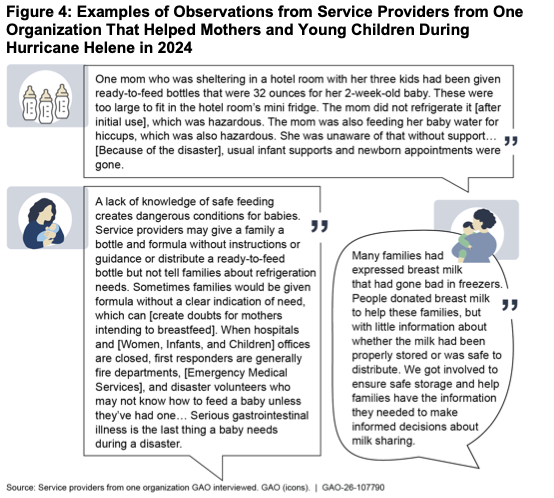
Turn to page 6. There is a figure titled “Hurricane Helene in 2024,” with three quotes in it.
All three are ours.
How we got into a federal report
A GAO analyst emailed our team address in September 2025, out of the blue. Her reason was specific: GAO had been working with FEMA, and “FEMA highlighted a training that the NCBfC SAFE team recently provided at the last VOAD conference.”
FEMA pointed the GAO at us.
That is what relationships do. Nobody at FEMA knew our names because we filed something. They knew us because our team showed up at a VOAD conference and taught infant feeding in emergencies to people who needed to know it. Blue-sky work, done in an ordinary week, with no disaster on the map. Months later it put a volunteer coalition in front of the United States Senate.
We answered eleven written questions during the October 2025 government shutdown, when GAO itself was closed and our interview had just been canceled. We sat down with them on December 8. When they asked who else they should talk to, we gave them our whole network: Baby2Baby, the Buncombe County Partnership for Children, La Leche League USA, the National VOAD Mass Care Subcommittee on Infants and Children, the National Pediatric Disaster Coalition, the Carolina Global Breastfeeding Institute, Johns Hopkins, and local WIC agencies. GAO went and met with them.
In February, GAO sent us the quotes they planned to use and asked us to check them. We did, carefully, as a team. They used our wording.
What we told them
A mother was sheltering in a hotel room with her three children. Her baby was two weeks old. Somebody had handed her ready-to-feed formula in 32-ounce bottles, which do not fit in a hotel mini fridge, so the milk sat out. She was also giving the baby water for hiccups. She did not know. There was no one to tell her, because the hospital was closed and the newborn appointments were gone.
Families opened their freezers and found the milk they had expressed for their babies had spoiled. Neighbors donated breast milk to help, with almost no information about how any of it had been stored. We stepped in so that families could store milk safely and decide about milk sharing with real information in front of them.
And underneath all of it, the plain fact: when the hospitals and the WIC offices are closed, the people who arrive are generally fire departments, EMS, and disaster volunteers, who may not know how to feed a baby unless they have had one. Serious gastrointestinal illness is the last thing a baby needs during a disaster.
That is in a federal report now, in our words, in front of the Senate.
You will also find us in Table 1, where GAO describes what an infant feeding sanitation kit is: food-safe bleach, bottle brushes, dish soap, and instructions for making water safe and storing milk. That is our kit. And on page 3, where one unnamed organization provided over 7,000 of them so families could feed their babies without power or safe water. That is our number. We tracked every one.
What the report does not say
We are glad this report exists. We are proud to be in it. And we are going to be honest about its edges, because babies do not benefit from our politeness.
It makes no recommendations. None. Not to FEMA, not to HHS, not to USDA, not to Congress. Two years of work, and nobody is asked to do anything. Nothing enters FEMA’s recommendation tracker, so nothing gets followed up.
The word “volunteer” does not appear anywhere in it. The 7,000 kits are in there. The people who assembled them on their own time, at their own expense, are not.
WIC does not appear at all. Neither does donor human milk, or milk banking, though we moved more than 250,000 ounces of it, equivalent to about 83,000 infant meals.
And this sentence is in the report, unchallenged: that these needs “may not always be considered because mothers and children are a small population compared with the general population of disaster survivors.”
Infants have the narrowest margin of any group in a disaster zone. Being a small population is not a reason to plan for them last. It is the reason they go first.
What happens in the next state
GAO found four examples in FEMA’s own records, across all of 2024, where FEMA fulfilled a request for assistance for mothers and young children. Four, across Beryl, Debby, Helene, and Milton.
Western North Carolina got lucky. Our coalition happened to exist. We happened to have each other’s cell numbers. Some of our people happened to be able to stop earning a living for two months.
Every baby in America is exactly as safe in a disaster as the nearest volunteer happens to make them.
We know how safe that is. We ran the volunteers.
The ask
In 2006, thirteen months after Katrina, Congress passed the PETS Act. It did three simple things. It put the word shall in the law, requiring state and local emergency plans to account for pets and service animals. It tied that requirement to FEMA preparedness money. It made the costs reimbursable. It passed with overwhelming bipartisan support, because nobody wants to vote against rescue.
Give the babies what the pets got.
- A shall in federal law requiring state and local disaster plans to account for infant and young child feeding.
- An owner. FEMA, HHS, or a desk between them, so the next coalition chair can find a person instead of a hole.
- Lactation support and safe feeding supplies explicitly eligible for disaster assistance. A bipartisan bill tried this in 2022 and died in committee.
- Let WIC activate in a disaster.
- Infant feeding in the state plan. Today in North Carolina, as best anyone who has checked can tell, roughly zero counties have a dedicated plan.
- Funding for the blue-sky work, the ordinary Tuesday before the storm, when the training and the relationships and the supply lines actually get built.
None of this is a moonshot. It is an administrative ask. Somebody can slip it in.
Read it yourself
Page 6 says “one organization.” One organization, run out of a group text, is not a national plan for feeding babies in a disaster. It is a warning.
Starting this month we are publishing Voices From the Storm, the full account of the Helene response, one post at a time. Subscribe to follow it.
The SAFE (Support and Advocacy for Feeding in Emergencies) Team is a national volunteer network of infant feeding and perinatal specialists, a project of Breastfeeding Family Friendly Communities in collaboration with the North Carolina Breastfeeding Coalition. Love Anderson chairs the North Carolina Breastfeeding Coalition and serves on the board of the U.S. Breastfeeding Committee.