
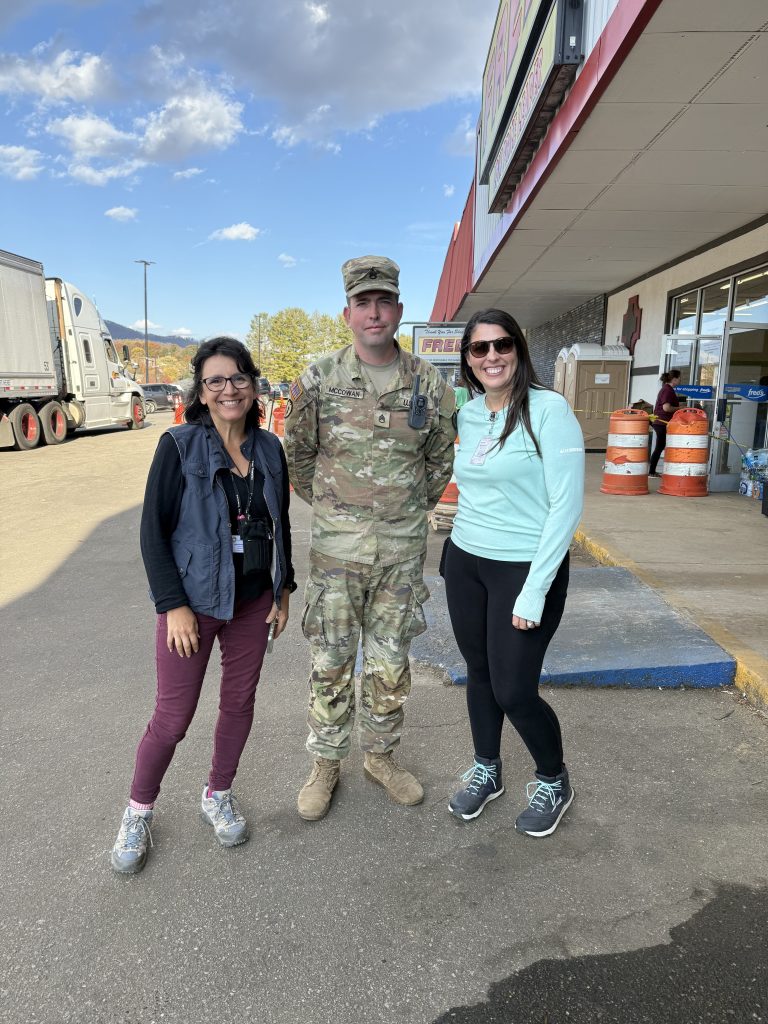
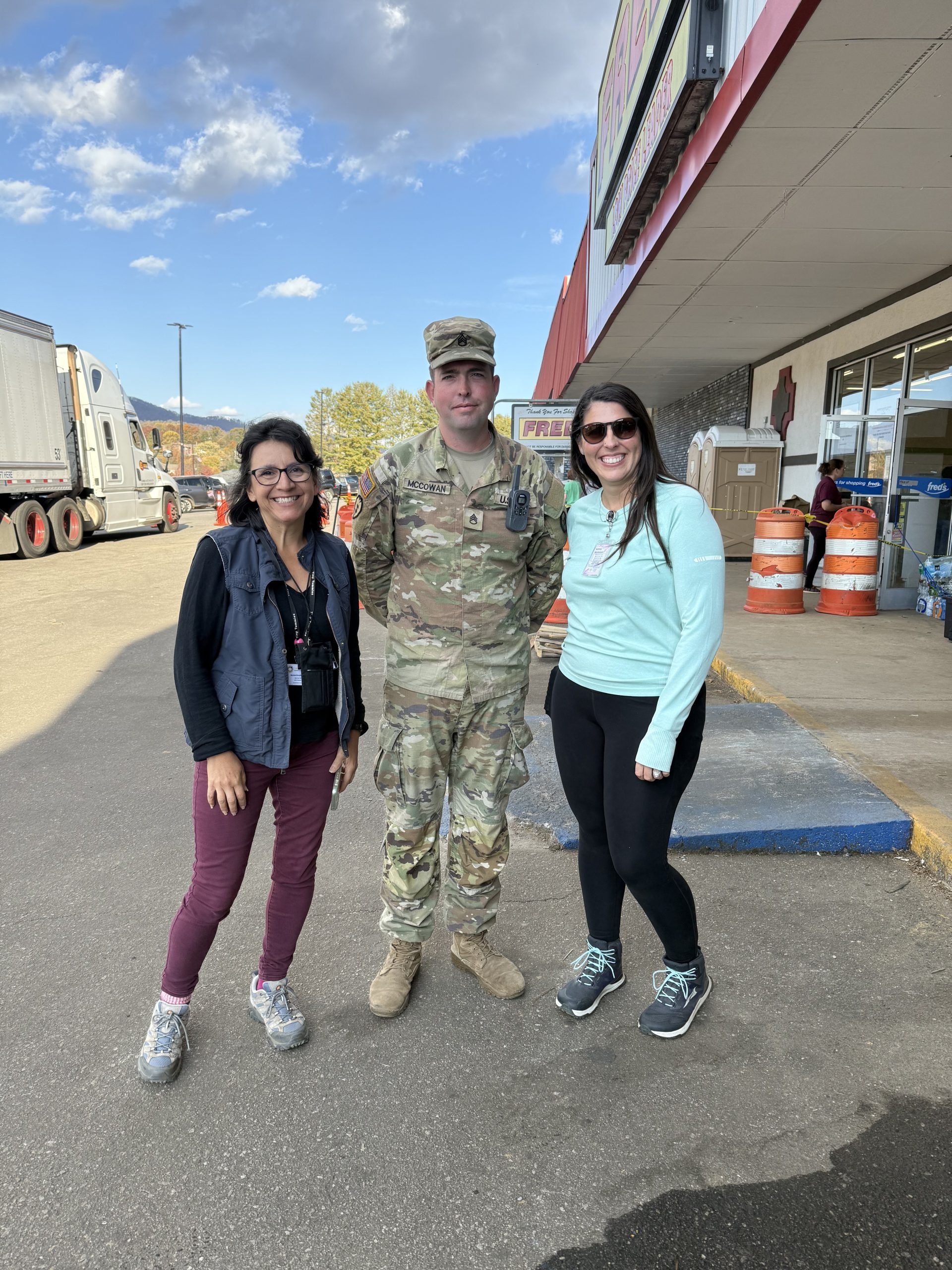
Fred’s Distribution Site, Burnsville, North Carolina, October 2024. Cameron McCowan was a Staff Sergeant during the Helene response and now serves as a Sergeant First Class in the North Carolina National Guard. This is his account, in his own words.
In mid-October 2024, I had just completed approximately seven days of search-and-rescue operations in Haywood County, North Carolina, serving as a swift-water technician with Cherokee Fire and Rescue in the aftermath of Hurricane Helene. Much of that time had been spent conducting rescue operations from a boat in communities affected by the storm.
As our fire department’s deployment came to an end, my North Carolina National Guard unit was still looking for soldiers to relieve personnel who had been deployed to Burnsville shortly after the hurricane. Many of those soldiers had been working tirelessly for more than a week, and they needed relief. Having completed my assignment with Cherokee Fire and Rescue, I volunteered to deploy.
I reported to Morganton, where we completed our mobilization requirements, administrative processing, and assignments. On October 17, I arrived in Burnsville with approximately 17 other soldiers to conduct what the military calls a relief in place, replacing the soldiers who had been operating there.
I was assigned as the Noncommissioned Officer in Charge (NCOIC) of Fred’s, a point of distribution serving the residents of Yancey County. I met the lieutenant overseeing the operation, and together we began evaluating the mission, the personnel, and the significant logistical challenges facing the site.
It was immediately apparent that Fred’s had been established under extraordinary circumstances. During the initial days following the hurricane, emergency responders and volunteers had done whatever was necessary to get relief supplies into the hands of people who desperately needed them. The operation had been built in the midst of a genuine crisis, and understandably, organization and efficiency had sometimes taken a back seat to the urgency of getting supplies where they were needed.
By the time we arrived, the situation was beginning to change. Roads were reopening, communities were becoming more accessible, and residents had greater opportunities to travel for essential supplies. Our responsibility was to adapt the distribution operation to meet those changing conditions.
Thousands upon thousands of pounds of donated supplies had accumulated at Fred’s, with additional deliveries arriving almost daily. We were essentially managing two operations simultaneously: receiving incoming relief supplies and organizing those supplies for distribution to the community.
Much of the material arrived on pallets, with little organization. We didn’t want families already dealing with unimaginable hardship to have to search through stacks of supplies to find what they needed. Our goal was to develop a more efficient, organized, and accessible distribution system.
My responsibility was to manage the soldiers assigned to the mission, anticipate the next day’s challenges, and ensure that everyone was fed, rested, and prepared to continue. We worked tirelessly to improve the operation, making adjustments and implementing changes each day.
One thing I remember vividly is how little motivation the soldiers needed. In many military operations, maintaining morale and motivation can be a significant leadership responsibility. But Hurricane Helene was different. This was their state. These were their communities, their neighbors, and in many cases, their own families who had been affected. Everyone wanted to work, and everyone wanted to make a difference. It was one of the most remarkable displays of selfless service I have experienced.
Throughout our deployment, we interacted with countless agencies, nonprofit organizations, volunteer groups, community members, and military and civilian leaders. Each brought different perspectives, resources, and ideas to the operation.
But I distinctly remember when Ashley and Norma from SAFE Infant Feeding arrived.
There was something immediately different about their approach. They understood their mission, knew what expertise they brought to the table, and were ready to contribute. They weren’t there simply to observe the operation or suggest how we should manage the entire distribution center. They had identified a specific, critical need, and they were prepared to address it.
They got straight to work.
Ashley and Norma began examining the infant feeding supplies, identifying expired or damaged formula, explaining the risks associated with those products, and helping us understand the specialized needs of families feeding infants during an emergency. They spoke directly with families about their feeding needs and the difficulties caused by the loss of running water and electricity. I also remember our soldiers helping them load the expired or damaged formula for removal from the site at the end of their workdays.
Their knowledge and initiative brought a level of attention to an area of the operation that, until then, I had not fully appreciated.
I remember sharing with them that I was a father to a young son whom my wife was breastfeeding.
Their work immediately made me think about my own family. I recalled the resources, guidance, and support that my wife and I had relied upon while navigating breastfeeding. I remembered trips to Walmart looking for supplies, using nipple shields, and consulting lactation specialists to better understand and support our son’s feeding needs.
And I began asking myself a simple question: What would my wife and son have done if we had been placed in the same circumstances as the families affected by Hurricane Helene?
What if we had no running water, no electricity, limited transportation, and no reliable way to obtain the supplies or professional support we needed?
That realization stayed with me.
As the NCOIC of Fred’s, I had been consumed with the broader mission: managing personnel, organizing supplies, coordinating deliveries, maintaining accountability, and making sure the operation functioned effectively. I knew that we had formula, diapers, and other infant supplies available. But I had not given the complexities of safe infant feeding the level of attention they truly deserved.
It wasn’t because those needs were unimportant. Rather, it was a reminder of how easily even critical needs can be overlooked when responding to a disaster of this magnitude.
During a major emergency, there are seemingly endless priorities competing for attention: food, drinking water, medical supplies, oxygen, fuel, electricity, shelter, communication systems, transportation, and countless other necessities. We work to account for everything, but even experienced responders can develop blind spots when the scope of a disaster becomes so overwhelming.
Ashley and Norma helped us recognize and address one of those blind spots.
Their presence was an enormous relief. They possessed specialized expertise that we did not, and they were able to take ownership of an important part of the relief effort while allowing our soldiers to continue managing the broader distribution mission. It was an excellent example of how specialized civilian organizations and military personnel can complement one another during disaster response.
Each evening, we participated in operational debriefings with leadership responsible for the broader Yancey County response. These meetings provided an opportunity to account for personnel, supplies received and distributed, operational accomplishments, and challenges encountered throughout the day.
I recall asking Ashley and Norma for a recap of their work: how many families they had assisted, how many were still without water or power, and how many needed additional education about safe infant feeding in disaster conditions. I included their information in my field notes, and we made a point of highlighting SAFE’s work and the value their team brought to our operation during our daily briefings.
Their efforts were not simply another volunteer activity taking place at Fred’s. They were addressing a genuine public health concern, helping families navigate an extraordinarily difficult situation, and improving our ability to serve the community.
Looking back, I am grateful that Ashley and Norma recognized the need and took the initiative to act.
I have responded to numerous emergencies throughout my career in public safety and military service, including Tropical Storm Fred, the Gatlinburg wildfires, and Hurricane Helene. Each disaster has reinforced how important coordination, adaptability, and cooperation are to an effective response.
But this experience taught me something more specific.
We cannot assume that having infant supplies available means we have adequately addressed the needs of families feeding young children. Those families may require specialized knowledge, practical assistance, safe supplies, and guidance that general emergency response personnel are not necessarily trained to provide.
The people responding to a disaster cannot be experts in everything. That is precisely why organizations like SAFE Infant Feeding are so valuable.
My hope is that experiences like ours at Fred’s help demonstrate the importance of incorporating trained infant and young child feeding specialists into emergency preparedness, disaster response planning, and relief operations.
Because ultimately, a successful disaster response is not just about how many supplies we distribute or how many missions we complete. It is about recognizing the needs of the people we serve, including those needs we may not have initially understood, and bringing together the right people to meet them.
Ashley and Norma helped us do exactly that.
Voices from the Storm
Previous: 8. The Day It Wasn’t a Ten-Day Project
Next: 10. The Day After the Guard Left
See all thirty-four pieces