
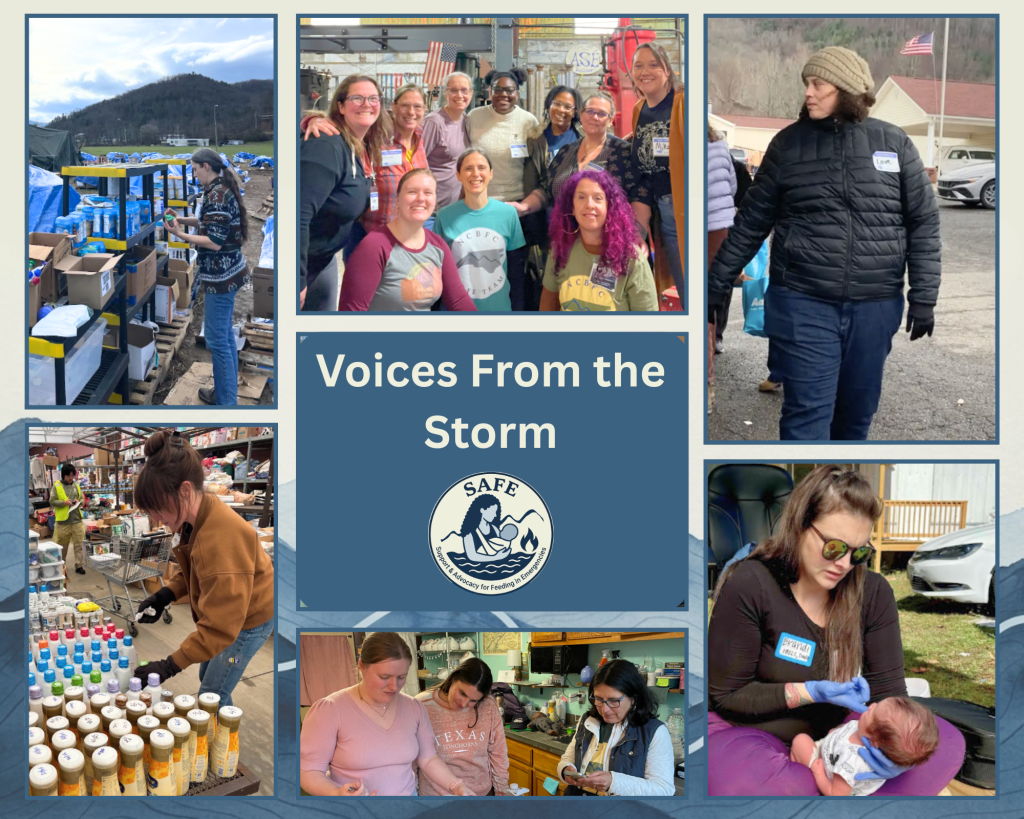
A short note from Love: I was not at Sacred Heart. I was three hours away on the phone, running numbers, writing grants, trying to keep the whole thing from falling apart. The daytime work, the actual meeting of a mother and a baby in the cold, was done by people braver and more skilled than I will ever be. This series is theirs. I am going to get out of the way and let you meet one of them.
In the first weeks after the storm, the instinct of the whole country was the same. Send formula. Truck in pallets of it, cases of it, cans stacked to the ceiling of every church and fire station and food line in the mountains. It is what disaster response knows how to do. A baby needs to eat, so you send the thing babies eat. Nobody stops to ask whether it is the right thing, because asking feels like a luxury you cannot afford when the water is gone.
Norma Escobar asked.
Norma is a lactation consultant who speaks Spanish, and she had done this kind of work before, in places where hurricanes are not a surprise but a season. She knew things the American system does not teach. She knew that in a disaster the open cans of formula sitting in the sun go bad, and that somebody has to walk the food lines with a black marker and throw them out before a baby gets sick from them. She knew that the pallet is the easy part, and the family is the hard part. And when she got to Sacred Heart, a small, mostly Spanish-speaking parish up in Burnsville where families were living in campers through an arctic winter, she noticed something that the pallets of formula had completely missed.
The formula was not moving. It sat there, untouched, while everything else ran out. Because at Sacred Heart, almost everyone was already breastfeeding. It was simply what mothers did. The cans the rest of the country had rushed to send were answering a question these families had never asked.
What they actually needed was heat. They needed clean water. They needed someone who could sit with a tired mother in her own language and say, you are doing it right, your body is still working even when everything around you has stopped. They needed a lactation consultant, not a delivery truck. And the one thing the disaster machine had not thought to send was the one thing that mattered most, which was a person like Norma.
So that became the work at Sacred Heart. Not handing out product, but protecting something that was already there and fragile. A mother under that much stress can start to doubt her own milk, can be told by a well-meaning stranger with a free can that she should probably switch to formula feeding just to be safe, and in a week the most reliable, sterile, temperature-proof food source in the entire disaster zone can quietly disappear. Norma’s job was to make sure that did not happen. To keep the breastfeeding families breastfeeding, in a place where that was the norm, precisely because the flood of good intentions could have washed it away.
There is a whole policy argument buried in that pile of unused cans, and I want to name it plainly, because Norma taught it to me without meaning to. The reflex to lead with formula is not neutral. In a community where breastfeeding is the norm, leading with formula can do harm. The right response is not a product. It is a skilled, trusted, culturally fluent human being who knows the difference. That is not something you can pre-position on a pallet. It is something you have to build, ahead of time, by training and paying and valuing people who can do what Norma did.
“Everyone breastfeeds here,” the note from that day said. Four words. It should have reorganized how we think about feeding babies in a disaster. It reorganized how I think about it. And it came not from a policymaker or an agency, but from one consultant who spoke the language, walked the line, and paid attention.