
Hurricane Helene made a devastating impact on the southeastern United States in late September 2024, with its effects felt from Florida’s Gulf Coast to the Appalachian Mountains. Landfall occurred in the Big Bend region of Florida on September 26th. The storm then made its way through Florida, Georgia and South Carolina before arriving in the western part of North Carolina and eastern Tennessee on September 27th. For a timeline of how the events unfolded click this interactive story map.
More than 200 people were killed by Hurricane Helene across six states, with most of the deaths occurring in North Carolina. This makes Helene the deadliest hurricane in the contiguous U.S. since Katrina in 2005. An estimate of $78.7 billion in damages places Helene as the seventh-costliest U.S. tropical cyclone, with records dating back to 1980.
The highest rainfall was recorded in western North Carolina, where totals reached over 30 inches (76 cm) in a three-day period. This extreme rain, combined with a pre-existing weather system, led to historic flooding and mudslides. Initial estimates indicated over 42 trillion gallons of water fell, equivalent to the flow of Niagara Falls for over 1.75 years. The French Broad River in Asheville, NC, reached a record crest, surpassing its 1916 record by over 1.5 feet (almost half a meter).
Entire communities were largely destroyed by mud-choked floodwaters. In the middle of this devastation, two local lactation consultants, Brandi Harrison and Jayne Carpenter, responded to the needs of their community. Breastfeeding, the safest way to feed babies, felt precariously fragile in the middle of the tide of uncertainty: “will my milk dry up?” “Can I breastfeed even if I have not eaten in 3 days?” “Am I hurting my baby?” – it became apparent that breastfeeding families needed reassurance that they had everything their babies needed and to empower them to continue breastfeeding. The normal supports were paralyzed – WIC agencies closed, local providers displaced, many roads impassible.
Brandi and Jayne also saw the needs of the parents who had been expressing human milk or depending on formula or donated human milk. They quickly recognized potential risks associated when babies are not exclusively breastfed – since there was no safe water for mixing formula or cleaning feeding equipment, no power for refrigeration and storage. Clean water was not restored to Asheville until 53 days after the event. Families did not know where to turn for help. All these families needed education and supplies as well as support to keep their babies safe.
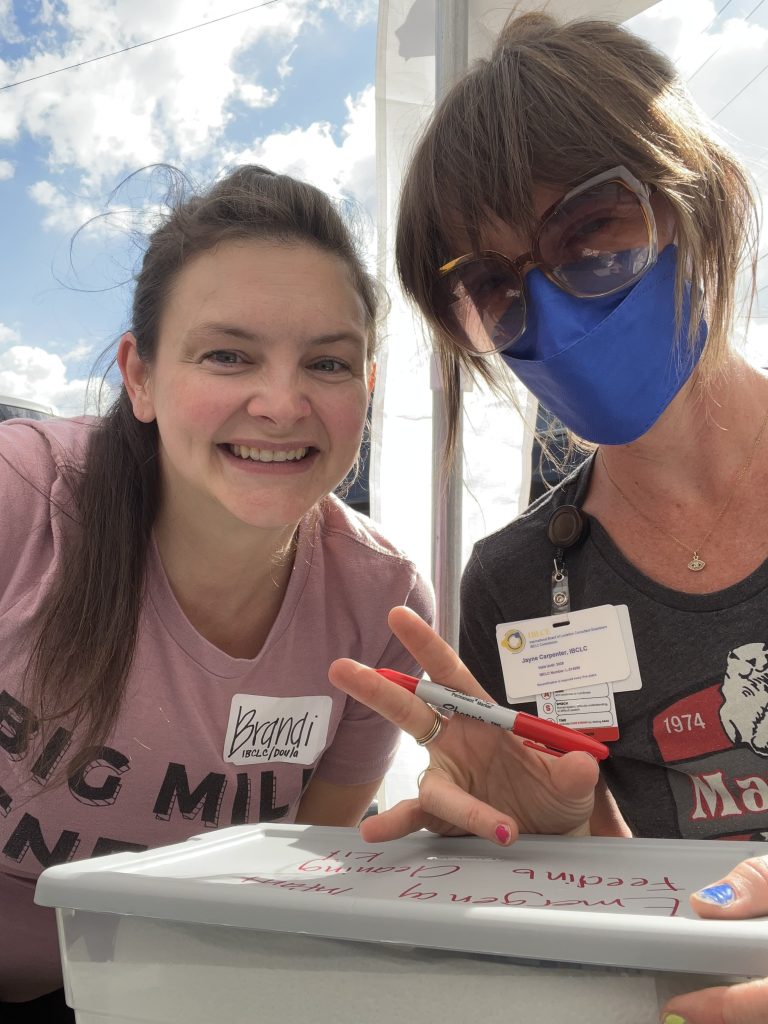
The needs were overwhelming, so these two pioneers called for help. They called Love Anderson, President and CEO of Breastfeeding Family Friendly Communities (BFFC) and chair of the North Carolina Breastfeeding Coalition (NCBfC). Brandi, Jayne and Love all served on the NCBfC board, which is how they knew each other and had each other’s contact information when it mattered.
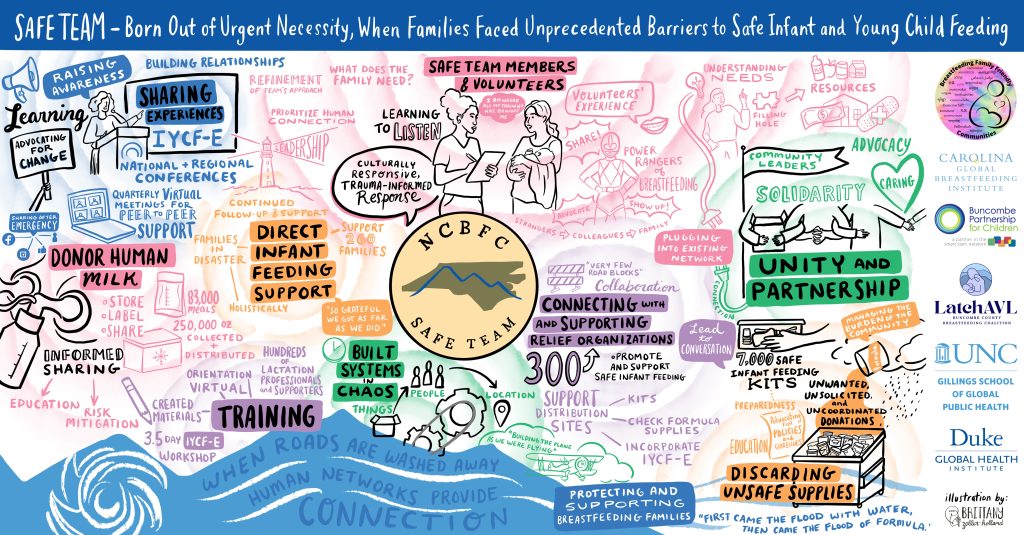
The first call to action went out at a North Carolina Breastfeeding Coalition meeting the Monday after the storm hit. Love brought people and funding together. BFFC provided the institutional infrastructure to make it happen, and NCBfC provided its social media and donated significant funds. SAFE was cofounded by NCBfC, BFFC and the Asheville Breastfeeding Coalition. In the beginning it barely existed: it was a group of volunteers who all threw their energy in, and it was not yet clear which organization held the work. Around day ten, the group gave itself a name: Support and Advocacy for Feeding in Emergencies. The SAFE Infant Feeding Team was launched in 2024 in response to gaps exposed during Hurricane Helene in Western North Carolina.
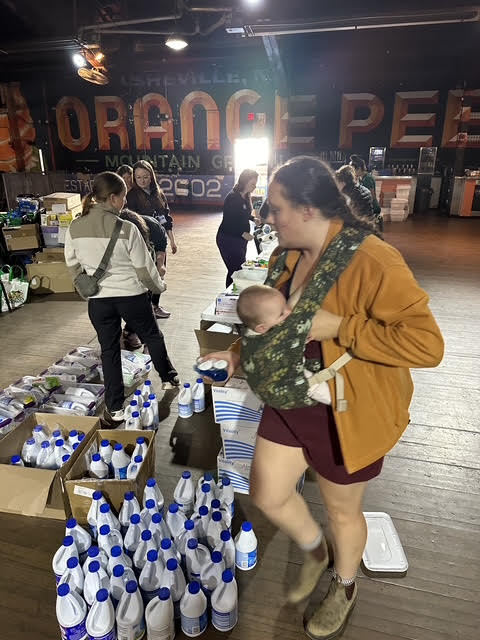
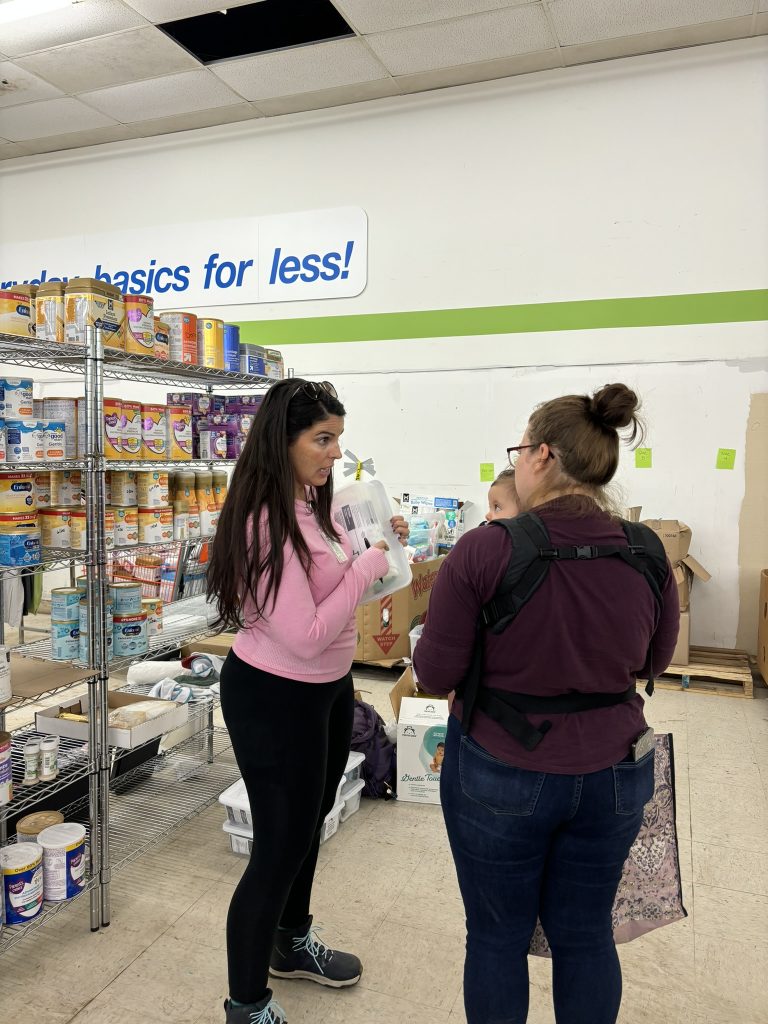
The first team of 23 infant feeding specialists were deployed October 6 in Asheville – They had to stay up to two hours away and bring in their own food and water in order to not take up the limited resources that were available in the immediate disaster area. Over the next five months, hundreds of volunteers from Breastfeeding Family Friendly Communities (BFFC) and the North Carolina Breastfeeding Coalition stepped in to fill critical needs for infants and caregivers who were reeling from the effects of the storm. Volunteers from across the United States included nurses, doctors, students, lactation consultants, peer counselors, nutritionists, speech pathologists, midwives and doulas who all showed up ready to help. They provided infant feeding sanitation kits, lactation support, education on safe formula feeding to families and training for disaster response staff and distribution centers as well as helping these sites sort and dispose of unsafe feeding supplies.
Over the course of the Helene response, 376 volunteers answered the call, more than 7,000 infant feeding sanitation kits went out, and more than 250,000 ounces of human milk moved, equivalent to about 83,000 infant meals.
Our team was created and tested by the waters of Hurricane Helene. We navigated countless challenges and, in the process, made many mistakes. These weren’t failures, but powerful lessons that taught us the importance of adaptability, resilience, and a deep understanding of the obstacles we’d face. Our goal is to share these experiences with you, so you can learn from our struggles and avoid our missteps. By offering you the essential skills and knowledge we’ve gained, we aim to ensure that you are better prepared for tomorrow’s emergency, today.
Our Founders
SAFE was started by Love Anderson, Brandi Harrison, and Jayne Carpenter. It would never have become a full-fledged, sustainable organization without every one of its ten founding members:
- Love Anderson, community health worker and national advocate
- Jayne Carpenter, IBCLC in western North Carolina
- Melinda Delisle, clinical nutritionist and childbirth educator
- Norma Escobar, bilingual IBCLC
- Rachel Fann, CLC and speech-language pathologist
- Corey Graywood, doula and parent advocate
- Brandi Harrison, IBCLC and doula
- Ashley Mickelson, IBCLC and speech-language pathologist
- Tashery Risner, doula and lactation supporter
- Paris Laliberte, who helped get SAFE started before stepping back from the board
Meet the current team on our Board of Directors page.
Where SAFE Lives Today
SAFE emerged from Breastfeeding Family Friendly Communities and the North Carolina Breastfeeding Coalition. NCBfC’s leadership was foundational, and BFFC gave the work its institutional infrastructure. As the work grew, the questions became how to sustain it financially and where it would permanently live. The SAFE Infant Feeding Team is now a project of Breastfeeding Family Friendly Communities, in collaboration with the North Carolina Breastfeeding Coalition, because it has become a national movement that reaches beyond the scope of a state coalition.
Since Helene, the SAFE Team has consulted on emergencies in Virginia, Texas, California and Wisconsin.
Today, SAFE has transitioned to building capacity nationwide through:
✅ Training and technical assistance for healthcare providers, lactation and childbirth professionals, first responders, community health workers, volunteers, public health professionals and anyone invested in emergency preparedness and response for safe feeding of infants and young children.
✅ Culturally responsive lactation and formula feeding support.
✅ Templates and materials for education.
✅ Advocacy for policies that center infants and families in disaster planning.
✅ Networking opportunities.
✅ Mentoring and emotional support to those responding to active emergencies.
View our Infant & Young Child Feeding in Emergencies Trainings (IYCF-E) here.
We Have a New Logo!
Check out our new logo! This will be a gradual change and we will be transitioning to the new logo over time.
Link to logo file to use at smaller sizes: SAFE logo for smaller sizes (PNG)
