
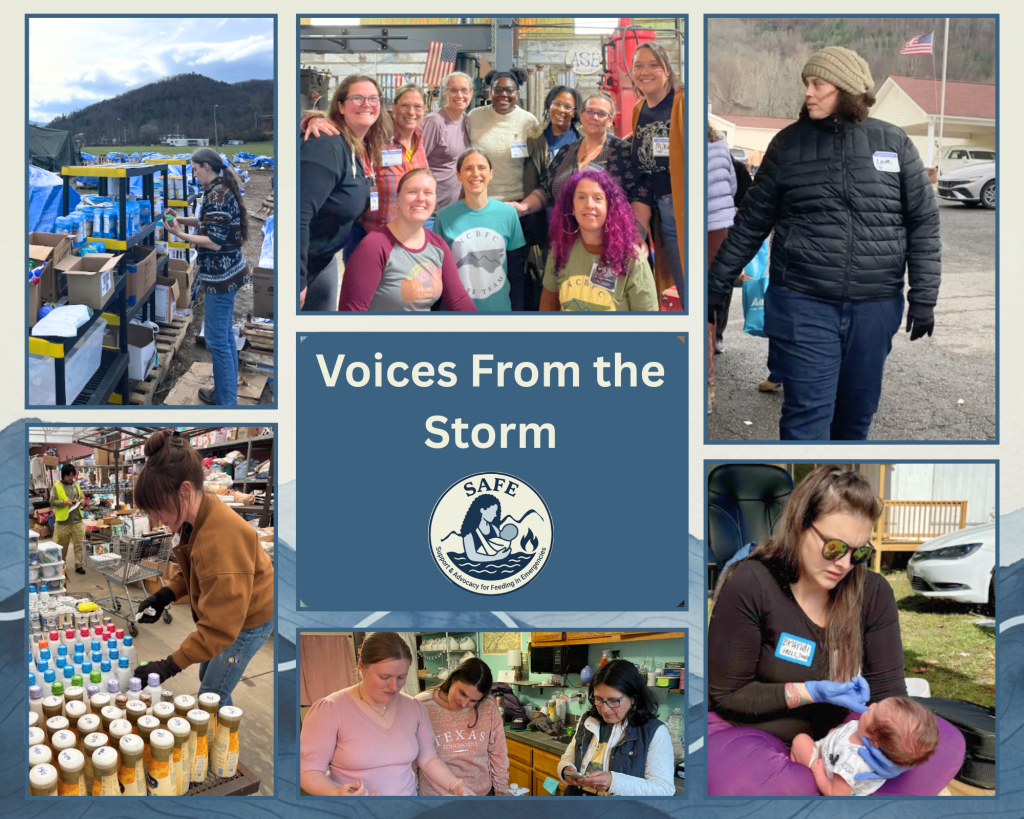
In many ways this project began almost a decade ago, and it did not begin with me. For years the folks in Western North Carolina had been organizing and connecting. Coalition meetings every other month. Child care centers and hospitals and health departments and employers, brought along one conversation at a time. The slow, unglamorous, entirely unphotogenic work of becoming a breastfeeding family friendly community, done with no disaster anywhere in sight and no expectation of one. The money for that work has always come in fits and starts, a grant here, a project cycle there, never steadily, and right now there is none at all. It has never once made the news. And it is the only reason any of what followed was possible.
Here is what a decade of it looks like on the ground. On October 16, 2024, nineteen days after the storm, a woman in Asheville finally got her power and her internet back. She did not have to build a network that morning. She already had one. So before she did anything else, she sat down and wrote to forty three people:
I hope you all fared ok in this awful disaster. My apologies in the delay of getting in touch with you! My area is a nightmare and I just received power and internet back so I can reach out and let you know if you don’t already, what amazing work has been going on in Buncombe and the surrounding counties!! I would like to brainstorm how we as the Buncombe Breastfeeding Coalition can jump in and connect with NCBC, Brandi, Georganna, Jayne, and Marcelle on this work. Please join us for an important meeting online 10/22 at 1pm. Love Anderson will be joining us from NCBC to walk us through phase II of the effort.
Read the last line again. Love Anderson will be joining us. I was the guest. Natasha Bowden called that meeting, and I was on her agenda.
She is the Shaping Buncombe Coordinator and the Breastfeeding Friendly Community Initiative Lead Consultant at the Buncombe Partnership for Children, which is a long title for the thing this entire series has been arguing about. Her actual job, before any hurricane, was making Buncombe County a breastfeeding family friendly community. The coalition she runs already existed. It already met every other month. She flipped it to monthly, pointed it at infant feeding in emergencies, and pulled the region into a room. That is what preparedness looks like. Not a warehouse. A woman with a mailing list and a standing meeting.
She opened that first gathering by naming exactly who was in it, that it would be really great to say, wow, we’re all back here after this insane disaster, that some of the people on the call had been working hard to make sure mothers were connected and getting what they needed while others had been trying to figure out how to survive and regroup, and that they were a hybrid meeting of people who had been busy on the ground and people just stepping in with fresh energy. Survive and regroup. She was in both categories at once, because while her own county was still dark she was driving to distribution sites in Yancey and Madison, and she was watching something nobody had named yet. She had been to all of them, she told us, so she knew the crap that was happening, which was that all the water was sitting out in the hot sun in plastic. And then she told us what she had started doing about it, and it changed how our whole response worked:
As I was hopping around all these distribution sites, I’ve been pulling certain materials to each one of the sites instead of us being an everything village all just sitting there. So I started taking medical supplies to the medical tent, taking any religious supplies to the churches, taking any baby supplies to one specific spot. Just trying to figure out how we could have more seamless distribution instead of it just sitting there wasting space with no one taking care of it. So I started that in Yancey and Madison.
That is the hub model. She does not claim she invented it. What she says is that using a hub model instead of the chaos that was happening was her idea, and she worked it out alone, in a car, sorting other people’s donations by hand across two counties. One of our researchers stopped the meeting to ask her when she had started the idea of the hubs, and I said out loud, on that recording, a sentence I stand by two years later: Natasha used the right words for me, because I’m using the wrong words.
She kept doing that. She kept handing us language and infrastructure we did not have. She brought in Sistas Caring 4 Sistas, nine doulas and a lactation consultant, and proposed pairing them with our volunteers for home visits, because she knew which families would open a door for whom. She built the Buncombe resource spreadsheet. She organized lunch and learns for health plans and WIC offices. She raised twenty five hundred dollars for the SAFE team from a managed care company in November, when we had no money at all. She routed Buncombe WIC’s request for forty sanitation kits for families living in tents and campers. She covered our email over Thanksgiving so the rest of us could stop. And when the winter closed in she was the one who asked the question none of us had thought hard enough about, which was how you cold sanitize and hot sanitize in a camper with limited everything, because when the distribution sites started, everybody was giving out tons of gas and tons of propane, and now that that reality had hit it was obvious we needed cold sanitation training for everybody living in campers and tents across Western North Carolina.
She also saw, before almost anyone, what this response was going to mean beyond our mountains. Five weeks after landfall, in a coalition meeting, while her neighbors were still without water, she told the room that this was groundbreaking, that once it was done with FEMA and once it had been reported to the White House and everywhere around the United States, it would be a model that could save infant lives around the world but especially in this country, and that she felt we all had a responsibility to make it a success. Five weeks. I am writing a policy series about exactly that two years later, and she said it on a Tuesday.
And she never let us shrink the mission. In February, chairing the meeting where we handed the work back to her county, she stopped the room:
I want to keep reminding everybody, this is not just infant feeding. This is children with mental and physical disabilities. This is elderly. This is adults with physical and mental disabilities. This is any vulnerable populations. The name of this is very specific. It’s not about just infants. It’s about any vulnerable person in a disaster.
That same day she gave the SAFE team the assessment I keep in my chest. That all of them had been trying to survive, and then here we came, and she loved it. That everybody who had been part of this hurricane had been stretched, and having this, being able to create a model, had been lovely, and had opened people’s eyes to what needs to happen. That if you went out to the distribution sites now you could see what they had learned, which was do not keep it out in the freezing rain, and do not keep your plastic bottles out in the hot sun and then give them to families to feed their babies with, and do not have expired formula. That last one, she said, was the big one, man, because the first couple weeks of the disaster that was what was really happening out there.
There is one more document I want to put in the record, because it is the plainest proof of what I actually believe. Our own transition plan, written in October 2024, has a phase four, and phase four is titled Full Transition to Natasha’s Team. The whole architecture of our response assumed that the outsiders would leave and the local coalition would carry it. That is not humility, it is the only version of disaster response that works. The handoff took longer than the plan said, the way everything did, but the principle held, and it is the principle I would write into federal law tomorrow if they let me: the people who were there before the storm are the response. Everyone else is a guest.
I have spent two years telling audiences that no one owns infant feeding in an emergency in this country. That is true at every level of government. But it was not true in Buncombe County, or Yancey County, or Madison County, in the fall of 2024, because one woman with a coalition and a mailing list decided it was hers. She got her internet back and called a meeting. Everything else is downstream of that.
Voices from the Storm
Previous: 5. I Will Be There By Eight Tomorrow Morning
Next: 7. The Freezing Car Line
See all thirty-four pieces