
Session 1 – Homework Summary
<< Back to main Session 1 page
Here is the whole assignment, step by step. Jump straight to any step below, or download the identical material as a printable handout.
- Conduct Community Assessment
- Review CDC RNA & SAFE RNA (rapid needs assessments)
- Review Trauma-Informed Care Reference Sheet
- Choose a stress management technique to try or practice.
- Complete the evaluation for this session
Additional handouts and resources are at the bottom of this page.
1. Community Assessment
The questions below are the community assessment. Answer them whichever way suits you — on paper, in your own notes, or straight into the Google form. It is the same set of questions either way, so you only need to do it once. Using the form also lets us see how to serve you better.
- What location do you serve?
- What are the most common disasters your community faces?
- How do those emergencies typically impact your community?
- What agency or organization is in charge of emergency response in your community? Be as detailed as you can.
- Who is in charge of making sure the needs of families with infants and young children are taken care of?
- In your current role, what is a concrete step you can take to support safe infant and young child feeding in your community? Feel free to elaborate to more than one if you would like.
- Other thoughts or comments. Anything specific you want to make sure we cover in training?
2. Review CDC & SAFE Rapid Needs Assessments
Familiarize yourself with both of these critical tools. We will practice in session 2.
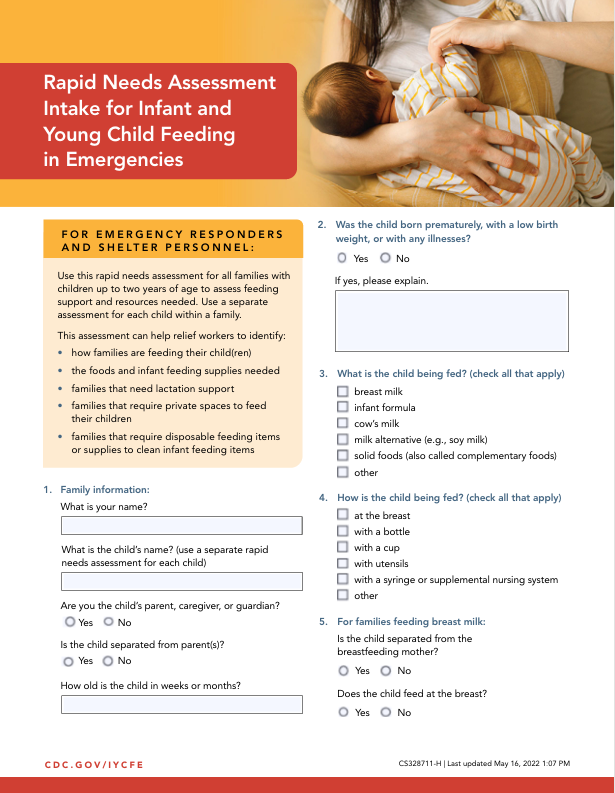
CDC Rapid Needs Assessment
Rapid Needs Assessment Intake for Infant and Young Child Feeding in Emergencies. The formal intake form, for emergency responders and shelter personnel.
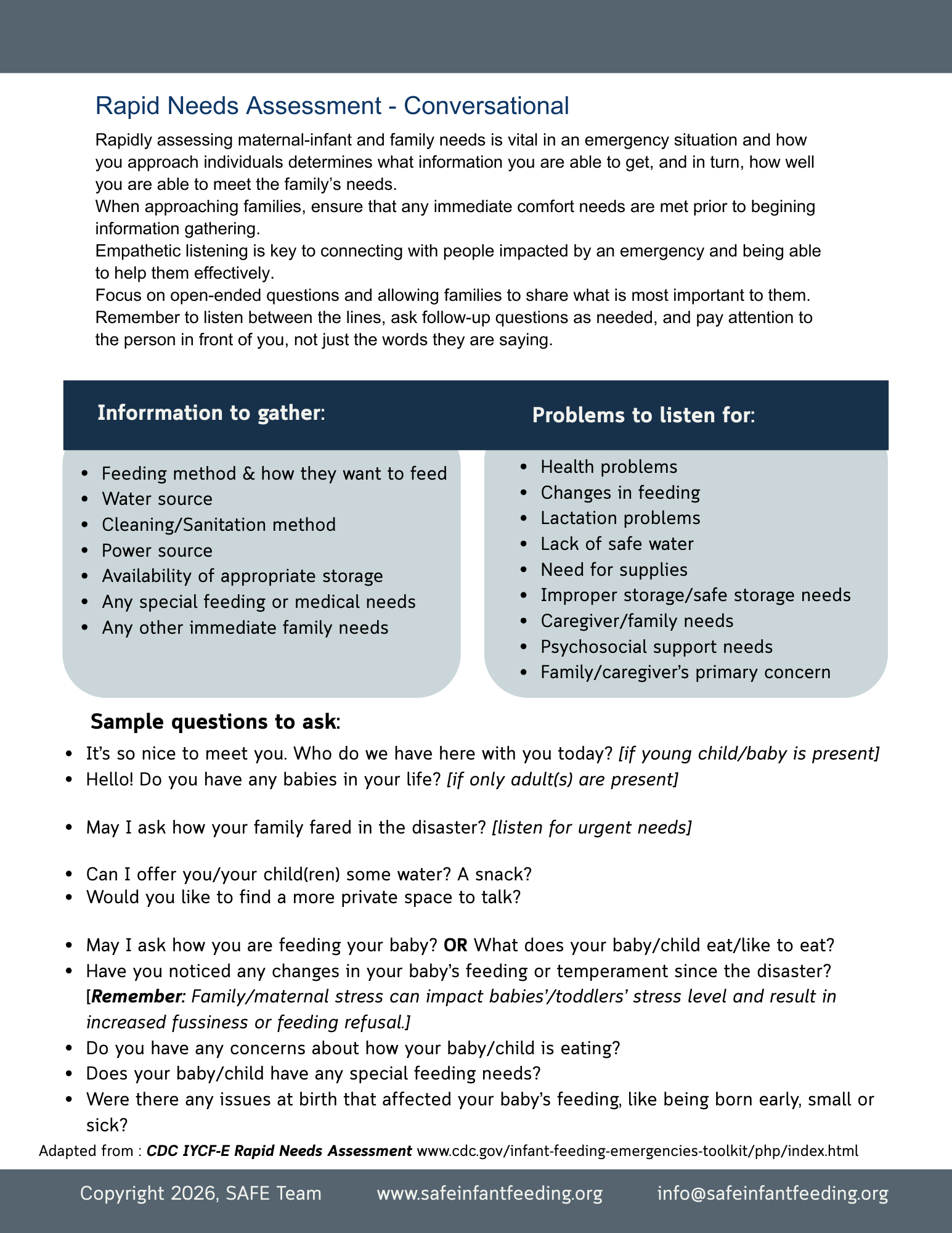
SAFE Simplified Rapid Needs Assessment
Our field version, designed to be conversational — what to gather, what to listen for, and sample questions you can use standing in a distribution line.
3. Review Trauma-Informed Care Reference Sheet
How to approach families and site staff who are exhausted, grieving or displaced — and how to look after yourself while you do it. Read it on the website or take the printable sheet into the field; the content is the same.
4. Choose a stress management technique to try or practice.
We can build our emotional resilience and reserves before being in an acute disaster response situation. These practices also help us deal with daily stress, and improve our ability to respond to unexpected stressors.
- Try to do a stress management or trauma-release practice daily, even if just for 2 minutes. You can use one from the handout above, or any technique you are familiar with.
Complete the Evaluation
To track your attendance and help us improve, please complete the short evaluation as soon as you can. It is how we verify your attendance for the certificate of completion at the end of the series.
Please Support Our Efforts
If you find this training helpful, please support our efforts with a financial donation. Click below and select “SAFE Team” to earmark for IYCF-E education and disaster response support.
Handouts, Links & Resources
New marks a handout you have not seen before; Shared earlier means it appeared in an earlier session.
Handout list
- Intro to IYCF-E — SAFE Training eLearning Module New
- Infant and Young Child Feeding in Emergencies Toolkit New
- Operational Guidance for Emergency Relief Staff and Programme Managers (OG‑IFE) New
- Save the Children IYCF‑E Toolkit New
- USBC IYCF‑E Constellation New
- Gillings on the Ground: Disaster Response Training Program New
- L.I.F.E. — Lactation and Infant Feeding in Emergencies New
New this session
Intro to IYCF-E — SAFE Training eLearning Module
If you have not already watched this video introduction, start here. The module takes 45–60 minutes and costs $10 through the North Carolina Breastfeeding Coalition.
Video module © 2025 The University of North Carolina at Chapel Hill and the North Carolina Breastfeeding Coalition. To license these materials for reuse or co‑branding, contact the UNC Chapel Hill Office of Technology Commercialization on 919‑966‑3932 or email Harmen Steele.
New this session
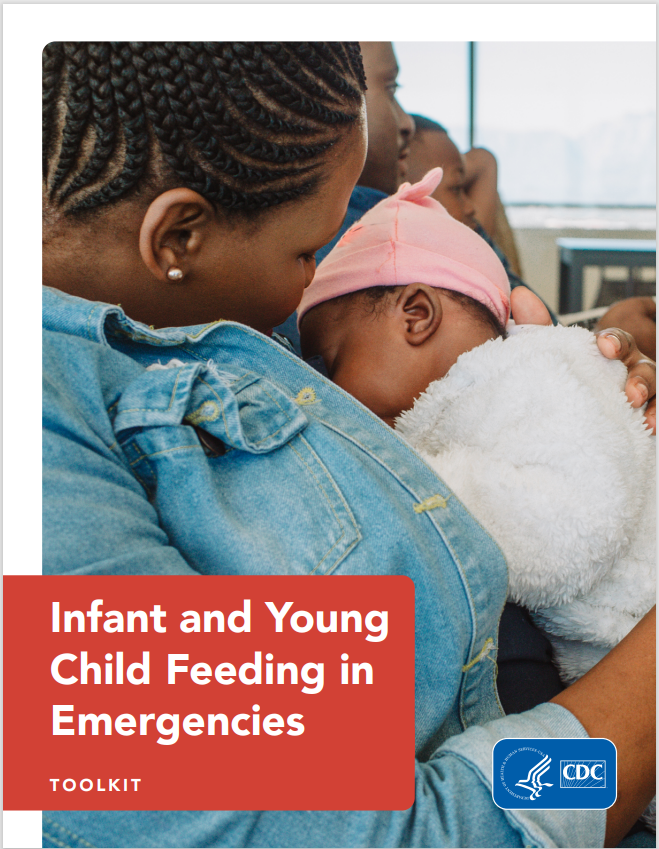
Infant and Young Child Feeding in Emergencies Toolkit
The CDC’s core toolkit for feeding infants and young children during an emergency. It contains:
- Guidance on supporting families and providing safe nutrition during an emergency
- Printable handouts to use with families, or to hand them directly
- Preparedness information written for families and caregivers
- Public-facing guidance on donations after a disaster
New this session
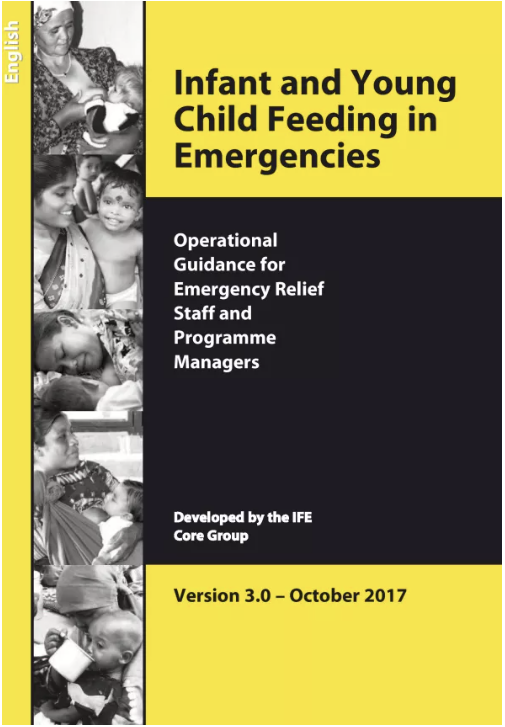
Operational Guidance for Emergency Relief Staff and Programme Managers (OG‑IFE)
From the Infant Feeding in Emergencies Core Group. The international reference standard, built around six practical steps:
- Endorse or develop policies
- Train staff
- Coordinate operations
- Assess and monitor
- Protect, promote and support optimal infant and young child feeding through multi‑sector interventions
- Minimise the risks of artificial feeding
New this session
Save the Children IYCF‑E Toolkit
Internationally focused, and the most detailed of the toolkits. Covers:
- IYCF‑E policy
- Conducting needs assessments
- Programme planning — secure and supportive spaces for lactating families, support for starting chest/breastfeeding, consistent messaging, appropriate complementary foods, and managing acute malnutrition
- Staff training
- Monitoring and supervising IYCF‑E programmes
New this session
USBC IYCF‑E Constellation
An emerging national subgroup of the United States Breastfeeding Committee, working on infant and young child feeding in emergencies.
New this session
Gillings on the Ground: Disaster Response Training Program
Disaster response training run in North Carolina by the UNC Gillings School of Global Public Health.
New this session
L.I.F.E. — Lactation and Infant Feeding in Emergencies
From the Carolina Global Breastfeeding Institute in North Carolina. Three sets of resources:
- The L.I.F.E. Support Basic Kit — the core rapid‑response bundle
- Resources for early care and education settings
- Community milk sharing resources
Thanks to our sponsors
This work is free because these people and organizations paid for it.

Marcia Brady Tucker Foundation
A private family foundation dedicated to supporting charitable organizations that align with its mission of giving back. Grants are made only as a result of the Foundation’s own initiative.
Breastfeeding Family Friendly Communities
Provides technical assistance to breastfeeding coalitions and health departments across the US, using the Ten Steps to a Breastfeeding Family Friendly Community. The SAFE Team is a project of BFFC.

In memory of Elsie Perry
Elsie Perry was a founding mother of La Leche League Boston in the 1960s. A gift made in her memory by her daughters funded an eleventh month of this training series.
BabyBjörn
Founded in 1961 and still family-owned, with a mission to make everyday life easier for parents with babies. If your community needs emergency baby gear, reach them at care@babybjorn.com.

Confident Pregnancy
Helps people be healthier, feel more confident, and find their inner strength. Tips for staying calmer and more resilient under stress at MelindaDelisle.substack.com. DBA Melinda Delisle Innovations.

Birthstone Center for Appalachian Perinatal Resilience
Strengthens perinatal health in Western North Carolina by centering families, uplifting birthworkers, and advancing equitable access to lactation, doula and maternal mental health support.
Sponsor this IYCF-E training
Interested in sponsoring or partnering with us? Get in touch.

Scan to open this page on your phone
These materials are shared under the SAFE Team Open Source Use Agreement — please reuse and adapt them, with attribution.