
In the beginning, I told everyone this would take two weeks.
That was the plan, if you can even call it a plan. The coalition would throw everything we had at Western North Carolina for a couple of weeks, get the babies through the worst of it, and then go back to our regular lives. I wrote it down in an early update. Our official plan, I said, was to transition out of each county three to five days after the local WIC office reopened. We were coordinating with FEMA and with the White House for what I actually called a graceful exit. In those first days, the shelters and distribution sites that needed our two-person teams dropped from seventy-six to sixteen in about a week, and I let myself believe the math was going our way. A sprint. A hard, awful sprint, and then home.
I remember the day I understood that that was a fantasy.
It arrived in pieces, the way the worst realizations do. It was learning that it would be weeks, not days, before the water came back on in some of these towns, and months before some of them had anything close to normal. It was realizing that the number of distribution sites that needed our support hadn’t dropped, only moved locations. It was hearing that the region was looking at two years of recovery. It was the slow, sinking arithmetic of a baby who has to be fed safely every single day, in a place where every single day was still an emergency. There was no clean cutoff coming. A WIC office reopening was not the finish line I had pictured. It was barely the starting line.
And on that day, the whole nature of what we were doing quietly changed. I said it out loud to the team, in words that have stuck with me ever since. Our response to the infant feeding emergency ended when WIC opened. And our real work, the work of a breastfeeding coalition, normalizing feeding, changing the systems, training people, that is when it started. Officially, our emergency ended and our sustainability began. Same day. Same breath.
Which meant we had to stop thinking like people running a two-week relief drive and start thinking like people building something that could outlast us. I began saying a sentence that became a kind of mission for the whole team, and I still say it today. Our goal is to put ourselves out of business. We are not here to become the permanent people who feed babies in disasters. We are here to make ourselves unnecessary, by handing this knowledge and this system to the communities that will always be closer to their own families than we could ever be. You do not build that in ten days. You build it slowly, on purpose, over seasons.
So we settled in for a season none of us had planned for, in the middle of a mountain winter. And the winter was not a metaphor. It was pipes freezing and formula freezing. It was families in campers and half-repaired houses with no reliable heat. It was distribution sites where donated formula sat outdoors in the sun or in an unheated shed and refroze overnight until it was no longer safe to give a baby. Our teams learned to check the overnight low before every route, because temperature had become a feeding safety issue. Some days the most important thing we did was help a family figure out how to keep both the formula and the baby warm at the same time, with no power, using a camp stove and whatever propane they could find.
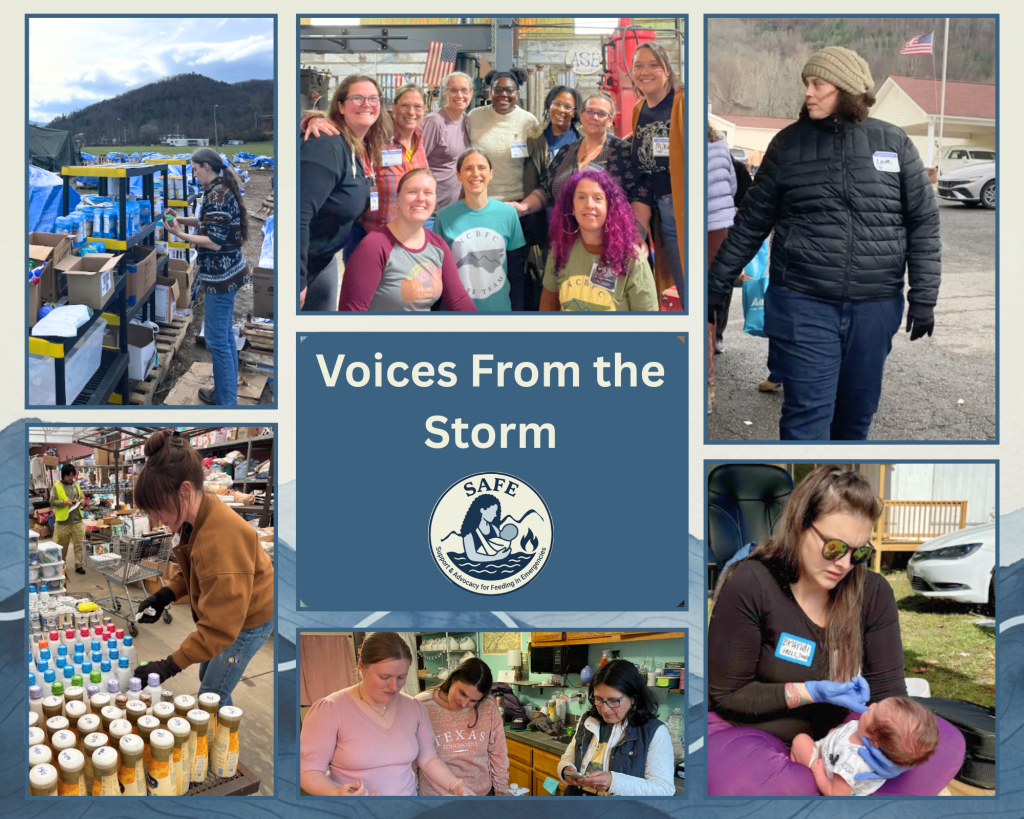
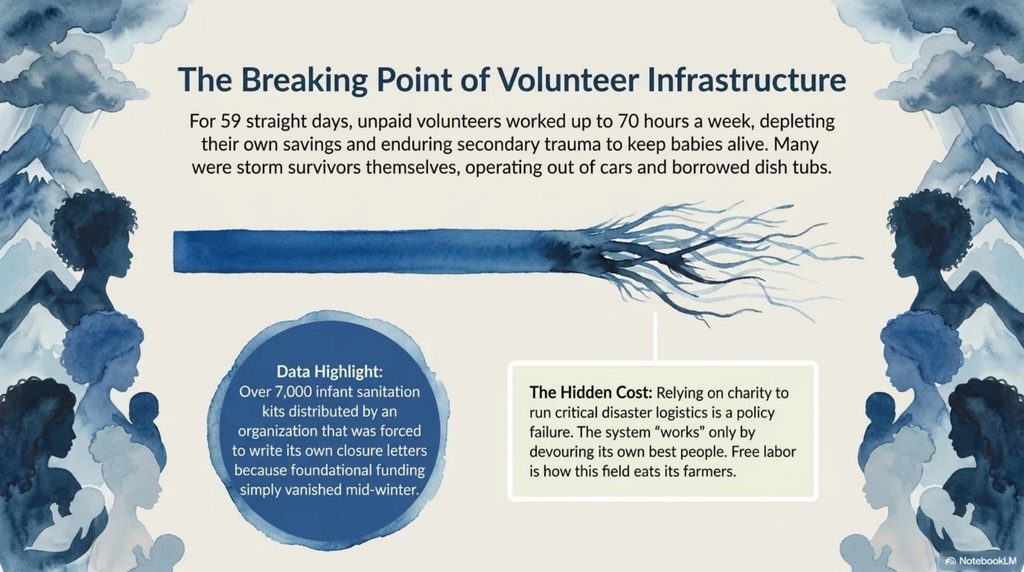
The volunteers changed too. In October, people had flown in from all over the country, and on a good day we had twenty of them. But you cannot sustain a response on adrenaline and plane tickets. As the shock wore off and the news trucks left, the out-of-town numbers dwindled, some days down to five, and the weight of the work settled onto a small local crew who were themselves storm survivors. Their own houses had been damaged. They kept showing up anyway. One of our IBCLCs put it plainly, months in — seventy hours a week for fifty-nine days straight was a lot. Another, looking at the mountains she loved, said simply, “it still looks like trash”. Everyone felt twitchy every single time it rained.
And here is the thing the long haul forced on us, the thing that changed everything that came after. If this was going to be a season and not a sprint, we could not keep running on a rotating cast of well-meaning strangers who finally got good at the work on day four and then drove home on day five. We needed people who could stay, and we needed a way to make more of them. That realization, born on the day I understood there would be no tenth day, is what sent us to build a real training. A seven-day program. An institute. A way to teach this so that the next community would not have to invent it from nothing the way we had.
But that is the next part of the story. What I want you to sit with here is smaller and harder. There is a particular grief in the moment you realize a crisis is not going to end on the timeline you promised yourself. You braced for a sprint, and someone quietly moves the finish line out to the horizon, and then removes it altogether. Everyone around you is exhausted, the cameras are gone, the casseroles have stopped coming, and the babies still need to be fed tomorrow, and the day after that, and the day after that.
That is the moment most disaster stories stop getting told, because that is the moment it stops being dramatic and becomes a long, cold, unglamorous act of staying. I want to tell you about the staying. Because the staying is where we almost lost everything.
Voices from the Storm
Previous: 5. The Freezing Car Line
Next: 7. A Mile From Home (Coming November 2026)
See all twenty-five pieces