
Making sure infants and young children can be fed safely is a life safety function, and in most emergency operations plans nobody has been assigned responsibility for it. Infants are the population least able to absorb that gap. During a disaster they remain completely dependent on caregivers for nutrition, hydration and safety, and unlike older children or adults, babies cannot skip meals, tolerate unsafe water, or quickly adjust to new feeding methods. Even small disruptions in feeding routines become serious health risks fast.
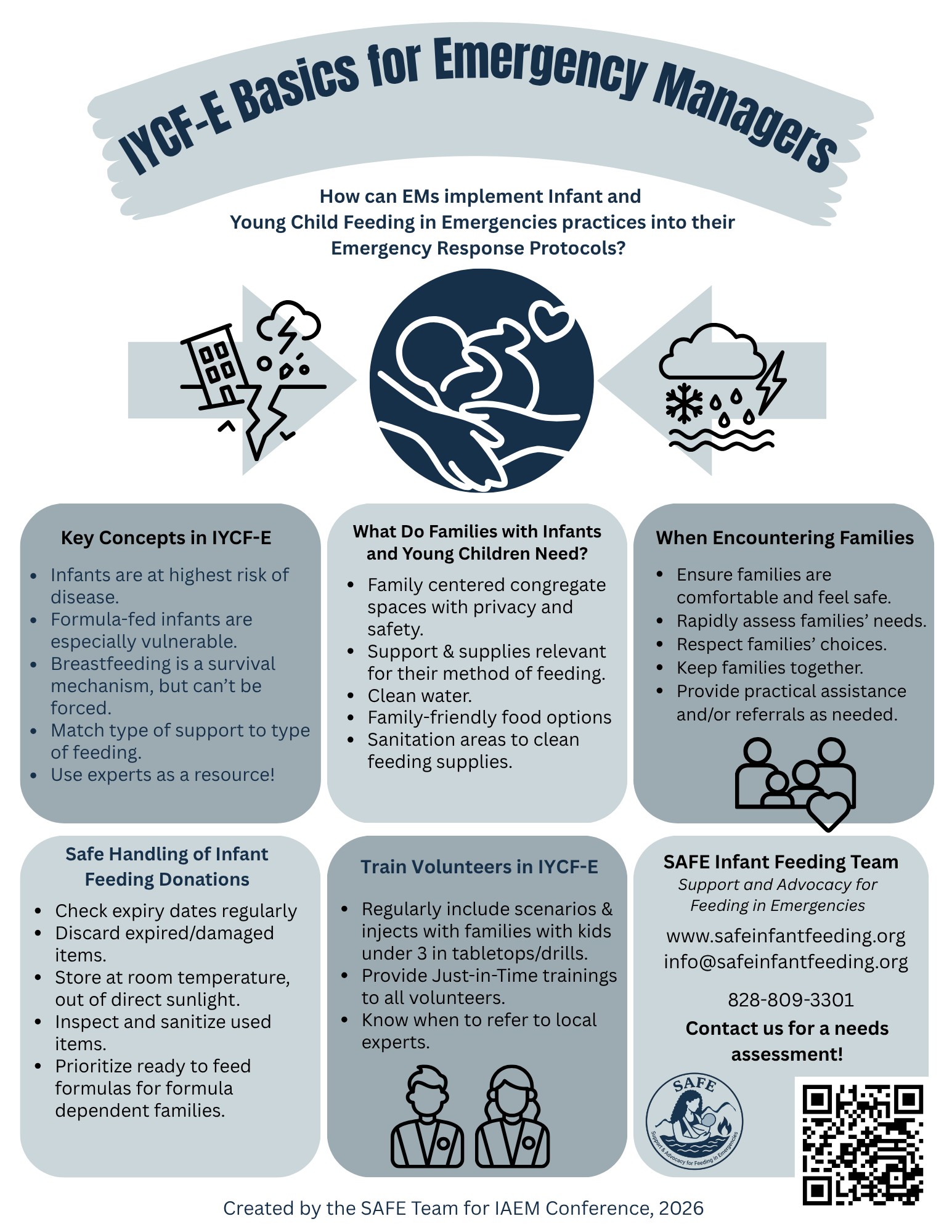
Take one page with you. IYCF-E Basics for Emergency Managers (PDF) is a single sheet built for a briefing, a tabletop, or a shelter binder: key concepts, what families with infants need, what to do when you meet them, how to handle donated feeding supplies, and how to train volunteers. Print it, hand it out, adapt it. Created by the SAFE Team for the IAEM Conference, 2026.
Choose a first step
- Find your gaps (Ten minutes): Run your plan through Does Your Emergency Plan Account for Infants? It returns a specific resource for each gap it finds.
- Adopt the policy (One meeting): The County Policy Adoption Toolkit has an editable template and designates an IYCF-E lead.
- Run a tabletop (Two to three hours): We build and facilitate them, and one can serve as a documented exercise for your program. Availability is limited by funding. Ask us.
Start wherever your county actually is. Most people begin in the middle. If you are standing up a community response rather than revising a plan, Build It in Your Community is the same material organized for a different job.
Learn how each family is already feeding before you offer anything
Every family who arrives is already feeding their baby somehow. The job is to find out how, and then protect it. That is why every tool on this page begins with an assessment rather than a supply list.
Human milk feeding is the only infant feeding method that does not depend on power, clean water, refrigeration or a supply chain. Protecting it is a resilience measure, not a preference. Families who are formula-dependent need immediate and specific protection, because their feeding method relies on exactly the systems the disaster just broke.
Before anything happens
This is where the work pays off. Almost none of it costs money.
Plan for the weather your region calls unusual. Hurricanes are what the mountains were not ready for. Ice is what the coast is not ready for. The hazard your systems have practiced is rarely the one that breaks them, and infant feeding fails fastest in the event nobody rehearsed, because it depends on water, power and a route to a store.
| What you need | Where to go |
|---|---|
| To find out whether my plan covers this | Does Your Emergency Plan Account for Infants? A self assessment, not a checklist. |
| A county policy I can adopt | IYCF-E County Policy Adoption Toolkit, with an editable Word template |
| To know who in my county can actually respond | Creating a Resource List for IYCF-E Connections, with a spreadsheet template |
| To stand up local preparedness from scratch | Setting Up Local Infant and Young Child Feeding Emergency Preparedness |
| Evidence this is a statewide and national gap | New Study Confirms Infant Feeding Is Missing From State Emergency Plans |
| The vocabulary our lactation partners should learn | Learning the Language of Emergency Management |
Two easy wins this month. Add infant and young child feeding information to your county website, and add safe sleep and safe feeding to your shelter plans. Both can go out with outreach you are already doing.
Where this fits your structure
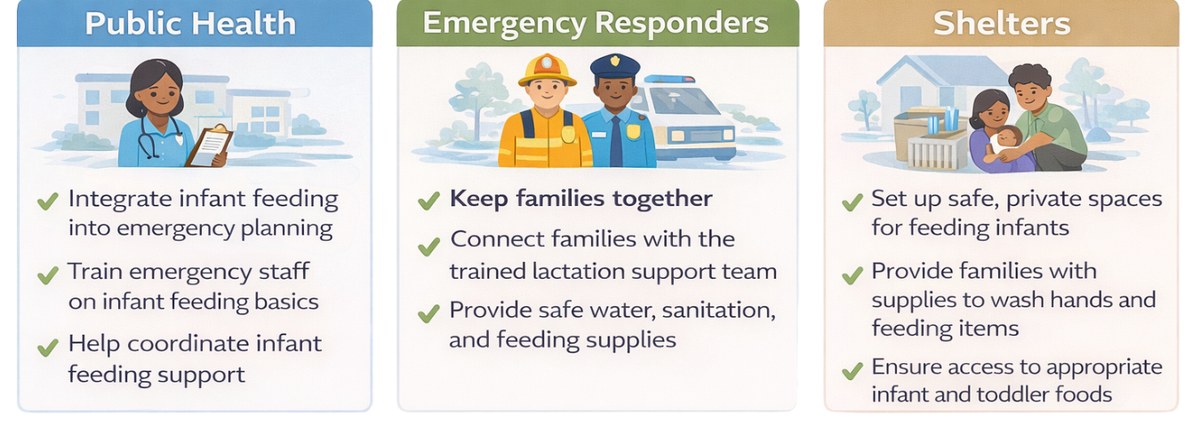
Short answer: Operations, Human Services Branch, where mass care sits, looping in Logistics for supply. We are not asking to be a command function.
| Where in the structure | What it needs there |
|---|---|
| Incident command | One named lead who reports in. The position should exist at any incident size. |
| Operations, Human Services Branch, mass care | Per infant assessment at registration at shelters. A private feeding space. Somewhere to wash a bottle, and somewhere cold and clean to store pumped milk. Family unity. Safe sleep alongside safe feeding. The same considerations apply at reception centers, mass feeding locations, disaster recovery centers and multi agency recovery centers. |
| Operations, points of distribution | Water and meals ready to eat do not feed an infant, a diabetic, or many elderly residents. |
| Logistics | Supply typing, climate controlled storage, a donations routing rule written in advance, and a last mile plan. |
| Planning | Infant feeding data reaching the situation report, and the after action review. |
| Public information | Multilingual messaging ready to push, including safe water and preparing formula with limited water. |
| Liaison and VOAD | The voluntary organizations, already at your table, need this guidance too. VOAD Resources |
| Recovery and case management | Feeding problems persist for months. A parent without child care cannot reach a disaster recovery center to apply. DCMs and Direct Survivor Support |
One clarification worth having in writing. Health and Human Services is congressionally the lead for sheltering at state and local level. FEMA sits in emergency support function 6, mass care, but is facilitating rather than leading, and will say so if asked. FEMA also only engages after a major disaster declaration, and most events that break infant feeding never get one. Do not plan on the assumption that sheltering arrives from outside.
We have exercised this. Experience with New Hanover County Disaster Coalition Command Center Simulation
How the branch actually moves. Each branch feeds information and resources up and down through the Incident Action Plan, which is where branches get their daily assignments. All parts of the state health and human services agency sit under this branch, alongside disability integration, shelter coordination, feeding, reception centers, and agriculture and animals. North Carolina publishes its Human Services Branch structure at ncdps.gov.
The emergency operations center and the incident command post are not the same room. An infant feeding function reports in to the incident command post rather than sitting at it. First responders are protective of the post, and rightly so. Plan to provide coordination and teams, not to occupy a seat on scene.
What you can be reimbursed for
Breastfeeding and chestfeeding support items are reimbursable in congregate shelters
Public Assistance Program and Policy Guide, Version 5, page 143, section c, Congregate Shelter Supplies and Commodities:
“Infant formula, breast feeding/chest feeding support items, baby food, and diapers;”
Before Version 5 that line carried no lactation item at all. It applies to incidents declared on or after 6 January 2025.
Two more lines on the same page are worth knowing. Durable medical equipment and consumable medical supplies are both eligible, and pumps, storage bags and cleaning supplies sit inside those categories. A county has three lines to claim against, not one.
Staff, not only supplies. The staff cost list includes personal assistance service staff. That line was already in the guide, carried over from work around 2011 on disability, access and functional needs, so it is not the new part. The new part is on page 143 and 144, where the personal assistance services definition now reads “eating/feeding” rather than “eating.” Michael Prasad, the researcher who asked FEMA for that change, reads it as aligning anyone performing personal assistance services for infant and young child feeding with disability, access and functional needs work. Feeding a baby is an activity of daily living, the same as the eating support already reimbursed in congregate shelters and fixed feeding sites.
Two honest caveats. No state or territory has yet tested this by requesting reimbursement for personal assistance services related to infant feeding on a declared incident with Category B approved, so it is an available reading rather than a settled one. And none of it starts until the President declares an emergency or a major disaster and Public Assistance Category B, Emergency Protective Measures, is specified. Plan to feed infants either way. Every level of government needs to do this whether or not the jurisdiction is reimbursed.
Worth knowing. That line was not in the draft FEMA published for public comment in June 2024. Those elements were added after emergency management researcher Michael Prasad filed a comment letter that July asking for them, supported by comments from the U.S. Breastfeeding Committee. Federal reimbursement policy changed in six months, without legislation. Before that change, the absence of even potential federal reimbursement is a large part of why many states and territories left infant feeding out of mass care planning altogether.
When it activates
Assessment first. Every time.
| What you need | Where to go |
|---|---|
| To decide whether this event needs an infant feeding response | Determining Need, a decision tree with four response levels |
| To find out what families actually need | Rapid Needs Assessment, adapted from CDC. Per infant, not per household. |
| The roles a response requires | Response Overview and the Field Coordinator SOP |
| To reach sites and ask the right questions | Contacting Sites, with scripts |
| To know what to stock, and roughly how much | How Much Formula to Stock. Prioritise ready to feed when water or power is uncertain. |
| Sanitation when the water is not safe | Sanitation Kit Guide |
| A rule for donated human milk | When Donated Milk Shows Up |
| A rule for unsolicited formula donations | Clarifying SAFE’s Position on Donations and The International Code |
| Guidance past infancy | Feeding Children 6 Months to 3 Years in an Emergency |
| Medication questions from breastfeeding parents | Medications and Breastfeeding in an Emergency |
Sizing it. For planning, expect roughly three children aged 0–3 per hundred shelter residents. A 300 cot shelter should plan for roughly nine. The figure comes from unofficial demographic information on shelter residents with children ages 0 to 3, across large scale United States disasters from 2020 through 2024. This should be used as a baseline, not a maximum, and should be reviewed and revised by each jurisdiction as part of its after-action review and improvement planning process. The figure is Barton Dunant’s (Emergency Management Training and Consulting). It is a planning default rather than a prevalence rate, and it beats planning for zero. Treat it as a baseline rather than a ceiling, and revise it for your own jurisdiction as part of after action review and improvement planning.
Why this number differs from the one on the stocking page. This is a shelter population planning factor, drawn from what has actually been observed in shelters, and it answers a staffing and space question: how many young children will be in the building, and therefore how many families need a private place to feed, a clean surface, and a conversation at intake. It counts every child from birth through age three. Our how much to stock page uses a different and deliberately narrower figure, because that one answers a procurement question: how much formula to buy. Most children over about twelve months need no infant formula at all, so a number that is right for planning space is wrong for planning supply. Use this one for people and that one for pallets.
Those nine are not nine of the same child. Plan the range, not the average. A newborn may be exclusively breastfed, or dependent on formula that has to be prepared with water heated to at least 158°F (70°C). A nine month old is starting solid food and still needs milk feeds. A toddler between one and three needs no infant formula at all, and stocking it for them wastes money and confuses families. What that age does need is shelf stable whole milk, soft food they can actually eat, a cup rather than a bottle, and somewhere safe to eat it. Toddlers are also the group most often missed, because a shelter that has thought about babies at all has usually thought only about bottles.
The procedure itself, including what to do when a site cannot reach that temperature, is on Preparing powdered formula safely in an emergency.
Say something when you hand it over. A bottle without instructions creates a new hazard. During Helene a mother sheltering in a hotel was given 32 ounce ready to feed bottles for a two week old. They would not fit the mini fridge and she did not refrigerate after opening, because nobody told her and her usual newborn appointments were gone. Distribution without guidance is not distribution.
In your shelters and distribution sites
Most of this costs nothing. The space is usually already there.
Sheltering is not only shelters. Federal Temporary Shelter Assistance places families in hotels after a federally declared event. A hotel room has no kitchen, often no more than a bar fridge, and the same barriers to pumping, storing milk and washing feeding items that a gym has. Reception centers, mass feeding locations, disaster recovery centers and multi agency recovery centers raise the same questions.
If your county evacuates rather than shelters in place, the work does not go away, it moves. Your shelters are post storm if they happen at all, your distribution points may be fire stations rather than one central site, and your first contact with a family who has a baby may come during re-entry rather than during the event. The questions are the same. Where you ask them changes, and a rapid needs assessment works at a fire station just as well as it works at a shelter.
| Change | What it takes |
|---|---|
| A designated feeding space | A sign on a door. If you provided a quarantine area during COVID, the same logic applies. |
| Site it deliberately | Near the nurse station, and near the activity area so older siblings are supervised next door. |
| Put it on the shelter walkthrough checklist | The one change that makes the others happen. If it is not on the checklist at setup, nobody remembers it on day three. |
| Somewhere to wash a bottle that is not a bathroom | Kitchens are usually not open for residents to use. Look for a staff break room with hot water and a sink. Kitchens open a liability concern through slips and falls, equipment and food safety. |
| A mini fridge in the shelter kit | Counties that ran mobile vaccine sites already own these. |
| “Family restroom” rather than “gender neutral restroom” | Same room. The label decides whether a parent with a baby knows it is for them. |
| Assess every family with an infant at intake | Individually, per infant. Distribution rests on documented need. |
| Safe sleep alongside safe feeding | An easy addition to shelter plans and to your county website. |
| Train registration and feeding staff, not only health staff | Health staff in a shelter are already carrying too much for this to sit only with them. |
| Put trained people in the role | Counties with mandatory staffing can match people to skills. WIC staff, or cross trained Medical Reserve Corps volunteers, or a remote counseling line. |
Your WIC agency is the strongest asset nobody has assigned. The 2026 review of state emergency operations plans found that state WIC programs produced the most comprehensive public facing infant feeding in emergencies guidance anywhere in the country, and that WIC has no formal role in emergency response structures. The authors call that one of the largest missed opportunities in United States disaster policy. Putting your WIC director on the notification roster costs nothing and closes it locally.
More for the people running those sites: Shelter and Congregate Area Resources and Resources for Distribution Sites.
On storage. Formula kept in an unconditioned warehouse until next season is not reusable. Heat cycling breaks it down. Give it away rather than store it badly.
Training and exercises
| What you need | Where to go |
|---|---|
| A tabletop exercise for your county | Role based, two to three hours, and it can satisfy your annual accreditation requirement. We have grant funding for a limited number and we are booking them now. Once that funding is committed we can still build and run one for your county on a contract basis. Ask us. |
| Recorded training staff can take on their own time | Nourishing Resilience, eleven sessions, no cost |
| Free federal courses | FEMA’s National Training and Education Division runs a six hour course on planning for children’s needs in disasters and a sixteen hour course on pediatric disaster response |
| A live training for my county | Join a live training or bring us to your community |
| Peer support while I implement this | SAFE Support and Strategic Core, free, quarterly |
| Trauma informed practice for responders | Trauma-Informed Response and the Trauma-Informed Care Film |
| Support for my staff after the event | Healing After Disaster, from Duke experts |
There is already a role for this, and its training does not cover it. FEMA’s Resource Typing Library Tool carries a Feeding Services Team Leader position, searchable there by name. It is a mass care role rather than a public health one, and states, counties, tribes and territories use these definitions to train and qualify their own team leaders. Its required training does not include IS-366.a, Planning for the Needs of Children in Disasters. In that course breastfeeding is never mentioned, and formula appears twice, one of those in the context of evacuating a daycare center.
Michael Prasad of Barton Dunant, who raised this with us, argues the sequence should be to fix the baseline training modules first and then make them requirements of the roles that serve people during disasters. If you qualify a Feeding Services Team Leader in your jurisdiction, you can add that course yourself without waiting for anyone.
We also turn up at North Carolina Emergency Management Association conferences and Healthcare Preparedness Coalition quarterly meetings. If your coalition needs an agenda item, we are happy to be one.
For emergency managers and preparedness coordinators
Your state already has a child care disaster plan, and federal rules already put your agency at the table for it. Under 45 CFR 98.16(bb), every state, territory and tribe receiving Child Care and Development Fund money must maintain a Statewide Child Care Disaster Plan showing how it will address the needs of children, including the need for safe child care, before, during and after a governor-declared state of emergency or a major disaster as defined by the Stafford Act.
The regulation names who writes it: the state human services agency, the state emergency management agency, the state licensing agency, the state health or public health department, local and state child care resource and referral agencies, and the State Advisory Council on Early Childhood Education and Care. If you have not seen your state plan, it exists and your agency is a required collaborator on it.
It also requires child care providers to have procedures for evacuation, relocation, shelter-in-place, lockdown, communication and reunification with families, continuity of operations, and accommodations of infants and toddlers, plus staff and volunteer emergency preparedness training and drills.
That last phrase is where the work is. The rule requires accommodations for infants and toddlers and does not define them. It does not say safe water for formula preparation, a private place to feed, or a trained point of contact. Reading your state plan against this page is a short exercise with a clear output: the list of things your child care sector is already required to plan for and has probably not specified. Our thanks to the New Hanover Disaster Coalition for surfacing this requirement.
Making the case inside your agency
| The argument | What to use |
|---|---|
| It is reimbursable | Public Assistance Category B, congregate shelter supplies, for incidents declared on or after 6 January 2025 |
| This is life safety | Health and Human Services leads sheltering. Emergency management and the whole system carry life safety. |
| Nobody has been assigned it | No designated lead agency at any level, and North Carolina’s own Helene after action review does not address it |
| A national body has told us to | The National Academies recommended in 2025 that FEMA, state and local emergency management agencies, and organizations such as the Red Cross build infant and young child feeding into preparedness guidance and plans |
| There is civil rights exposure if we do not | A site stocked only with water and meals ready to eat does not serve infants, diabetics, people on low sodium diets, or many elderly residents |
| It costs almost nothing | Free template, free training, a sign on a door, a fridge you may already own, and supplies that are now reimbursable |
| It satisfies a requirement we already have | Preparedness coordinators owe a tabletop annually for accreditation |
| Talking points for a commission or elected official | What to Bring to Your Next Advocacy Conversation |
| Published research | The IYCF-E Research Repository |
| The repeat event argument | Promoting IYCF-E As Our Climate Changes |
Who checked this. The incident command crosswalk and the shelter guidance on this page were reviewed by Audrey Hart, Director of the New Hanover Disaster Coalition, who advises the SAFE infant feeding committee. The federal reimbursement section was reviewed by Michael Prasad of Barton Dunant, whose July 2024 comment letter is the reason the lactation line exists in the guide. Any errors that remain are ours.
Where we stop
We do not provide protocols for informal human milk sharing. State liability rules vary too much for us to write one that is safe everywhere. When Donated Milk Shows Up covers what we do say.
We do not distribute the trainer flipcharts. Those belong to the University of North Carolina.
Everything else is released under our Open Source Use Agreement. Take it, adapt it, put your county’s name on it.
Want guidance? We can help.
If you are adapting the policy template and something does not fit your structure, reach out. We would rather talk to you than have you guess. We ran this during a real event and we will tell you plainly what did not work.