
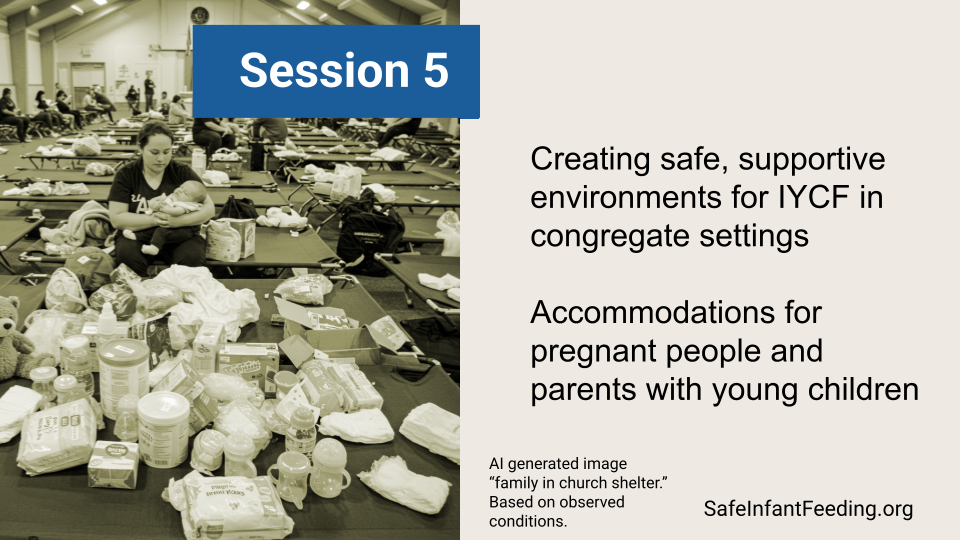
Session 5 – Homework Summary
<< Back to main Session 5 page
Here is the whole assignment, step by step. Jump straight to any step below, or download the identical material as a printable handout.
- Review Handouts
- Consider Joining SAFE Support and Strategic Core
- Signs for Congregate Areas – Choose, edit, or create signs to use
- Start learning about your community’s preparedness
- Field / Community Experience – RNA with 3 caregivers
- Complete the Evaluation
Finished? Complete the session evaluation.
Additional handouts and resources are at the bottom of this page.
1. Review Handouts
Everything for this session is listed below. New marks a handout you have not seen before; Shared earlier means it appeared in an earlier session.
Handout list
Signs you can print for your site
- Signs for Shelters & Congregate Areas — CDC New
- Signs for Shelters & Congregate Areas — Safely Fed Canada Shared earlier
- Signs for Shelters & Congregate Areas — CGBI New
- Breastfeeding Welcome Signs — USDA New
- Breastfeeding Welcome Signs — Breastfeed Durham New
Setting up the space
- CDC Guidance on Creating Safer Spaces New
- UNICEF “Baby Tents” New
- Baby Friendly Spaces New
- UNICEF Blue Dot Support Centres New
Assessing a site and making contact
- Site Assessment Handout & Quick Reference — Safely Fed Canada New
- L.I.F.E. Support Kit — Carolina Global Breastfeeding Institute Shared earlier
- Contacting Sites for IYCF-E Template Shared earlier
Hand these to families
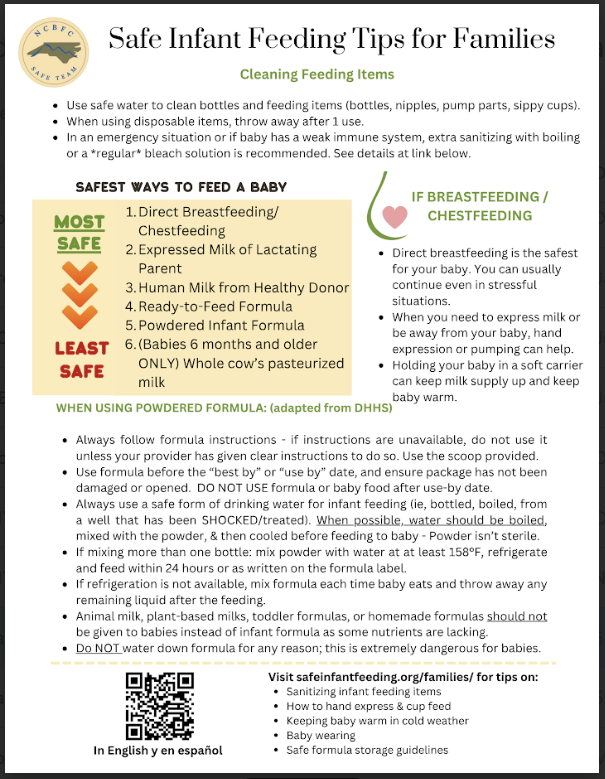
- Safe Infant Feeding Tips for Families Shared earlier
- Resources for Families & Caregivers Shared earlier
- Resources for Organizations & Recovery Sites Shared earlier
Research
Each name jumps to its card in Handouts, Links & Resources below.
2. Consider Joining SAFE Support and Strategic Core
Ongoing IYCF-E preparation & implementation support.
This is a quarterly support & strategy meeting for current & former SAFE training participants. The meeting is similar to a mastermind – inviting attendees to bring wins and challenges from their own efforts to implement policies and practices in their local area to improve infant and young child feeding in emergencies and other low-resource settings.
Meetings typically include updates from both the SAFE Team and participants, discussion on topics of interest, and breakouts for small group discussion, sharing of expertise, and brainstorming.
- Currently scheduled for the first Tuesday of the second month of each quarter, at 1 pm Eastern.
- Next session: February 3, 2026 – 1-2:30 pm Eastern
- Register here.
3. Signs for Congregate Areas – Choose, edit, or create signs to use
Signs welcoming breastfeeding and instructing caregivers on where and how to safely feed their babies and clean infant feeding items help support breastfeeding and reduce illness. Decide which signs you think would be suitable to use in your area. If desired, edit available signs or create your own. Prepare to bring a set to shelters and other congregate areas in case there are none.
Be sure to check with your local breastfeeding coalition – they may already have a set of signs to use or adapt.
Signs you can use, adapt or use as inspiration follow in the handouts list.
4. Start learning about your community’s preparedness
Preparing and making connections during blue sky times makes a significant difference when an emergency occurs.
First – If you have not done so already, find out how to contact your local (city, county, or regional) emergency preparedness group. Some rural areas may only have an emergency preparedness manager who works with the local healthcare coalition. Some areas may have a website with much of this information, or you may need to email or call and ask someone directly.
In a kind and respectful way, find out:
- How does your community respond when an emergency occurs and people are displaced?
- Are there standard group shelters that typically activate?
- Do they use hotels instead, or rely on an outside organization to set up shelters?
- When do they activate?
- How do they handle infant and young child feeding in these situations?
- Are there supports in place for breastfeeding or mixed feeding families?
- Are there separate wash stations for infant feeding items?
5. Field / Community Experience – RNA with 3 caregivers
If you have already done this, great! We encourage you to go out and support more families or help with (more) organizing.
The best way to get comfortable working with families and sites is to do it, then practice periodically to develop and maintain that skill. You don’t need to wait for an emergency situation to occur – there are families everywhere who do not have reliable access to safe water and other resources needed to safely feed children under 3 years old, and organizations that try to meet their needs.
In the next month, aim to use the Rapid Needs Assessment with at least 3 caregivers. If you are unable to connect with people who may be in need, ask someone to help you practice by role playing a scenario.
Keep going with us. The SAFE Support and Strategic Core meets quarterly as a free mastermind for people putting IYCF-E into practice — shared problem-solving, peer support, and updates from the team. See the dates and register.
Complete the Evaluation
To track your attendance and help us improve, please complete the short evaluation as soon as you can. It is how we verify your attendance for the certificate of completion at the end of the series.
Please Support Our Efforts
If you find this training helpful, please support our efforts with a financial donation. Click below and select “SAFE Team” to earmark for IYCF-E education and disaster response support.
Handouts, Links & Resources
New this session
Signs for Shelters & Congregate Areas — CDC
Signs you can download and print to mark family‑friendly areas in a shelter.

Shared earlier
Signs for Shelters & Congregate Areas — Safely Fed Canada
Signage for congregate areas, including multi‑lingual versions:
New this session
Signs for Shelters & Congregate Areas — CGBI
Area signs from the Carolina Global Breastfeeding Institute:
New this session
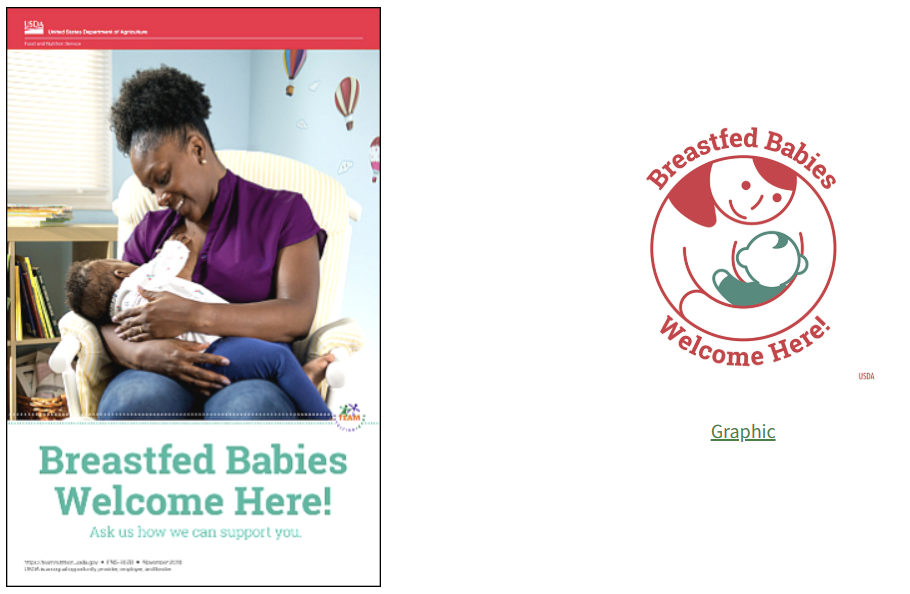
Breastfeeding Welcome Signs — USDA
Graphic and poster versions of the “Breastfed Babies Welcome” sign.
New this session
Breastfeeding Welcome Signs — Breastfeed Durham
Artistic signs marking a space as breastfeeding and chestfeeding friendly.
New this session
Site Assessment Handout & Quick Reference — Safely Fed Canada
Resources to help volunteers assess a site and know what to do first.
Shared earlier
L.I.F.E. Support Kit — Carolina Global Breastfeeding Institute
The Lactation and Infant Feeding in Emergencies rapid‑response bundle, for health workers, shelter managers and volunteers.
New this session
CDC Guidance on Creating Safer Spaces
Guidelines, suggestions and signage for setting up a space where caregivers can feed and settle a baby.
New this session
UNICEF “Baby Tents”
An earlier model of the safer congregate space, for caregivers of young children. Watch the video.
New this session
Baby Friendly Spaces
Save the Children’s guidance on creating baby‑friendly spaces in an emergency.

New this session
UNICEF Blue Dot Support Centres
How UNICEF’s Blue Dot centres combine child protection, feeding support and family services in one place.
New this session
The Effect of Mass Evacuation on Infant Feeding: The Fort McMurray Wildfire
Peer‑reviewed research on what happened to infant feeding when a whole city evacuated. Useful evidence when you need to make the case to an agency.
Shared earlier
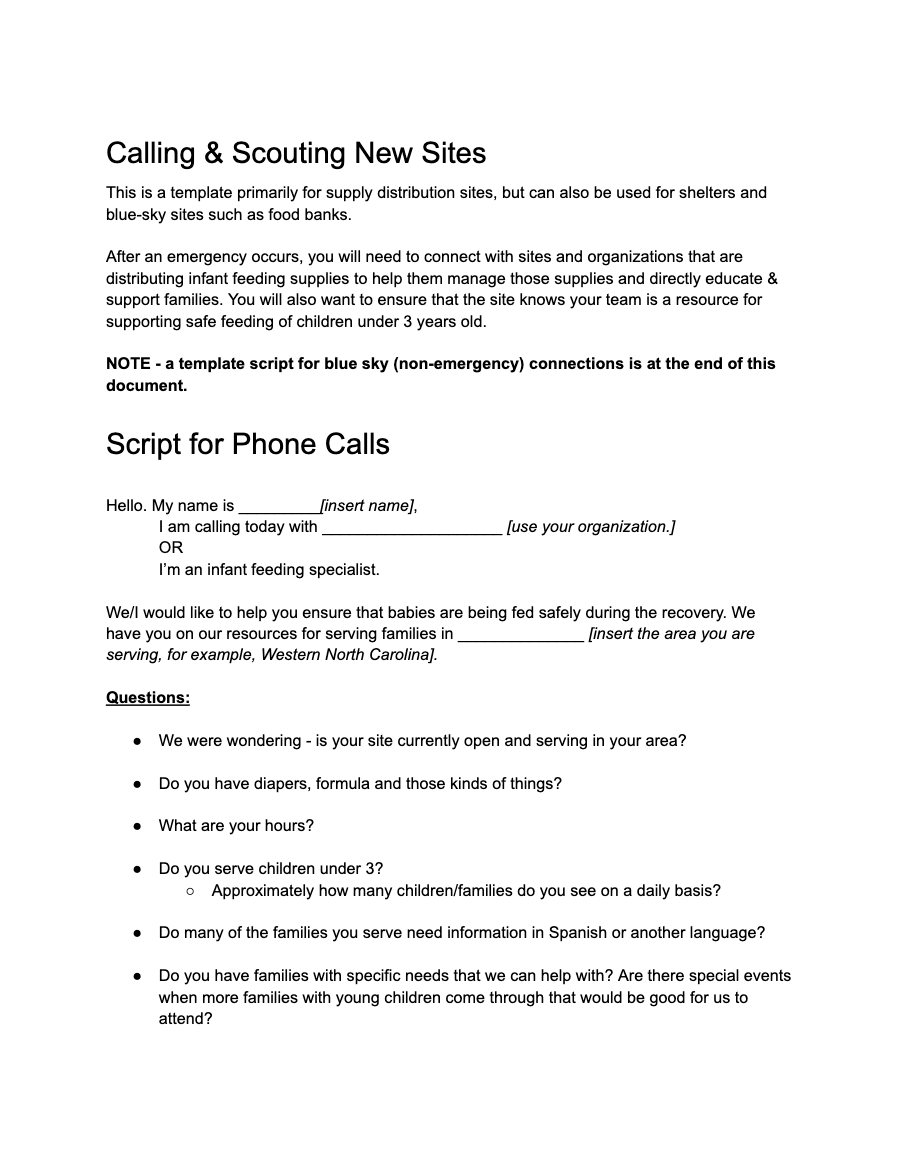
Contacting Sites for IYCF-E Template
A script for reaching sites already distributing infant feeding supplies, so they can manage what they have and know your team is a resource.
Shared earlier
Resources for Families & Caregivers
Videos and plain‑language information for caregivers on feeding a baby or young child safely in an emergency.
Shared earlier
Resources for Organizations & Recovery Sites
What recovery sites need to train staff on, and what to hand families.
Thanks to our sponsors
This work is free because these people and organizations paid for it.

Marcia Brady Tucker Foundation
A private family foundation dedicated to supporting charitable organizations that align with its mission of giving back. Grants are made only as a result of the Foundation’s own initiative.
Breastfeeding Family Friendly Communities
Provides technical assistance to breastfeeding coalitions and health departments across the US, using the Ten Steps to a Breastfeeding Family Friendly Community. The SAFE Team is a project of BFFC.

In memory of Elsie Perry
Elsie Perry was a founding mother of La Leche League Boston in the 1960s. A gift made in her memory by her daughters funded an eleventh month of this training series.
BabyBjörn
Founded in 1961 and still family-owned, with a mission to make everyday life easier for parents with babies. If your community needs emergency baby gear, reach them at care@babybjorn.com.

Confident Pregnancy
Helps people be healthier, feel more confident, and find their inner strength. Tips for staying calmer and more resilient under stress at MelindaDelisle.substack.com. DBA Melinda Delisle Innovations.
Birthstone Center for Appalachian Perinatal Resilience
Strengthens perinatal health in Western North Carolina by centering families, uplifting birthworkers, and advancing equitable access to lactation, doula and maternal mental health support.
Sponsor this IYCF-E training
Interested in sponsoring or partnering with us? Get in touch.

Scan to open this page on your phone
These materials are shared under the SAFE Team Open Source Use Agreement — please reuse and adapt them, with attribution.