

Presenting at the International Association of Emergency Managers Conference
View the slides Workbook and handouts
The Invisible Infrastructure: Securing “First Food” in the Wake of Hurricane Helene. Ashley Mickelson and Love Anderson at the IAEM 74th Annual Conference and EMEX, which is the room where the country’s emergency managers actually are.
Monday, November 9, 2026, 11:00 AM to 12:00 PM Pacific
Room 102A, Long Beach Convention and Entertainment Center, Long Beach, California. The conference runs November 6 through 12 (full program). Hashtag: #IAEM26.
SAFE is the national IYCF-E implementation of Breastfeeding Family Friendly Communities. BFFC is the blue skies strategy, the slow work of building communities where feeding a baby is everyone’s business. This is the gray skies work, for the days that strategy gets tested.
Helene showed what happens when the infrastructure that feeds infants is invisible in a plan. It is not a shelter supply line and it is not a medical annex. It is a system of people, and when it breaks there is no form for it. This session makes the case to emergency managers that first food belongs in the plan before the storm, not in the after action report.
Everything from the session, in one place
Share this page with your team. The short address is safeinfantfeeding.org/iaem.
Jump to: Workbook and handouts · What the session covers · Start here: five documents · Tools to take home · Shelters and distribution sites · Training · Bulletin article · Speakers
Workbook and handouts
Print the handout and workbook, or keep them on your phone. They are also in the IAEM conference app under the session.
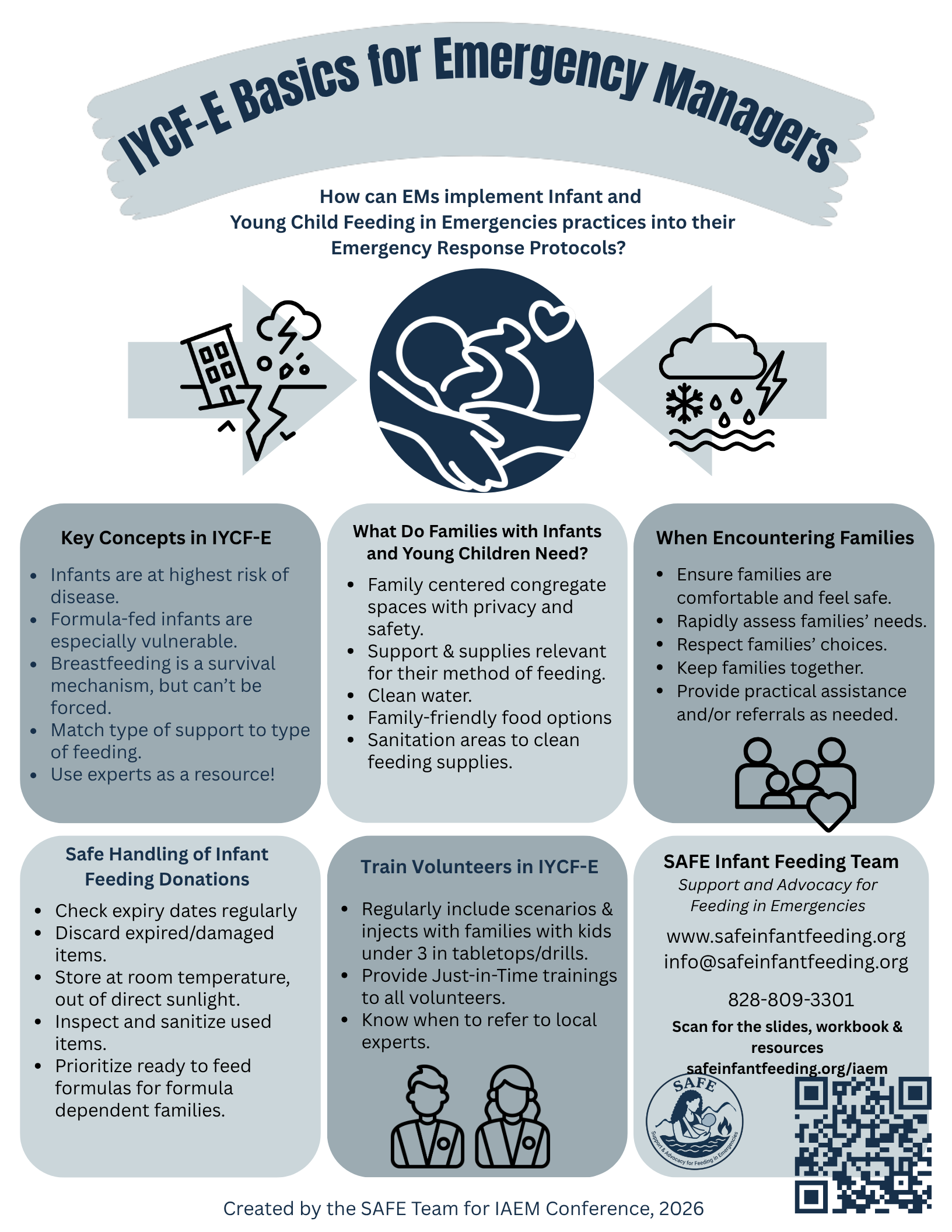 IYCF-E Basics for Emergency ManagersOne-page handout · PDF
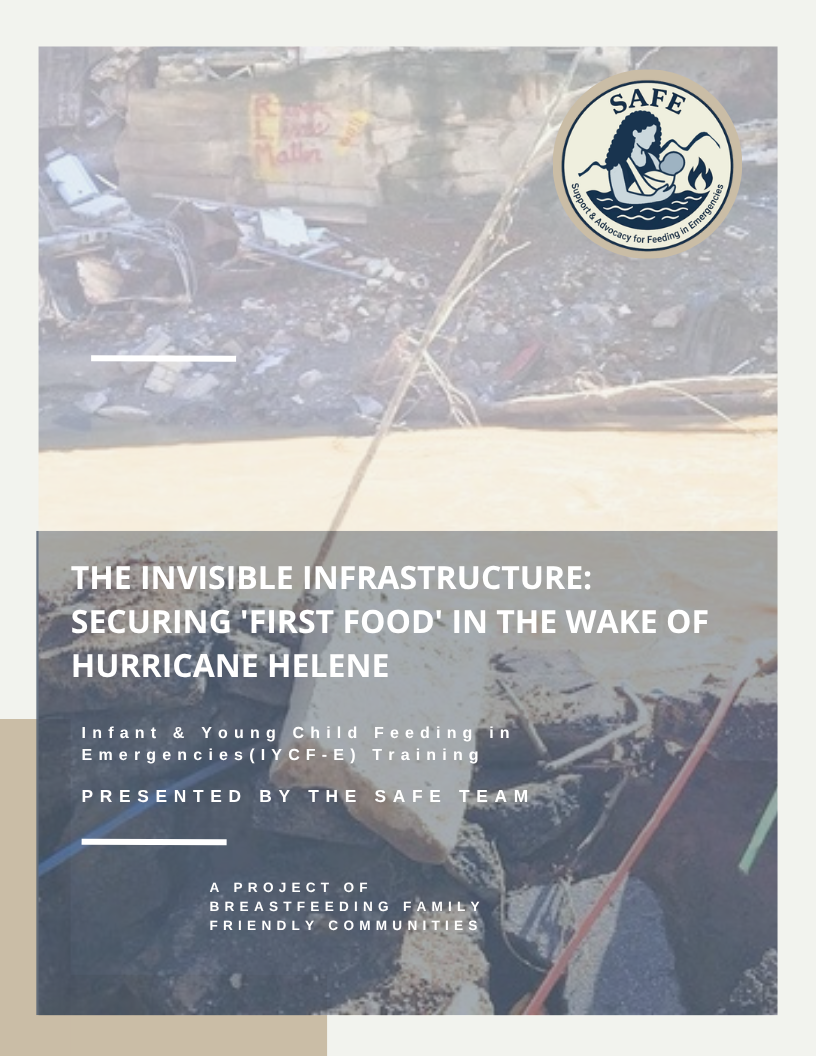 Conference workbookSelf-assessment, county policy template, rapid needs assessment · 19 pages · PDF
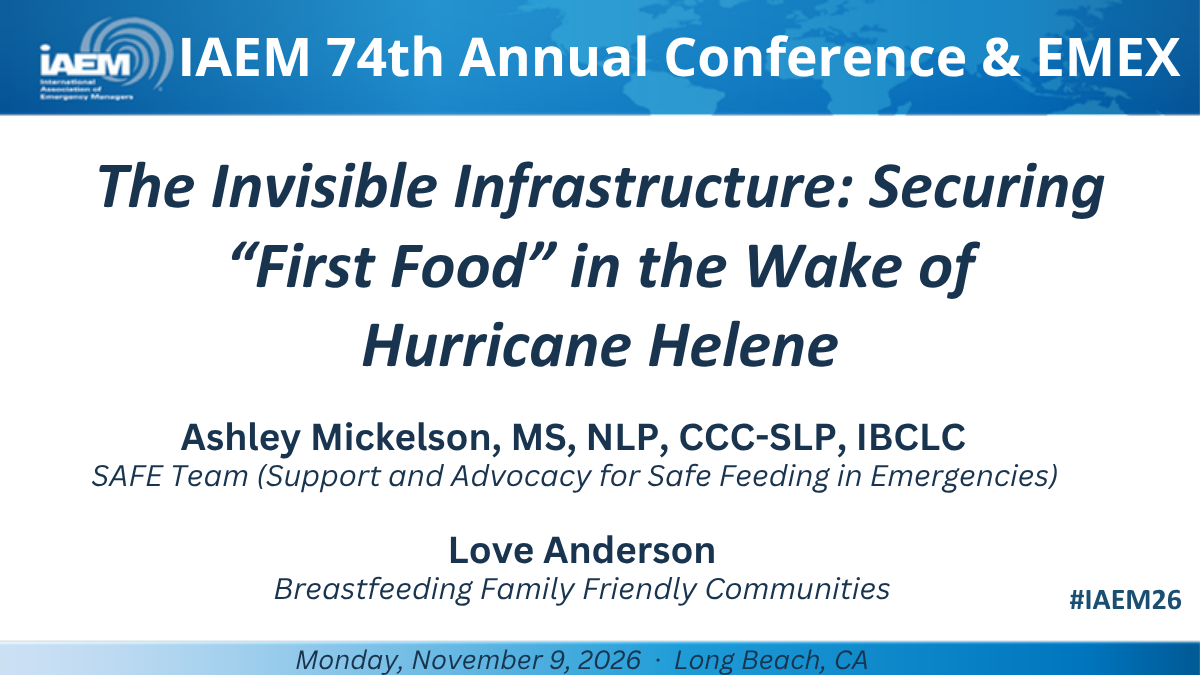 The slidesView on Canva
What the session covers
When Hurricane Helene hit western North Carolina in September 2024, no plan at any level of government said who was responsible for feeding babies and toddlers. Volunteers filled the gap. Infant feeding specialists deployed nine days after landfall and, over the months that followed, ran more than 5,000 rapid needs assessments, moved about 250,000 ounces of donor human milk, distributed more than 7,000 SAFE infant feeding kits, and supported more than 300 relief organizations across seven counties and the Eastern Band of Cherokee Indians. That was luck, not a plan.
By the end of the session, participants will be able to:
- Analyze the physiological and immunological risks (dehydration, waterborne pathogens) that infants face during infrastructure collapse.
- Evaluate county Emergency Operations Plans against the Operational Guidance on Infant Feeding in Emergencies (OG-IFE) to find the gaps in infant and young child feeding support.
- Design a “donation gatekeeper” protocol and a mother-baby area plan for local mass care settings.
- Coordinate between clinical lactation specialists (IBCLCs) and emergency logistics teams so breastfeeding is protected and ready-to-feed formula distribution is targeted and safe.
Start here: five documents you already keep
You do not need a new plan. You need infant feeding written into the documents you already maintain.
- The EOP and the ESF-6 annex. Name who is responsible for infants and young children, and name the infant feeding specialists on your contact list before the storm. The IYCF-E County Policy Adoption Toolkit has the language, and the workbook above includes a sample county policy.
- The shelter plan and walkthrough checklist. A private, non-bathroom place to feed, a place to wash feeding supplies, potable water, an outlet, a small refrigerator for expressed milk. Shelters and congregate areas.
- Registration and intake. Ask every family with a child under two how the child is fed. The Rapid Needs Assessment is the right questions for the first few minutes, and it is reprinted in the workbook.
- Logistics and resource typing. Ready-to-feed formula in single-serve containers, disposable nipples and cups, cold sanitation kits. Powdered formula needs water at 158°F. How much formula to stock and the sanitation kit guide.
- The training and exercise plan. Put a family with a newborn in your next tabletop. Nourishing Resilience is our free recorded training series.
Tools to take home
- Does your emergency plan account for infants? A quick self-assessment for agencies and coalitions.
- Setting up local infant and young child feeding emergency preparedness: the first steps for a county.
- Creating a resource list for IYCF-E connections: who to have on the contact list before a disaster.
- Resources for emergency managers, including the federal precedents (the PETS Act and the Child Care and Development Block Grant disaster plan rule) and what they leave out.
- When donated milk shows up and SAFE’s position on donations in emergencies: how to manage unsolicited formula and milk.
- Infant Feeding Safety Scale: the safest to least safe ways to feed a baby. This is the hierarchy from the scenario slides.
- Learning the language of emergency management: for the lactation and public health people in your community who want to work with you.
- CDC Infant and Young Child Feeding in Emergencies Toolkit, including safe, family-friendly spaces in emergency shelters.
- Managing donations (Carolina Global Breastfeeding Institute).
Shelters, points of distribution, and partners
- Shelters and congregate areas
- Points of distribution
- VOADs
- Disaster case managers and direct survivor support
- For families and caregivers, including picture instructions in English and Spanish and preparing powdered formula safely in an emergency.
- Build It: everything we learned about standing up an infant feeding response, from deciding whether to act to the field coordinator SOP.
Training and support
- Nourishing Resilience: eleven recorded sessions on infant and young child feeding in emergencies, free.
- SAFE Support and Strategic Core (S3C): implementation support for teams building this in their own community.
- Technical assistance: tabletop exercises, plan development, and trainings for emergency managers, public health preparedness staff, and shelter teams. Bring us to your community.
- Sign up for the SAFE Team newsletter.
The companion article
“Anchored in Writing: Putting Infant Feeding Into Your Policies and Procedures,” by Ashley Mickelson and Love Anderson, was accepted for the IAEM Bulletin conference issue, “IAEM 2026: Charting through Preparedness, Anchored in Resilience.” IAEM keeps the conference issue open to non-members for a year. We will link it here when it is published.
Speakers
Ashley Mickelson, MS, NLP, CCC-SLP, IBCLC, Communications Director, SAFE Infant Feeding Team. A medical speech-language pathologist and lactation consultant working at the intersection of feeding and swallowing across the lifespan, Ashley served as the SAFE Team’s digital coordinator during the Helene response and sits on the National VOAD Children and Disasters Subcommittee and the National Pediatric Disaster Coalition. ash@safeinfantfeeding.org
Love Anderson, President and CEO, Breastfeeding Family Friendly Communities, and cofounder of the SAFE Infant Feeding Team. Love chairs the North Carolina Breastfeeding Coalition and serves on the board of the U.S. Breastfeeding Committee. After Helene, Breastfeeding Communities in Western North Carolina grew into the SAFE Team, which now works on national policy for infant and young child feeding in emergencies. love@breastfeedingcommunities.org
Handout and workbook by Ashley Mickelson, SAFE Infant Feeding Team. Workbook policy template developed by Breastfeeding Family Friendly Communities as part of the SAFE Infant Feeding Project, in partnership with the North Carolina Breastfeeding Coalition.

Scan to open this page on your phone: safeinfantfeeding.org/iaem
About SAFE
SAFE is the national IYCF-E (infant and young child feeding in emergencies) implementation of Breastfeeding Family Friendly Communities. BFFC is the blue skies strategy, the slow work of building communities where feeding a baby is everyone’s business. This is the gray skies work, for the days that strategy gets tested.
The SAFE Infant Feeding Team is committed to protecting and supporting the feeding practices of all families. Our programs and materials are guided by and in full compliance with the International Code of Marketing of Breastmilk Substitutes and subsequent World Health Assembly resolutions. The resources on this page are open to everyone.