
Session 9 – Homework Summary
<< Back to main Session 9 page
Here is the whole assignment, step by step. Jump straight to any step below, or download the identical material as a printable handout.
Finished? Complete the session evaluation.
1. Review Handouts
New marks a handout you have not seen before; Shared earlier means it appeared in an earlier session.
Handout list
- Determining Need for SAFE Feeding Support New
- Disaster Response on an Island: Lessons from Puerto Rico New
- Deploying as an Individual or Small Group New
- Infant Feeding Support for Clients in an Emergency New
- SAFE Team IYCF-E Response Overview New
- Resource List Guide for IYCF-E Connections Shared earlier
- Operations & Locations Spreadsheet Template New
- Inventory & Logistics Spreadsheet Template New
- Safe Infant Feeding Supply Distribution Shared earlier
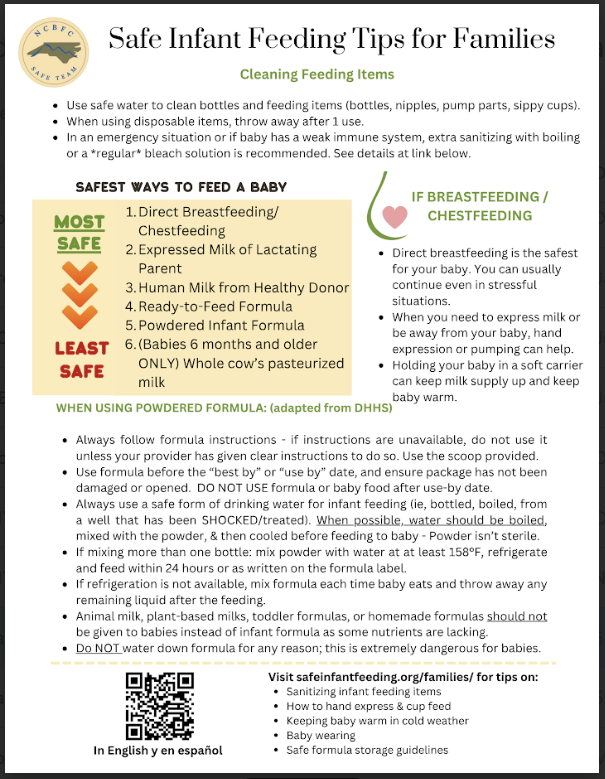
- Safe Infant Feeding Tips for Families Shared earlier
- SAFE Support and Strategic Core (S3C) Meetings Shared earlier
2. Start or continue looking for your State/Local Core Response Team
If your area’s emergency preparedness team does not currently include IYCF-E, OR if they would need support from infant feeding specialists (tip – nearly all will need support), find your tentative core team.
Explore who might be willing to be part of this core group if/when an emergency occurs. Look to your local breastfeeding coalition, birth network, lactation professional organizations, or other groups of perinatal professionals. A great place to connect is other people in your state who are registered for this training series (ask us!), and our quarterly S3C meetings.
- Make a list of some potential people and reach out to them. Let us know if you want to connect with other trainees in your state.
- Find out who is willing to consider it. Help them know what this would involve. They do NOT need to commit at this time.
- Ensure that you trade contact info and store it in your phone contacts AND somewhere you could access another way.
- Include phone number and physical address as well as email and any socials you could contact them through.
3. With your potential Core Team, discuss how you would approach an emerging event, initial communication, and scope.
During blue sky times (before an emergency occurs), start making some plans about what you would do. Understand that these plans are likely to change, especially if a major disaster were to happen. Reviewing the Supporting Clients in IYCF-E After a Disaster for Small Orgs & Individuals document before your discussion may be helpful.
Together, discuss:
- What emergencies are likely to come up in your area? Which would you possibly want to take action on?
- What actions would you want to take if there is an incident approaching or one that occurred?
- What scope of response you would probably be willing to do if/when an incident were to occur?
- Who will begin to develop relationships with the local emergency planning committee or emergency planner, healthcare coalition, state VOAD, or ongoing support organizations.
- How you will organize information now so it will be ready when needed. You can make copies of our spreadsheet templates and set up a shared Google Drive or OneDrive folder.
- How would you connect after an incident? Do you want to set up a potential meeting location? (See session 8 homework for more considerations)
- What organizations you can partner with for distributing educational information before incidents, teaching others, and getting volunteers if needed.
- Will you operate as a group of individuals or under the umbrella of one of the above existing organizations?
Remember – you can always revisit the recordings of this training series, or reach out to us at 828-809-3301 or safe@infantfeeding.org to discuss your training & support needs.
4. Find and connect with your county emergency planning manager or group, local healthcare coalition, and your state VOAD
Having friendly contacts before an emergency makes an enormous difference. It can take time to find the right people and connect with them. If you have not already done so, reach out to local and state organizations that handle disaster response in your area. See the Resource List Guide for IYCF-E Connections file for questions to ask and more tips.
5. Complete the Evaluation
Complete the Evaluation
To track your attendance and help us improve, please complete the short evaluation as soon as you can. It is how we verify your attendance for the certificate of completion at the end of the series.
Please Support Our Efforts
If you find this training helpful, please support our efforts with a financial donation. Click below and select “SAFE Team” to earmark for IYCF-E education and disaster response support.
Handouts, Links & Resources
New this session
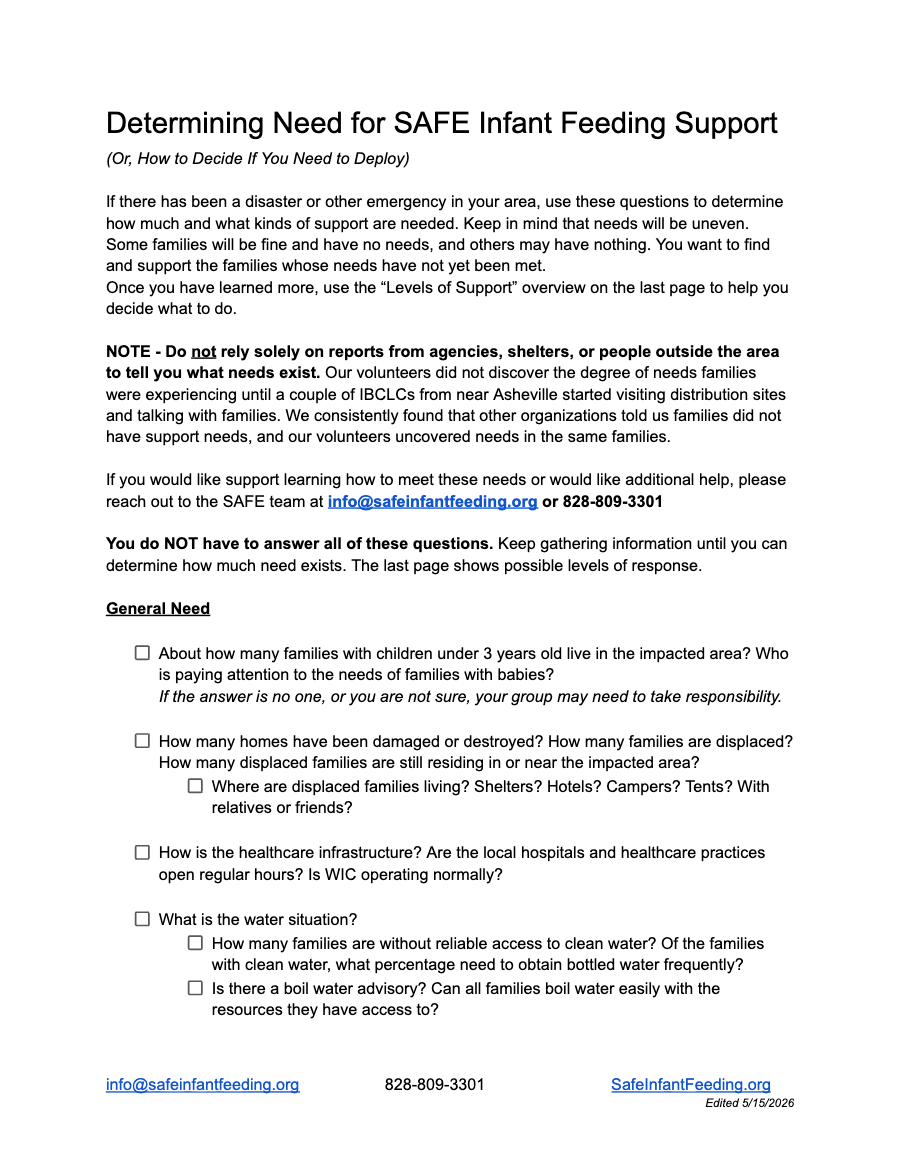
Determining Need for SAFE Feeding Support
When an emergency hits, the first question is whether an infant feeding response is needed at all, and at what scale. This walks you through deciding.

New this session
Disaster Response on an Island: Lessons from Puerto Rico
What an IYCF‑E response looks like when you cannot drive supplies in. Hard‑won lessons from the Puerto Rico response.
New this session
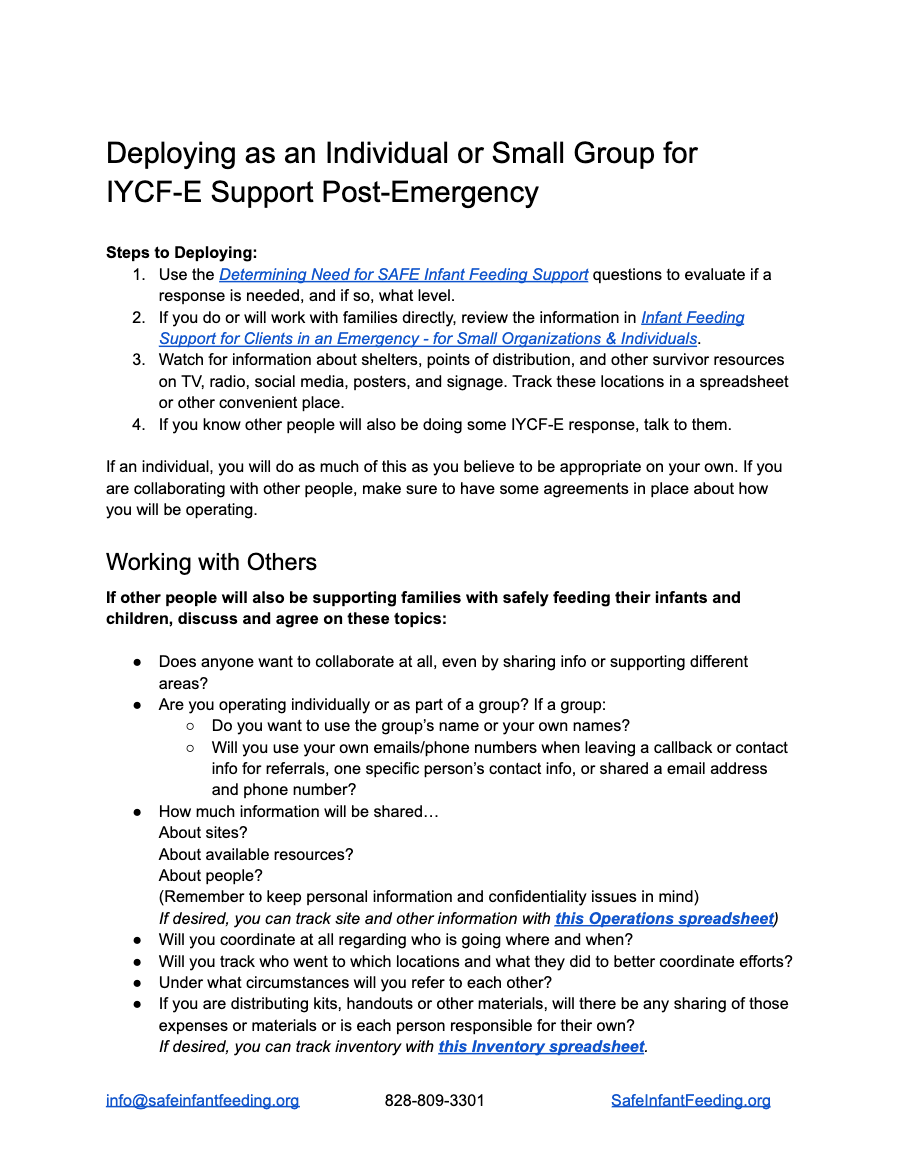
Deploying as an Individual or Small Group
What to think about before you go — for people responding without a large organisation behind them.
New this session
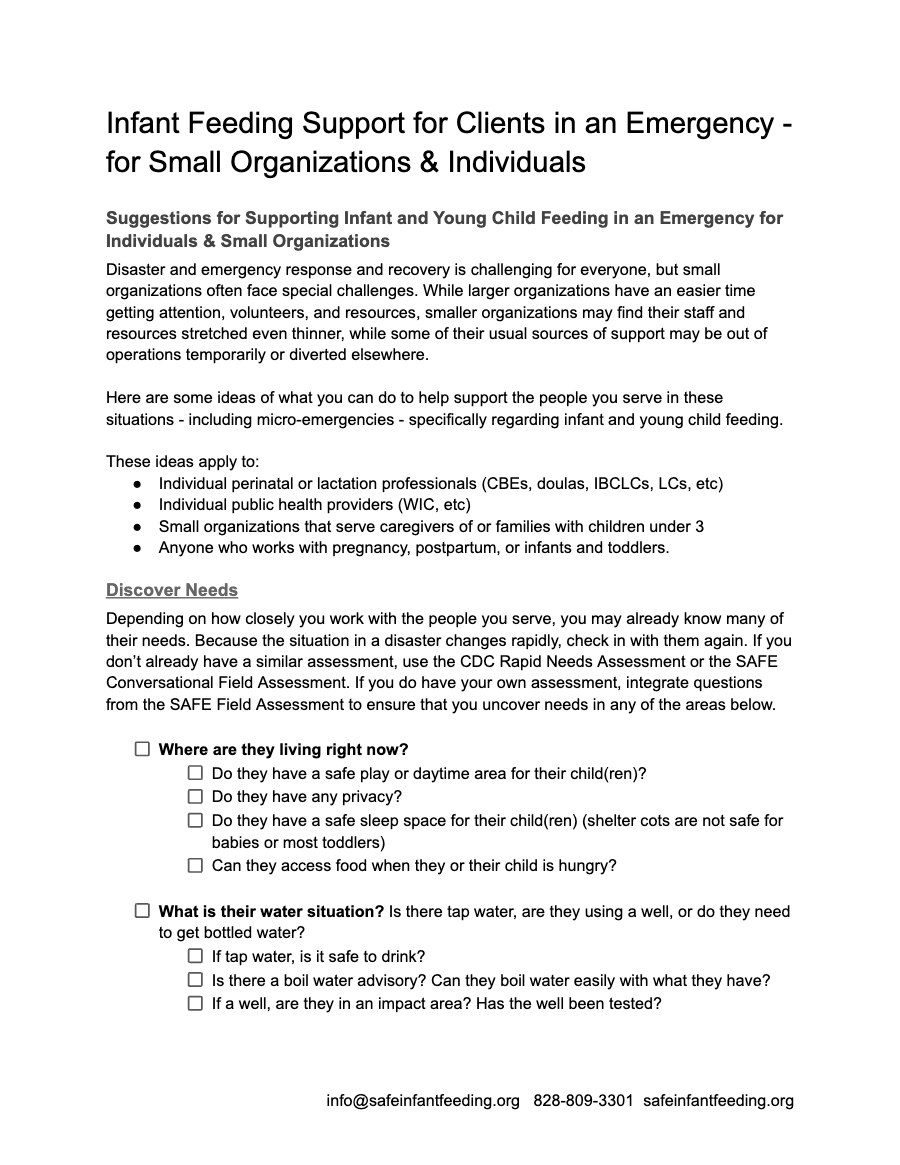
Infant Feeding Support for Clients in an Emergency
Written for small organisations and individual practitioners already serving families, who now need to support feeding in an emergency.
New this session
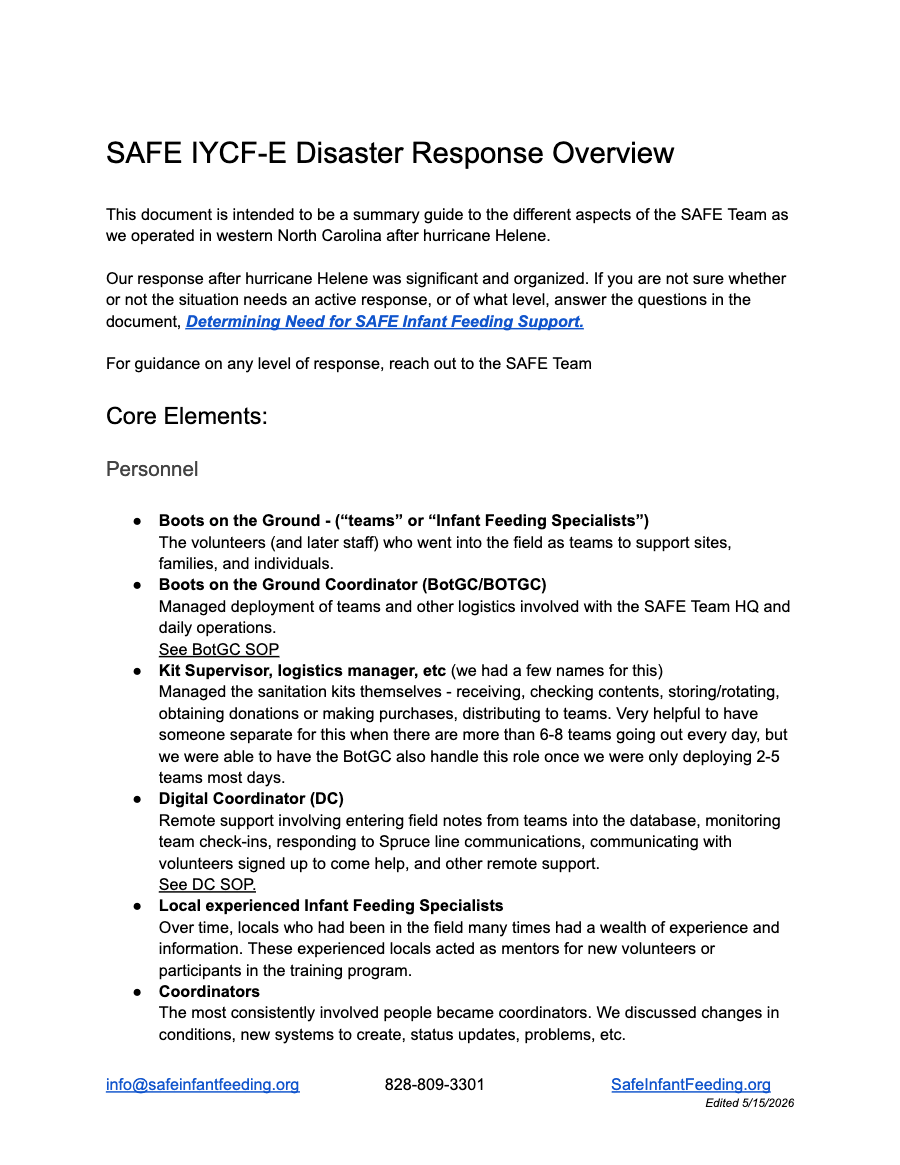
SAFE Team IYCF-E Response Overview
How the SAFE Team actually ran its response after Helene, start to finish. The closest thing to a map of the whole operation.
Shared earlier
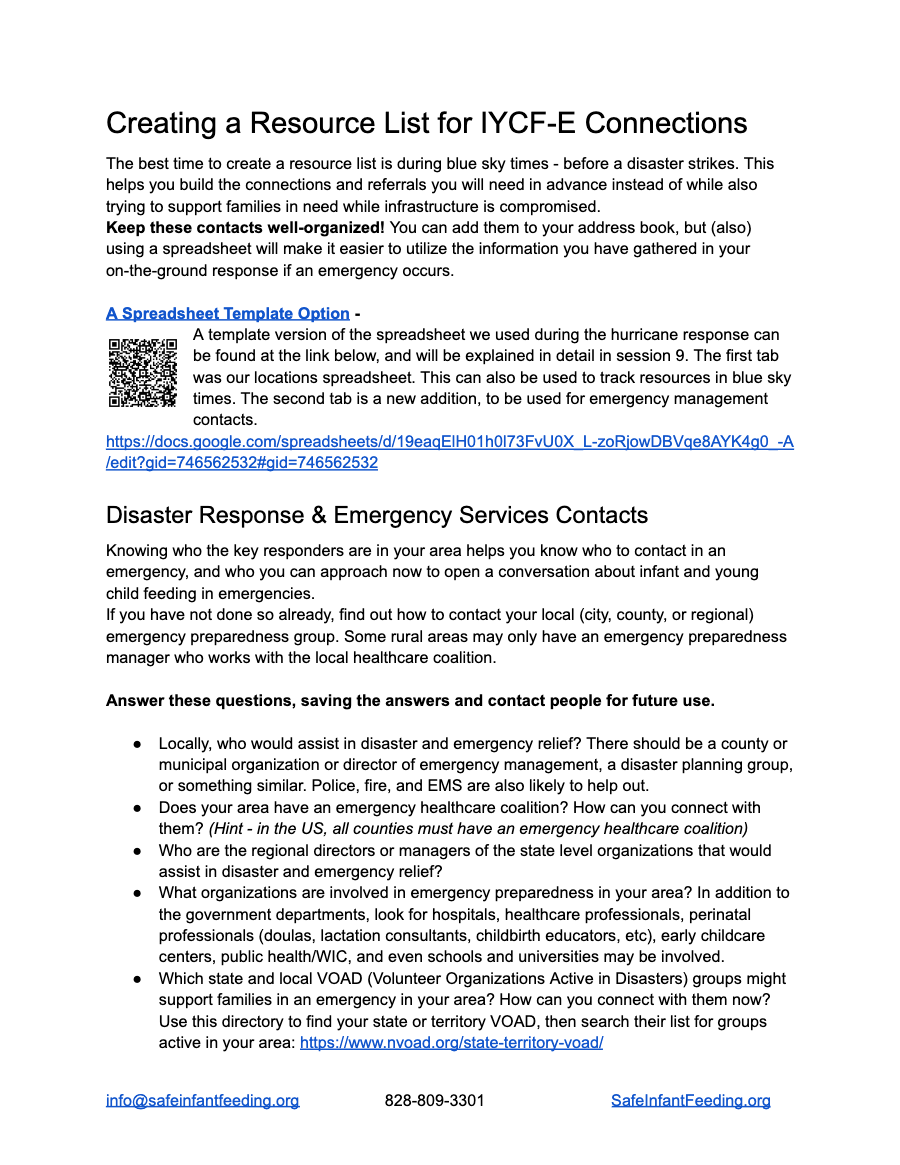
Resource List Guide for IYCF-E Connections
How to build the list of people and organisations you can call on, and how to keep it current.
New this session
Operations & Locations Spreadsheet Template
The locations and operations tracker we used, as a template you can copy. Make your own copy before editing.
New this session
Inventory & Logistics Spreadsheet Template
The inventory and logistics tracker we used, as a template you can copy. Make your own copy before editing.
Shared earlier
Safe Infant Feeding Supply Distribution
A single legal‑size page for distribution sites on how to receive, store and hand out infant feeding supplies safely.

Shared earlier
SAFE Support and Strategic Core (S3C) Meetings
Our quarterly support call for people preparing and running IYCF‑E work in their own communities. Register once on Zoom and you are on the list for every session.
Thanks to our sponsors
This work is free because these people and organizations paid for it.

Marcia Brady Tucker Foundation
A private family foundation dedicated to supporting charitable organizations that align with its mission of giving back. Grants are made only as a result of the Foundation’s own initiative.
Breastfeeding Family Friendly Communities
Provides technical assistance to breastfeeding coalitions and health departments across the US, using the Ten Steps to a Breastfeeding Family Friendly Community. The SAFE Team is a project of BFFC.

In memory of Elsie Perry
Elsie Perry was a founding mother of La Leche League Boston in the 1960s. A gift made in her memory by her daughters funded an eleventh month of this training series.

BabyBjörn
Founded in 1961 and still family-owned, with a mission to make everyday life easier for parents with babies. If your community needs emergency baby gear, reach them at care@babybjorn.com.

Confident Pregnancy
Helps people be healthier, feel more confident, and find their inner strength. Tips for staying calmer and more resilient under stress at MelindaDelisle.substack.com. DBA Melinda Delisle Innovations.

Birthstone Center for Appalachian Perinatal Resilience
Strengthens perinatal health in Western North Carolina by centering families, uplifting birthworkers, and advancing equitable access to lactation, doula and maternal mental health support.
Sponsor this IYCF-E training
Interested in sponsoring or partnering with us? Get in touch.

Scan to open this page on your phone
These materials are shared under the SAFE Team Open Source Use Agreement — please reuse and adapt them, with attribution.