

- This event has passed.
Training Durham’s Community Advisory Board Partners
View the training slides Printable handouts
SAFE Infant Feeding in Micro-Emergencies. A training for Durham’s home visitors and direct service staff, led by Love Anderson and Rachel Fann and delivered by the Breastfeed Durham team.
Most emergencies are small. A house fire, an eviction, a power cut, a breakdown on the highway with a cooler of milk in the back. They do not make the news and they do not activate an emergency operations center, but they separate a baby from their feeding plan just as effectively as a hurricane does. The people who catch them are home visitors, and they are usually already in the house.
Everything from the training, in one place
Share this page with coworkers and families. The short address is safeinfantfeeding.org/durham.
Jump to: Printable handouts · Feeding babies safely · Emergency kit checklist · Family preparedness · Communication boards · Durham County · Staying together · More
Printable handouts
Print these for families or keep them in your visit bag. Each is one page, in English and Spanish, with the QR code back to this page.
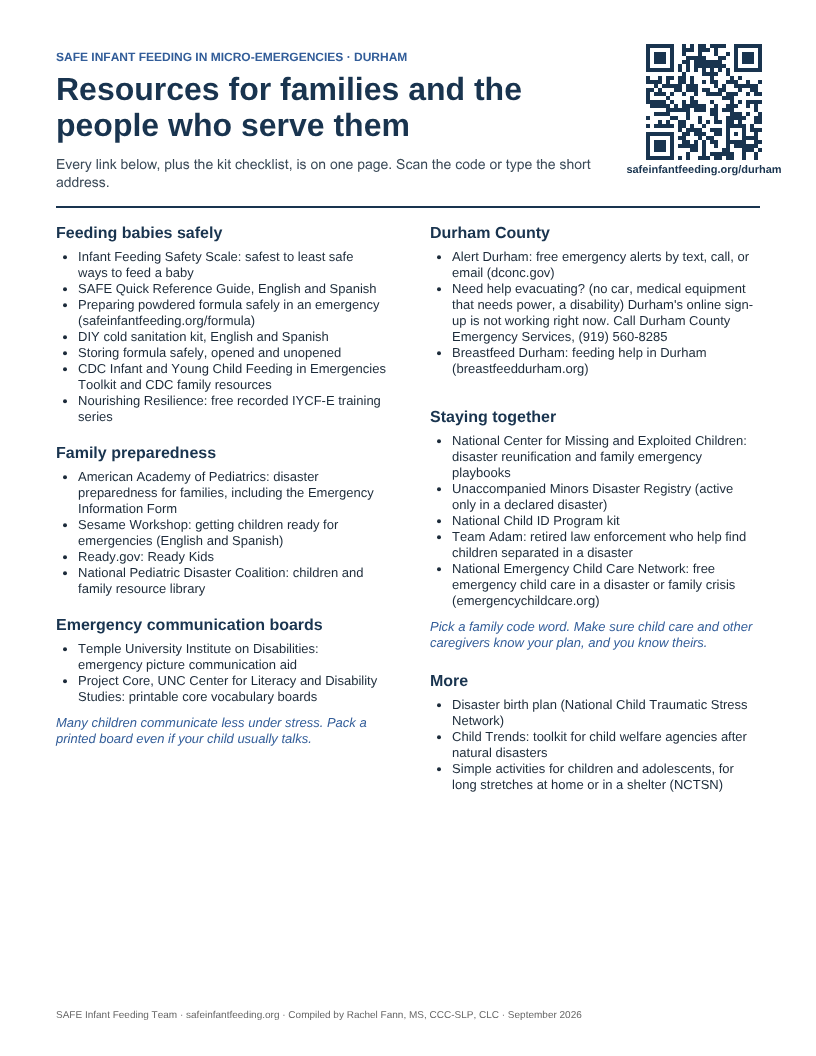 Resources for families and the people who serve themOne page · PDF
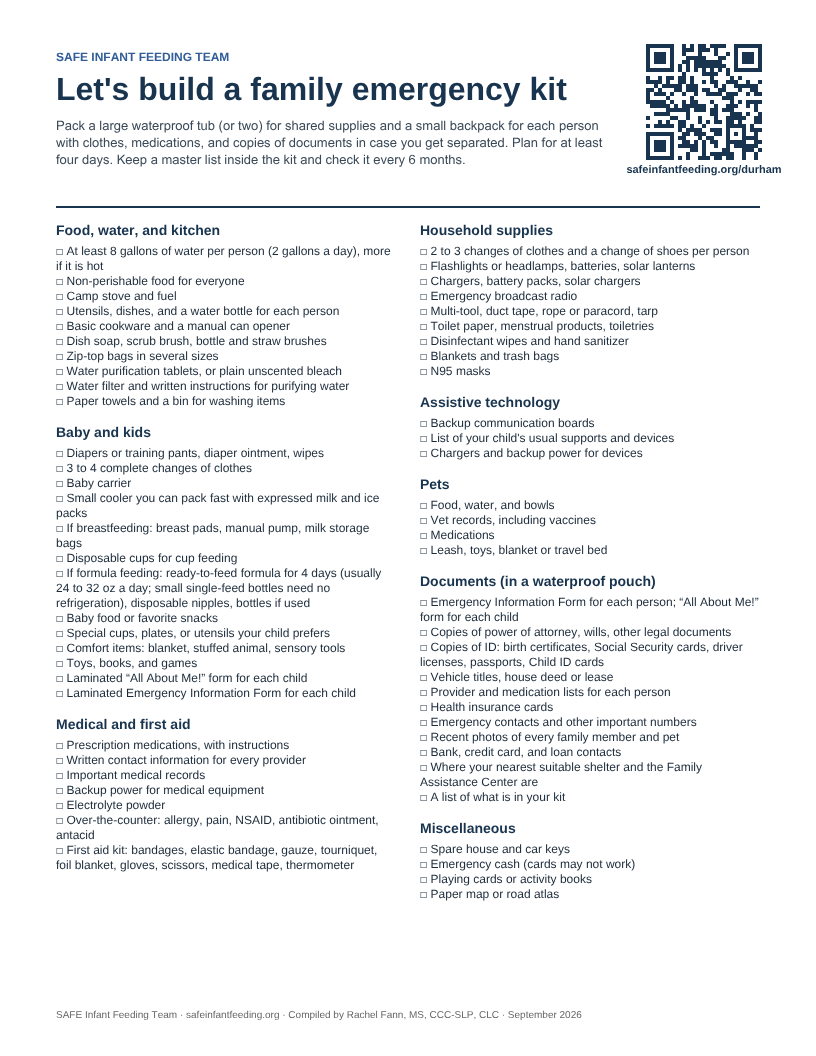 Let’s build a family emergency kitOne-page checklist · PDF
En español: Recursos para las familias y quienes las atienden (PDF) · Preparemos un kit de emergencia familiar (PDF)
Feeding babies safely
- Infant Feeding Safety Scale: the safest to least safe ways to feed a baby. This is the hierarchy from the table activity.
- SAFE Infant Feeding Quick Reference Guide / Guía de referencia rápida: simple picture instructions for families, in English and Spanish.
- Preparing powdered formula safely in an emergency: the water temperature matters more than anything else.
- DIY cold sanitation kit / en español: clean bottles, pump parts, and cups without power or hot water.
- Storing formula safely: opened and unopened containers.
- Planning ahead for winter weather with infants and young children
- Short videos: Safe infant feeding in emergencies · Hand expression · Infant carrying · Keeping baby warm / en español
- CDC resources for families and the full CDC Infant and Young Child Feeding in Emergencies Toolkit
- All SAFE Team family resources
- Want to go deeper? Nourishing Resilience is our free recorded training series on infant and young child feeding in emergencies.
Let’s build a family emergency kit
Most families pack a large waterproof tub (or two) for shared supplies and a small backpack for each person with their clothes, medications, and copies of documents in case you get separated. Plan for at least four days. Keep a master list inside the kit and check it every 6 months, or sooner when your family’s needs change. Tap each section to open it, or print the one-page checklist (en español).
Food, water, and kitchen
- At least 8 gallons of water per person (2 gallons per person per day), more if it is hot
- Non-perishable food for everyone in the family
- Camp stove and fuel
- Utensils, dishes, and a water bottle for each person
- Basic cookware and cooking utensils
- Manual can opener
- Dishwashing supplies: soap, scrub brushes, bottle and straw brushes
- Zip-top bags in several sizes
- Water purification tablets, or plain unscented bleach (nothing added) for purifying water
- Water filter, and written instructions for purifying water
- Paper towels
- A bin for washing items
Baby and kids
- Diapers or training pants, diaper ointment, and wipes
- 3 to 4 complete changes of clothes
- Baby carrier
- A small cooler you can pack quickly with expressed breast milk and ice packs
- If breastfeeding: breast pads, a manual breast pump, and milk storage bags
- Disposable cups for cup feeding
- If formula feeding: enough ready-to-feed formula for 4 days (a fully formula-fed baby usually takes 24 to 32 oz a day; small single-feed bottles mean nothing has to be kept cold), disposable bottle nipples, and bottles if you use them
- Baby food or your child’s preferred snacks
- Any special cups, plates, or utensils your child prefers
- Comfort items: blanket, stuffed animal, sensory tools
- Toys, books, and games
- A laminated “All About Me!” form for each child
- A laminated Emergency Information Form for each child (the AAP has one to download)
Medical and first aid
- Prescription medications, with instructions
- Written contact information for every provider
- Important medical records
- Backup power for medical equipment
- Electrolyte powder
- Over-the-counter medications: allergy, pain, NSAID, antibiotic ointment, antacid
- First aid kit: bandages, elastic bandage, gauze, tourniquet, foil blanket, gloves, scissors, medical tape, thermometer
Household supplies
- 2 to 3 complete changes of clothes and a change of shoes for each person
- Flashlights or headlamps, batteries, and lanterns (solar is best)
- Chargers, battery packs, and solar chargers
- Emergency broadcast radio
- Pocket knife or multi-tool, duct tape, rope or paracord, and a tarp
- Toilet paper, menstrual products, and other toiletries
- Disinfectant wipes and hand sanitizer
- Blankets and trash bags
- N95 masks
Assistive technology
- Backup communication boards (see communication boards below)
- A list of your child’s usual supports and devices
- Chargers and backup power for devices
Pets
- Pet food, water, and bowls
- Veterinary records, including vaccines
- Medications
- Leash, toys, and a blanket or travel bed
Documents (in a waterproof pouch)
- An Emergency Information Form for each family member and an “All About Me!” form for each child
- Copies of power of attorney documents, wills, and other legal documents
- Copies of ID: birth certificates, Social Security cards, driver licenses, passports, National Child ID Program cards
- Vehicle titles and your house deed or lease
- Provider lists and medication lists for each family member
- Health insurance cards
- Emergency contacts and other important phone numbers
- Recent photos of every family member and pet, alone and together
- Bank, credit card, and loan contact information
- Where the nearest shelter that meets your family’s needs is, and where the Family Assistance Center will be
- A list of what is in your kit
Miscellaneous
- Spare house and car keys
- Emergency cash (cards may not work)
- Playing cards or activity books
- A paper map or road atlas
Family preparedness
- American Academy of Pediatrics: disaster preparedness for families, including the Emergency Information Form
- Sesame Workshop: helping children get ready for emergencies (English and Spanish)
- Ready.gov: Ready Kids
- National Pediatric Disaster Coalition: resources for children and families
Emergency communication boards
Many children have a harder time communicating under stress. Pack a printed board even if your child usually talks.
- Temple University Institute on Disabilities: emergency picture communication aid
- Project Core, UNC Chapel Hill Center for Literacy and Disability Studies: printable core vocabulary boards
Durham County
- Alert Durham: free emergency alerts by text, call, or email for the addresses you choose.
- Would someone in your home need help evacuating (no car, medical equipment that needs power, a disability)? Durham’s online sign-up for this is not working right now, so call Durham County Emergency Services at (919) 560-8285 and ask how to let Emergency Management know.
- Feeding help in Durham: Breastfeed Durham
Staying together
Pick a family code word, and make sure your child’s caregivers and child care program know your emergency plan and theirs.
- National Center for Missing and Exploited Children: disaster preparedness and reunification, including family emergency playbooks in English and Spanish
- Unaccompanied Minors Disaster Registry (only active during a declared disaster)
- National Child ID Program kit
- Team Adam: retired law enforcement who help find children separated from their families in a disaster
- National Emergency Child Care Network: free emergency child care for any family in a disaster or a personal crisis like a house fire, job loss, or medical emergency. Fill out their form online and trained volunteers come to you.
More
- Disaster birth plan (National Child Traumatic Stress Network)
- Child Trends: toolkit for child welfare agencies to help young people heal and thrive during and after natural disasters
- Simple activities for children and adolescents: written during COVID, and just as useful for any long stretch at home or in a shelter
Resources and kit checklist compiled by Rachel Fann, MS, CCC-SLP, CLC, SAFE Infant Feeding Team.
Scan to open this page on your phone: safeinfantfeeding.org/durham
About SAFE
SAFE is the national IYCF-E (infant and young child feeding in emergencies) implementation of Breastfeeding Family Friendly Communities. BFFC is the blue skies strategy, the slow work of building communities where feeding a baby is everyone’s business. This is the gray skies work, for the days that strategy gets tested.
This is a closed session for Community Advisory Board core partners (DBNC staff and volunteers, Healthy Families Durham, and Family Connects Durham) along with Early Head Start home-based staff. The resources on this page are open to everyone.