
Session 4 – Homework Summary
<< Back to main Session 4 page
Here is the whole assignment, step by step. Jump straight to any step below, or download the identical material as a printable handout.
1. Review Handouts
Everything for this session is listed below. New marks a handout you have not seen before; Shared earlier means it appeared in an earlier session.
Handout list
- SAFE Infant Feeding Quick Reference Guide Shared earlier
- Breast Milk Storage and Preparation New
- Safe Preparation, Storage and Handling of Powdered Infant Formula New
- Safe Formula Storage Guidelines Shared earlier
- The Four Pillars of Safe Milk Sharing New
- Informal (Peer-to-Peer) Human Milk Sharing New
- Crisis Feeding Support: Infant Regulation & Baby Carrying New
- Baby Carrying Resources New
- Infant Feeding Safety Scale Shared earlier
- State & Territory VOAD Directory New
Each name jumps to its card in Handouts, Links & Resources below.
2.Start a Resource List
Most organizations serving low-resource people will still operate after an emergency. Start compiling a list of these organizations that would be great referral partners during an emergency. While you are searching, look for the emergency services and disaster planning organizations and contacts that serve your area.
See more details here:
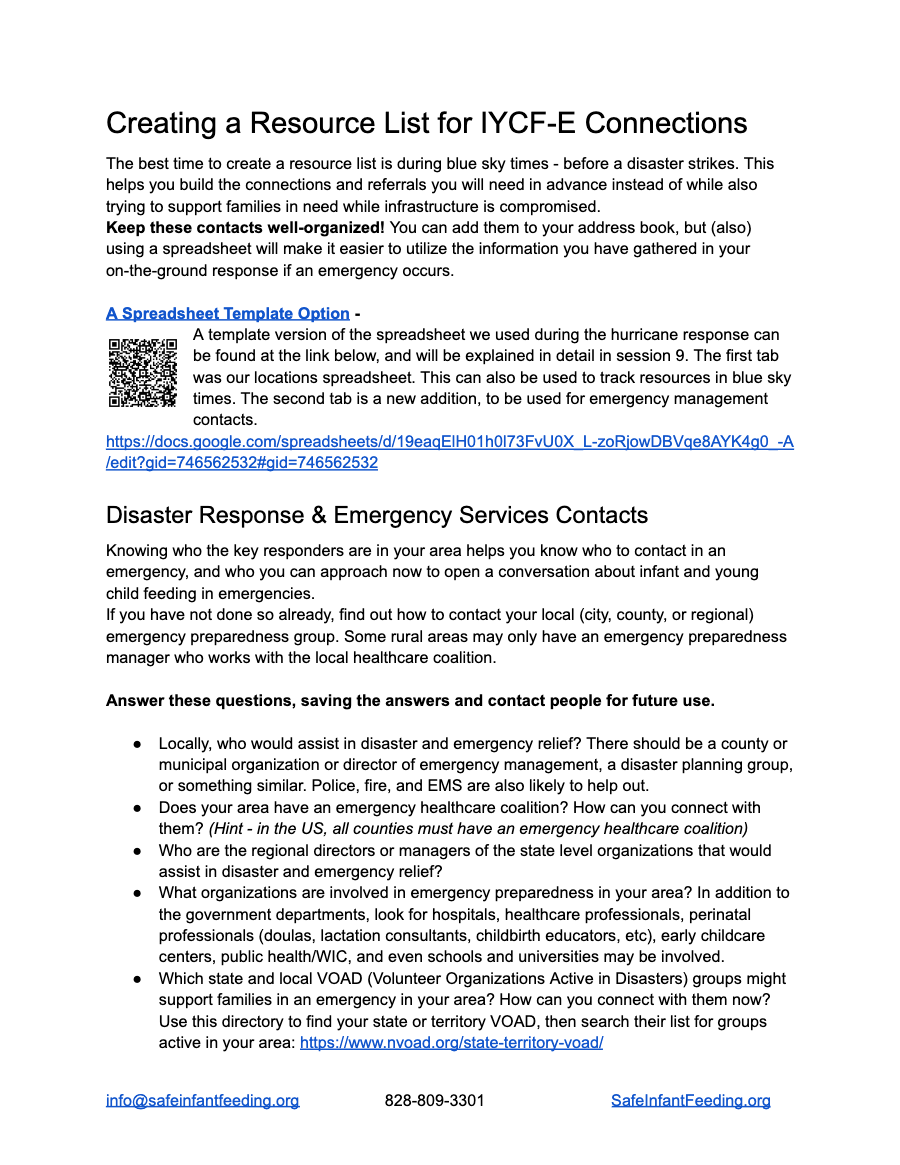
- Most organizations serving low-resource people will still operate after an emergency. Start compiling a list of these organizations that would be great referral partners during an emergency. While you are searching, look for the emergency services and disaster planning organizations and contacts that serve your area.
- See the Resource List Guide for IYCF-E Connections for details.
3. Research in Your Community – Donated Human Milk
Find out what options exist in your area for human milk. It’s likely there are more options than you realize.
Start with these questions:
- What are the available options for obtaining or donating human milk? Look for community or peer-to-peer options as well as official milk banks.
- For each option:
- Who does the organization serve?
- What are the screening or other protective processes in place?
- What is required to donate human milk?
- What is required to obtain human milk?
4. Field / Community Experience
If you have already done this, great! We encourage you to go out and support more families or help with (more) organizing.
The best way to get comfortable working with families and sites is to do it. You don’t need to wait for an emergency situation to occur – there are families everywhere who do not have reliable access to safe water and other resources needed to safely feed children under 3 years old, and organizations that try to meet their needs.
Try to attend an event or volunteer with an organization for 1-2 hours in the next month. If possible, try to both help with organizing feeding items and talk with families using the RNA.
Suggested steps to follow:
- Identify an organization that serves low resource people with young children. You may need to reach out to multiple organizations to find a suitable one. Examples include food banks, diaper banks, or possibly WIC, if you have access.
- Prepare – Write out what you want to say/ask. Use the Contacting Sites Template. Be sure to include:
- Who you are, and your organization, if you want to claim one.
We encourage you to call yourself something like an infant feeding specialist, and avoid titles referring to lactation. - Why you are calling. For this experience, you may want to state that you want to help the site organize their baby feeding items and help low-resource families be certain they are feeding their babies and young children as safely as they can with the resources they have access to.
- Find out when it is convenient for them for you to help.
- Who you are, and your organization, if you want to claim one.
- Call or email the organization – If possible, volunteer to help at an event or during their open to the public hours. If not, you can help sort infant feeding items during volunteer hours. This may help build rapport for later public events.
- Ask to talk to families about their feeding practices with their young children.
- Decide what you will bring. See the lists below, and consider if you also want to bring kits, the Quick Reference Guide, or the DIY handout to give families.
| Consider Bringing If Organizing Items | Consider Bringing If Talking With Families |
| Permanent marker, preferably black Safe Storage Guidelines Steps for Safe Distribution of Infant Feeding Supplies Safe Infant Feeding Tips for Families sheet, to hang up. Distribution site resource page | Safe Infant Feeding Tips for Families, for reference & to hang up. Quick Reference Guide, printed or on a card families can scan. Short referral list for other needs (opt) DIY Sanitation Kit handout Sanitation kits, if desired. Family resource page |
Complete the Evaluation
To track your attendance and help us improve, please complete the short evaluation as soon as you can. It is how we verify your attendance for the certificate of completion at the end of the series.
Please Support Our Efforts
If you find this training helpful, please support our efforts with a financial donation. Click below and select “SAFE Team” to earmark for IYCF-E education and disaster response support.
Handouts, Links & Resources
Shared earlier
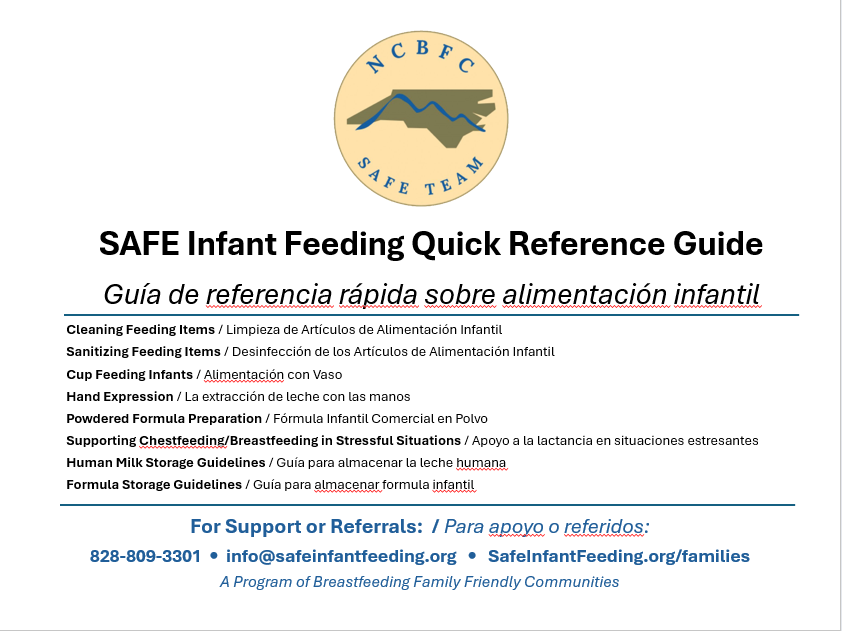
SAFE Infant Feeding Quick Reference Guide
The bilingual handout booklet we distributed in western North Carolina after Helene. Cleaning and sanitising feeding items, cup feeding, hand expression, formula preparation, and milk and formula storage.
See also: Safe Infant Feeding Tips for Families
New this session
Breast Milk Storage and Preparation
CDC guidance, drawn from the Academy of Breastfeeding Medicine. The reference to quote when someone asks how long expressed milk keeps.
New this session
Safe Preparation, Storage and Handling of Powdered Infant Formula
The WHO guidelines, covering both bulk preparation and single feeds. Powdered formula is not sterile, and this is the document that explains what follows from that.
Shared earlier
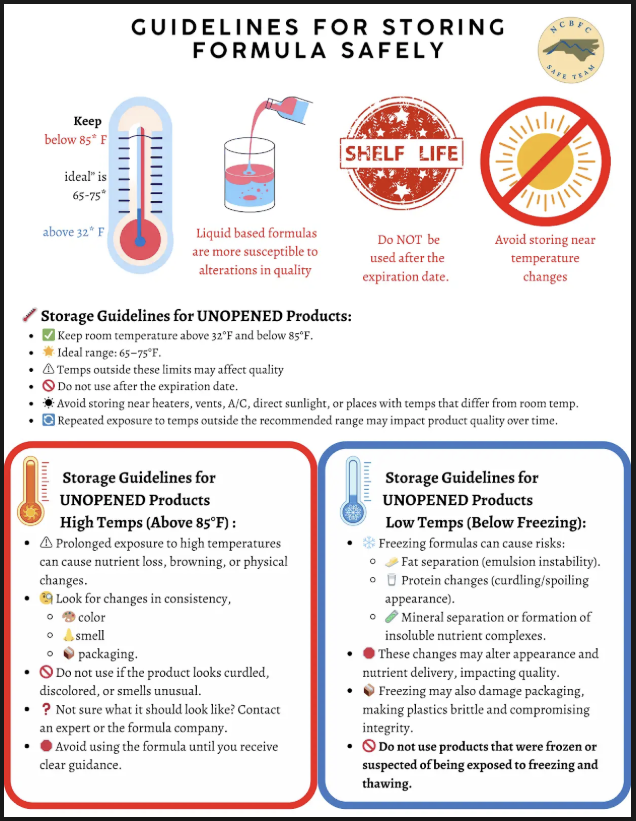
Safe Formula Storage Guidelines
How long formula keeps, and at what temperature. Two quick‑reference posters split it the way families actually ask:



New this session
The Four Pillars of Safe Milk Sharing
Eats on Feets sets out what informed, safe milk sharing looks like — screening the donor, safe handling, safe storage and home pasteurisation.
New this session
Informal (Peer-to-Peer) Human Milk Sharing
A handout from Perinatal Services BC in Canada, discussing the risks and benefits of peer‑to‑peer milk sharing in plain terms.
New this session
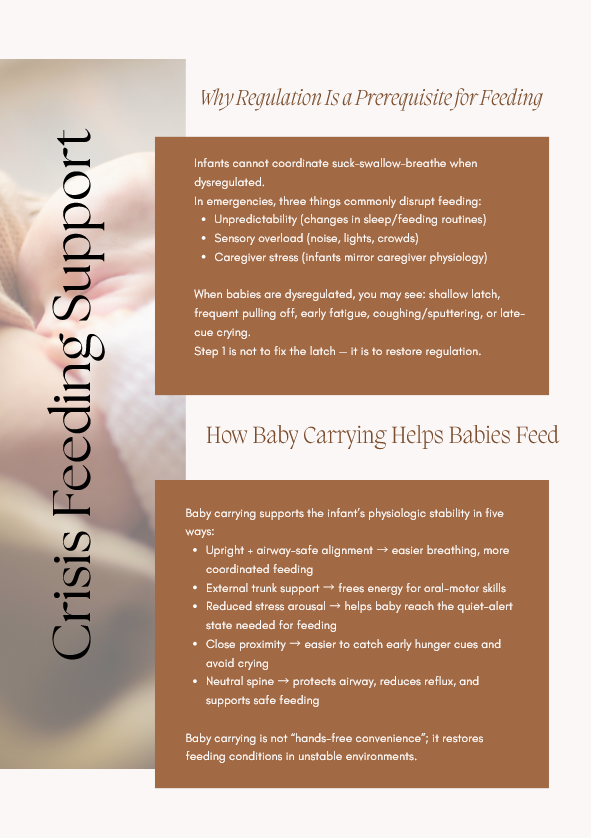
Crisis Feeding Support: Infant Regulation & Baby Carrying
Why an emergency disrupts feeding at the level of the baby’s nervous system, and what closeness and carrying do about it.
New this session
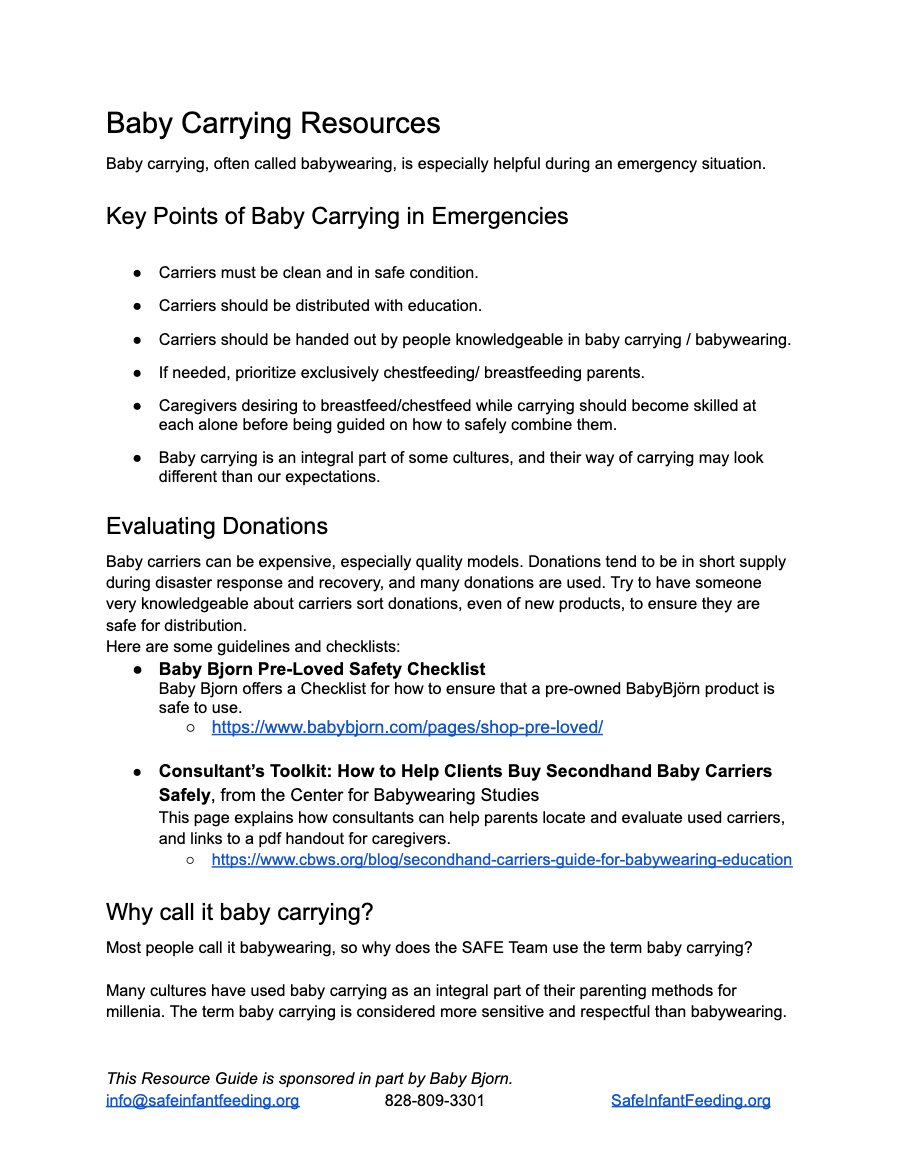
Baby Carrying Resources
The essentials of safe baby carrying, plus where to learn more.
Shared earlier
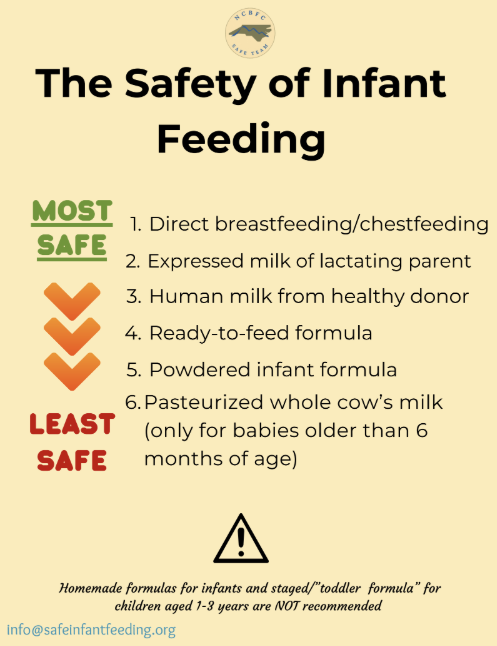
Infant Feeding Safety Scale
Sometimes called the hierarchy of feeding. Ranks the ways of feeding a baby from most to least safe, so you can explain the trade‑offs to caregivers without judgement.

New this session
State & Territory VOAD Directory
Find the Volunteer Organizations Active in Disaster group for your state or territory. This is usually the fastest route into an existing disaster response structure.
Thanks to our sponsors
This work is free because these people and organizations paid for it.

Marcia Brady Tucker Foundation
A private family foundation dedicated to supporting charitable organizations that align with its mission of giving back. Grants are made only as a result of the Foundation’s own initiative.
Breastfeeding Family Friendly Communities
Provides technical assistance to breastfeeding coalitions and health departments across the US, using the Ten Steps to a Breastfeeding Family Friendly Community. The SAFE Team is a project of BFFC.

In memory of Elsie Perry
Elsie Perry was a founding mother of La Leche League Boston in the 1960s. A gift made in her memory by her daughters funded an eleventh month of this training series.
BabyBjörn
Founded in 1961 and still family-owned, with a mission to make everyday life easier for parents with babies. If your community needs emergency baby gear, reach them at care@babybjorn.com.

Confident Pregnancy
Helps people be healthier, feel more confident, and find their inner strength. Tips for staying calmer and more resilient under stress at MelindaDelisle.substack.com. DBA Melinda Delisle Innovations.

Birthstone Center for Appalachian Perinatal Resilience
Strengthens perinatal health in Western North Carolina by centering families, uplifting birthworkers, and advancing equitable access to lactation, doula and maternal mental health support.
Sponsor this IYCF-E training
Interested in sponsoring or partnering with us? Get in touch.

Scan to open this page on your phone
These materials are shared under the SAFE Team Open Source Use Agreement — please reuse and adapt them, with attribution.